Models
Genie 4: Google imagines interactive worlds that move, sound and speak
Genie 4 generates interactive worlds with sound. How Google's model works, what creators might use it for and where it still falls short.
Imagine exploring a scene, then changing its weather, moving the camera or introducing a character simply by asking an AI. On October 27, Google DeepMind introduced Genie 4, an interactive world simulation model that generates visuals and sound, including ambience and dialogue (Google DeepMind).
The demonstration resembles a video game. But Genie 4 remains a limited-access research project, and Google acknowledges limitations in consistency and session length. For game and film creators, its near-term appeal may be exploring visual ideas; its real capabilities still need testing beyond Google's selected examples.
What is a world model?
A world model aims to produce a representation of an environment that evolves in response to actions. In Google's demonstrations, users navigate with a keyboard and give natural-language instructions while the scene continues. The model generates the appearance and reactions of the scene as interaction unfolds (Google DeepMind).
Google says Genie 4 draws on capabilities from the Gemini family: Gemini helps structure events and steer the simulation, while Genie generates the environment's appearance and sound. The following diagram simplifies that description; it is not a complete technical architecture.
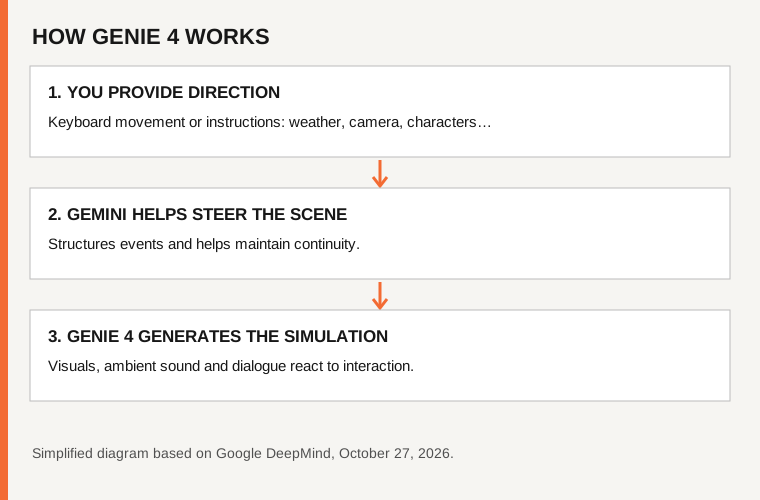
Source: Google DeepMind, Genie 4 announcement, October 27, 2026.
What the demonstrations show
Google highlights four capabilities: changing a scene in real time with instructions, exploring it with a camera, generating sound alongside visuals, and creating characters that react and speak. It also shows examples of movement and collisions it describes as more realistic (Google DeepMind).
Native audio is a notable addition: wind, ambient sounds, music and dialogue can accompany the scene. Google also says real-time audio accuracy still needs improvement. The published videos are the developer's demonstrations, not an independent evaluation across all scenarios.
| Feature | What Google shows | What to keep in mind |
|---|---|---|
| Live instructions | Change weather, camera or scene elements | Complex changes can increase inconsistencies |
| Visuals and sound | Generate ambience, music and dialogue with the world | Audio accuracy remains under development |
| Characters | Make characters react and talk | Complex interactions among multiple agents remain a research challenge |
| Exploration | Navigate an interactive scene | Continuous sessions are limited to a few minutes |
Sources: Google DeepMind announcement and model page.
Can it create a complete video game?
Not based on the published information. A conventional game engine generally maintains explicit state — positions, objects, inventory, rules and collisions — that developers can program and control. Genie 4 generates an interactive scene; Google's announcement does not describe a complete system for exporting a game, maintaining an inventory indefinitely or guaranteeing game rules.
The difference appears in limitations Google acknowledges: objects and details may drift over a session, text may be hard to read, complex interactions need work, and continuous exploration lasts a few minutes. Google also says real-world locations are not reproduced perfectly (Genie 4 model page).
In a trapped-manor game, for example, a collected key must remain collected, a door must retain its state and a timer must follow a stable rule. Genie 4 might help explore the atmosphere or appearance of a room, but a reliable system would still be needed for those mechanics. This is our illustrative use case, not a production feature announced by Google.
What about animation and Blender?
Google says testers in creative industries are exploring previsualization: quickly trying a scene, camera angles, lighting or dialogue. For an independent filmmaker, such a tool could help explore a visual direction before producing a controllable scene in Blender (Google DeepMind).
A generated simulation is not automatically an editable 3D project. The announcement does not say Genie 4 exports models, rigs, animations or Blender scenes. The published images therefore do not establish that objects can be retrieved and edited individually.
The same caution applies to circuit reconstructions: a convincing scene may still get the layout, proportions or elevation wrong. Google acknowledges imperfect reproduction of real places. An accurate track still requires references, measurements and verification.
How can you access it?
At announcement, Genie 4 is a research preview for a limited group of trusted testers. Google plans subsequent access for Google AI Ultra subscribers through Project Genie and early-access partners using the Gemini API and Google AI Studio. A waitlist is open, but the announcement gives no precise general release date (Google DeepMind).
The documents also do not publish Genie 4-specific API pricing, resolution or frame rate. The planned Ultra rollout does not establish a future per-use price, quotas or immediate access for every subscriber.
Our take
Genie 4 brings audiovisual generation closer to an experience that can be steered as it unfolds. It is an intriguing direction for exploring environments, staging and training scenarios.
Visual plausibility does not guarantee accuracy, control or continuity. Before calling it a replacement for a game engine or 3D software, creators need access to test session length, export options and cost. For now, Genie 4 looks more like a research and creative exploration tool than a complete production pipeline.
Sources
- Google DeepMind, introducing Genie 4, October 27, 2026
- Google DeepMind, Genie 4 model page and limitations, accessed October 29, 2026
- Google, Genie 4 announcement, October 27, 2026
Spotted an error in this article? Report it · Our corrections policy