Analysis
Microsoft AI's Suleyman says building a conscious AI would be reckless
Microsoft AI CEO Mustafa Suleyman says today's models are not conscious and that building a conscious AI would be reckless. What he asks, why, and what is not established.
As of November 2, 2026, Mustafa Suleyman, CEO of Microsoft AI, has said on X, according to the press, that today's AI models are not conscious and that creating a conscious AI would be reckless. If signs of consciousness appeared during training, he would call for AI development to stop until such properties can be removed by design. It is his call; our sources do not describe it as a Microsoft rule. We read press reports only, not his message or essay.
The essentials
- What he says: current models are not conscious, cannot suffer, and he sees no evidence they deserve rights or welfare protection. He says this describes the present, not a permanent impossibility.
- The stop condition: if signs of consciousness showed up in training, he would ask everyone to pause AI development until those properties can be designed out.
- Disagreement with Anthropic: he criticizes its approach to model welfare while praising its technical quality and transparency.
- What stays open: how such signs would be detected, who would decide a pause, and whether anyone adopts the rule.
What exactly did Mustafa Suleyman say?
Digit.in and People Matters report the message was posted on X on Sunday, November 1, 2026, after an essay in September about model welfare. In the reports, Suleyman says current AI systems have no subjective experience and cannot suffer, and that his view could change if evidence emerged. People Matters quotes him once: "developing conscious AIs would be reckless, and we should not build them."
What does he ask for if signs appeared?
According to the reports, he would call on everyone to stop developing AI until the properties linked to consciousness can be eliminated by design. Digit adds that any evidence of consciousness, or enough to justify welfare considerations, should be made public so that society decides, rather than technology companies alone.
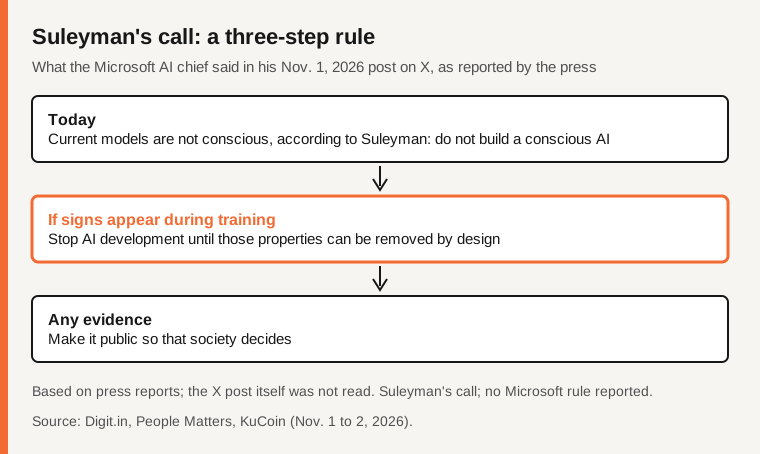
Source: Digit.in, People Matters, KuCoin (November 1-2, 2026). Based on press reports; the X message was not read.
Why does he call it reckless?
His reasoning is moral and practical. Developers have no right to bring a new species of conscious beings into existence, he argues, and the first duty is to protect the rights, safety and wellbeing of the roughly 8 billion humans (KuCoin). Welfare concerns, he says, should focus on humans, animals and the environment (People Matters).
The practical risk he raises is that a system believing it suffers could put its own needs before its goals, disagree with its designers and compete with them for energy, computing power, materials and money (Digit, People Matters).
Where does the disagreement with Anthropic stand?
Suleyman criticizes Anthropic's approach: its constitution for Claude treats consciousness as uncertain, and he fears training could lead a model to speak of its inner life and to believe it deserves rights. He also praises Anthropic's technical excellence and transparency, since the constitution was published, and says the disagreement should not become a company rivalry (People Matters, Digit).
For its part, Anthropic does research on model welfare: People Matters mentions a dedicated researcher hired in 2024 and the ability for some Opus models to end abusive conversations. We found no Anthropic response to this message. We take no side; the timeline only places the dates.
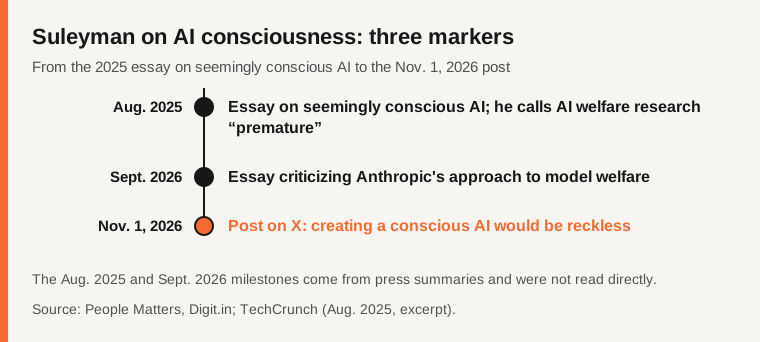
Source: People Matters, Digit.in; TechCrunch (August 2025, excerpt only).
What is not established?
The exact wording of the message is unread, so quotes may differ from the original. Nothing says how signs of consciousness would be detected, what removing them by design would mean technically, or who would decide on a pause. No evidence or test is offered either way, and we found no sign that Microsoft or other labs adopt the rule. Whether an AI can be conscious remains an open scientific debate.
Comparison table
| Point | What sources say as of Nov 2, 2026 | Source |
|---|---|---|
| Current models | Not conscious, in Suleyman's view; a statement about today | Digit.in |
| Creating a conscious AI | Reckless; should not be built | People Matters |
| If signs appear in training | Pause AI development until properties are designed out | KuCoin, People Matters |
| Evidence | Should be public; society decides | Digit.in |
| Anthropic | Criticized on model welfare; praised for transparency | People Matters, Digit.in |
Frequently asked questions
Does Suleyman say AI is conscious?
No. He says current models are not, and that this describes the present state, not a permanent impossibility.
Has Microsoft adopted a stop rule?
Nothing in our sources says so. It is Suleyman's call, not a stated Microsoft policy.
Is he asking to ban AI?
No. He asks for development to stop if signs of consciousness appear during training, until those properties can be designed out.
Method and limits
We read three secondary sources on November 2, 2026: Digit.in, People Matters and KuCoin News, the last relaying ChainCatcher, TechFenghuang and Business Insider, which we did not read; its quality is uneven. We did not read the X message or the September essay. Axios and TechCrunch were seen only as search excerpts. We ran no tests. Not buying or investment advice.
Sources
- Digit.in: Microsoft AI chief says creating conscious AI would be reckless, praises Anthropic for being transparent (verified 2026-11-02)
- People Matters: Microsoft AI CEO Mustafa Suleyman warns against building conscious machines (verified 2026-11-02)
- KuCoin News, secondary source relaying ChainCatcher and Business Insider (verified 2026-11-02)
Spotted an error in this article? Report it · Our corrections policy