Analysis
OpenAI launches Grid Protectors, pledging up to 1,000 MW of flexible demand at its Georgia campus
OpenAI's Grid Protectors program has its campuses cut power draw when grids are strained. In Georgia, up to 1,000 MW is planned; nothing runs yet.
OpenAI announced on November 2, 2026 a "Grid Protectors Program": the compute campuses it builds are to cut their electricity use when local grids are under strain. In Georgia, the plan covers up to 1,000 MW of flexible demand out of about 3,200 MW expected. This is a commitment for a campus still under development, not a measured result.
The essentials
- What OpenAI announces: a national program under which its future campuses reduce consumption during demand peaks or extreme weather, on terms agreed with each utility.
- What is planned in Georgia: up to 1,000 MW of flexible demand on a campus expected to draw about 3,200 MW, under a 25-year contract with Georgia Power.
- Who pays what: OpenAI commits to pay the infrastructure and electric service costs of the Effingham County project, not the whole grid.
- Not published: notice period, duration, hours per year, other sites.
What is Grid Protectors?
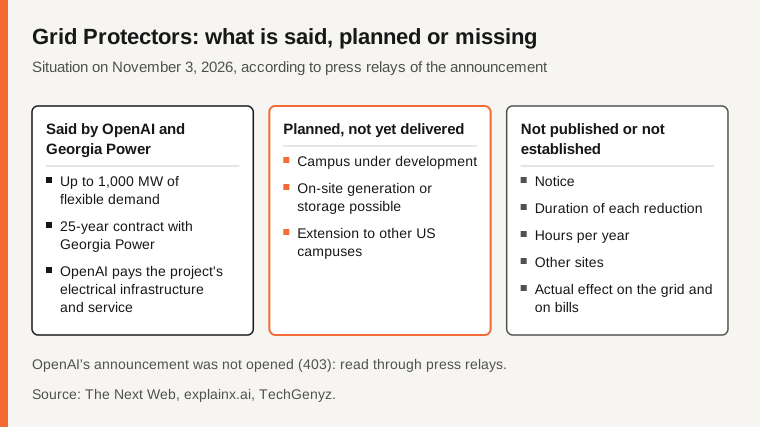
According to The Next Web, explainx.ai and TechGenyz, which relay OpenAI's announcement, the program has OpenAI's campuses reduce their draw when local grids are strained, at peak demand or in extreme weather. Amounts, speed and duration are to be agreed with each utility. OpenAI named no site other than Georgia, and plans to extend the model to other U.S. campuses depending on local conditions, without confirming identical agreements.
According to the relays, the mechanisms could include on-site generation or storage (generators, batteries) and power controls that smooth swings. TechGenyz notes this is not confirmed for every campus.
What does the Georgia pilot plan?
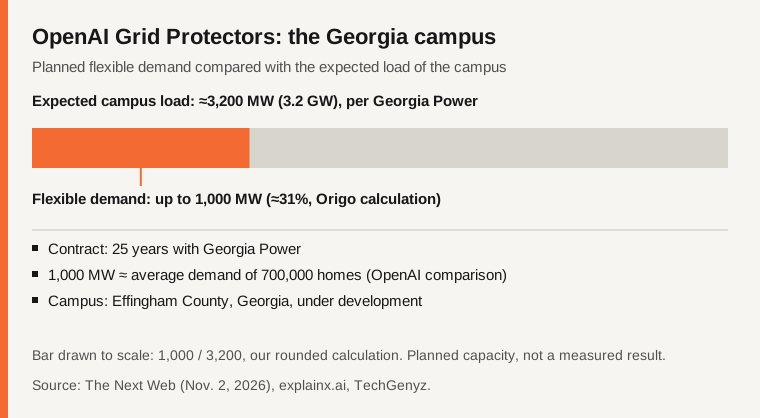
The pilot is a planned campus of about 3.2 GW in Effingham County, roughly 45 minutes from Savannah, served by Georgia Power and still in development. The 3,200 MW is the load Georgia Power expects, not a measurement.
Source: The Next Web (November 2, 2026), explainx.ai, TechGenyz.
The Next Web reports a 25-year contract under which Georgia Power can reduce up to 1,000 MW of power delivered to the site in high-demand hours. By our rounded calculation, that is about 31% of the expected load (1,000 / 3,200). OpenAI puts 1,000 MW at roughly the average demand of 700,000 homes, an average-use comparison, not homes served at all times.
Who pays, and what do the announced savings say?
OpenAI commits to pay the infrastructure and electric service costs needed for the Effingham County campus, a pledge Georgia Power repeats according to explainx.ai. The stated aim is that households and small businesses do not finance the project. The relays differ on whether Georgia's utility commission, which reviewed the contract in August, held a formal vote.
Georgia Power projects about $950 million a year in customer savings from 2029, per The Next Web and explainx.ai, across its whole portfolio of large loads, not this campus alone. OpenAI's announcement, as relayed, also cites a Georgia Power projection of at least $15 a month for a typical residential customer at 1,000 kWh a month.
What is shown, and what is not?
Source: The Next Web, explainx.ai, TechGenyz.
Capping peak demand does not necessarily reduce annual consumption, TechGenyz notes. OpenAI acknowledges that flexibility cannot replace new supply and transmission investment, per The Next Web.
What is not established?
Notice, duration and hours of curtailment per year; the load interruptible beyond 1,000 MW; the real effect on grid reliability and bills; other sites; on-site generators and their emissions; and OpenAI's original text, which we did not read.
Comparison table
| Point | What sources say as of Nov 3, 2026 | Source |
|---|---|---|
| Program | Campuses to cut draw when grids are strained; terms set per utility | The Next Web, TechGenyz |
| Georgia campus | About 3.2 GW expected, Effingham County, in development | explainx.ai, The Next Web |
| Flexible demand | Up to 1,000 MW; about 31% of expected load (our calculation) | The Next Web, explainx.ai |
| Contract | 25 years with Georgia Power | The Next Web |
| Costs | OpenAI commits to pay project infrastructure and electric service | explainx.ai, TechGenyz |
| Notice, duration, hours per year | Not published | No source gives it |
Frequently asked questions
What does 1,000 MW of flexibility mean?
Up to 1,000 MW: Georgia Power can reduce the power delivered to the site during high demand. That is about 31% of the 3,200 MW expected, by our calculation.
Does OpenAI pay for all the electrical infrastructure?
OpenAI commits to pay the infrastructure and electric service costs of the Effingham County project, not the entire grid.
Is the program already running?
No. The campus is in development and the capacity is planned.
Method and limits
OpenAI's announcement returned a 403 error and could not be opened; Georgia Power's release and the commission's decision were not opened either. We read the pages through automatic summaries and verified no figure independently. We tested nothing. This is not investment advice.
Sources
- The Next Web, "OpenAI launches Grid Protectors to ease AI's strain on power grids" (November 2, 2026) (verified 2026-11-03)
- explainx.ai, secondary source (verified 2026-11-03)
- TechGenyz, secondary source (verified 2026-11-03)
- DEV Community, secondary source (verified 2026-11-03)
- OpenAI, "Introducing the Grid Protectors Program" (not opened, 403)
Spotted an error in this article? Report it · Our corrections policy
