Analysis
RAM shortage: are AI data centers and consumers now fighting over memory?
Sam Altman's remark about PC memory put the RAM shortage in the headlines. What TrendForce and Micron say, who is affected, and what is actually being done.
As of October 31, 2026, "war" is the question in the headline, not a finding. What the sources show is a memory market that is undersupplied, with suppliers steering capacity toward servers, and effects that reach PCs, phones, graphics cards and SSDs. Micron's CEO does not see a return to balance in sight, and none of the sources we read describes a quick fix.
The essentials
- The trigger: a remark by OpenAI CEO Sam Altman, reported by Notebookcheck. His argument concerns local AI inference, not gaming or everyday use.
- The shortage: according to TrendForce, contract prices for conventional DRAM rise 10 to 15% in Q4 2026 and NAND Flash 15 to 20%. Micron expects conditions to be much tighter in 2027 and 2028 than in 2026.
- Consumer effects: laptop sales are weighed down by component costs, and brands are cutting SSD capacities in mainstream models.
- Solutions: none quick in the sources we read. Supply is being redirected toward servers.
What exactly does Sam Altman say?
According to Notebookcheck (October 30, 2026), which cites the "Cheeky Pint" interview on YouTube, Altman finds it "quite terrible" that everyone's share of the limited global DRAM sits in their own computer. He says that memory is used 5% of the time, and he stresses maximum use in the cloud in a supply-constrained environment. No data is provided for the 5% figure; it is his claim.
His argument is about local AI inference. Notebookcheck notes that it does not address other uses of RAM such as gaming, everyday applications or multitasking. It also ties his position to OpenAI's model: closed models run in data centers, sold through subscriptions and the cloud. Data centers would remain necessary to train large models even if local AI spread (Notebookcheck).
Where does the memory shortage stand?
TrendForce's press release of September 30, 2026 describes a market that stays undersupplied. Suppliers prioritize advanced process capacity for high-performance server products. In servers, cloud providers and server makers are buying more RDIMM for agentic AI, and some suppliers see their increases delayed by long-term contracts (TrendForce).
Micron's figures point the same way. In the fiscal fourth quarter, CFO Mark Murphy said DRAM prices rose in the high teens in percentage terms and NAND about 30%. CEO Sanjay Mehrotra said: "We do not have line of sight to when supply and demand will return to balance." More than 75% of 2027 output is already committed, under multi-year take-or-pay contracts, and new fabs take time to ramp up, becoming meaningful only "a few quarters after initial output" (CIO, citing Reuters).
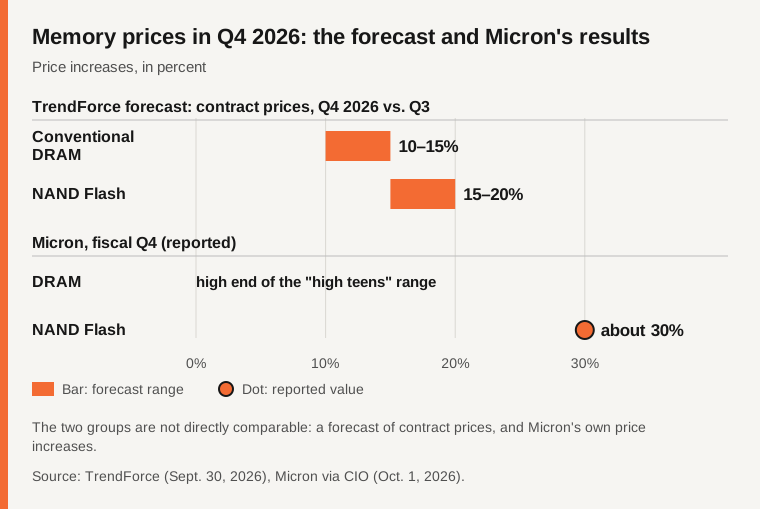
Source: TrendForce (September 30, 2026), Micron via CIO (October 1, 2026).
Who is affected: consumers too?
TrendForce reports effects well beyond servers. Laptop inventories reflect higher component costs, which weigh on sales. PC makers still buy aggressively because they expect tight supply in 2027. Suppliers delivered the agreed volumes every quarter of 2026, but PC DRAM supply could shrink in 2027. Smartphone production is cut by higher costs and exhausted cheap inventory, with tight allocations. Major suppliers are still reducing consumer DRAM output.
Enterprise SSD bit demand is expected to rise more than 80% year over year in 2026, driven by cloud providers' AI inference. It is the only segment where price increases accelerate in Q4, and brands are cutting SSD capacities in mainstream models to limit cost. For graphics memory, some PC brands are considering alternatives to GDDR6, GDDR7 demand comes mostly from AI chips, and suppliers are reducing GDDR6.
On December 3, 2025, Micron announced it was leaving the Crucial consumer business to improve supply and support for larger, strategic customers in faster-growing segments, with shipments through the consumer channel until February 2026 (Reuters via MarketScreener).
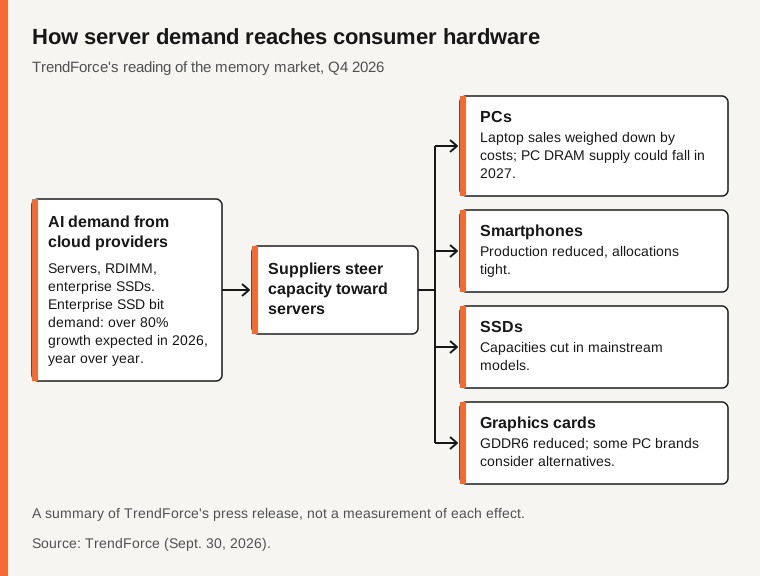
Source: TrendForce (September 30, 2026).
What solutions are being considered?
The sources we read describe no quick solution, only a reorientation.
- Supply side: suppliers direct capacity to servers, sign multi-year contracts, and new fabs are slow to ramp up (Micron).
- Consumer side: brands cut SSD capacities, consider GDDR6 alternatives, and PC makers buy ahead.
- Altman's proposal: concentrating memory in the cloud. It is his argument, not a measure in force.
For running models on your own machine, see our Ollama guide.
Comparison table
| Segment | Situation in Q4 2026 | Source |
|---|---|---|
| Server DRAM | Undersupplied; cloud and server makers buy more RDIMM; some increases delayed by long-term contracts | TrendForce |
| PC DRAM | Volumes delivered in 2026; supply could shrink in 2027; laptop sales weighed by costs | TrendForce |
| Mobile DRAM | Production cut by costs and exhausted cheap inventory; tight allocations | TrendForce |
| Graphics DRAM | Some brands consider GDDR6 alternatives; GDDR7 demand mostly from AI chips | TrendForce |
| Enterprise SSD | Bit demand up more than 80% in 2026; price increases accelerate in Q4 | TrendForce |
| Consumer SSD | Capacities cut in mainstream models | TrendForce |
Frequently asked questions
Is the shortage caused by AI?
According to TrendForce, cloud providers' demand for AI, including RDIMM for agentic AI and enterprise SSDs for inference, pulls prices up while suppliers shift capacity to servers.
Will prices fall in 2027?
Micron expects memory and storage conditions to be much tighter in 2027 and 2028 than in 2026, with no line of sight to a return to balance.
Should we give up local RAM?
No. Altman was talking about local AI inference, and Notebookcheck notes he does not cover gaming or everyday use. This article gives no buying advice.
Method and limits
This article relies on the TrendForce press release, Notebookcheck, CIO and Reuters via MarketScreener, read on October 31, 2026. The "Cheeky Pint" interview was not watched: Altman's words come from Notebookcheck. The Tom's Hardware article could not be read, as the page was truncated. The 5% figure is Altman's claim, with no data. Forecasts are TrendForce's and Micron's, not ours.
Sources
- TrendForce: press release, September 30, 2026 (verified 2026-10-31)
- Notebookcheck: "Quite terrible", Sam Altman says PCs waste the world's limited DRAM supply (verified 2026-10-31)
- CIO: memory squeeze set to tighten through 2028, Micron says, October 1, 2026 (verified 2026-10-31)
- Reuters via MarketScreener: Micron to exit Crucial consumer memory business, December 3, 2025 (verified 2026-10-31)
Spotted an error in this article? Report it · Our corrections policy