Market
Sovereign AI: Canada backs Cohere, France backs Mistral, but will every country get its own AI?
Canada announced up to C$1.6B in Cohere on October 29, 2026; Mistral raised €3B in September. What "sovereign AI" means, and what we think comes next.
On October 29, 2026, Canada's Prime Minister Mark Carney announced an equity investment of up to C$1.6 billion in Cohere, while France already has Mistral AI, which announced a €3 billion round on September 8, 2026. But "having your own AI" covers very different things. Our reading, which is an analysis and not a fact: most countries will get a sovereign AI built on an adapted or open model, and few will get a frontier model of their own. Sovereignty here means control more than independence.
The essentials
- Canada (fact): up to C$1.6 billion in equity in Cohere, paid in instalments, alongside private investors including NVIDIA, Bell and Schwarz Group (Prime Minister's release).
- France (fact): Mistral announced a €3 billion Series D at a post-money valuation above €21 billion (company figures), led by Samsung Electronics.
- World (fact, Counterpoint): more than 55 countries outside the United States and China have an active sovereign LLM, and 56% of such models are adapted from an existing base model.
- Dependencies (analysis): both companies count Nvidia among their investors, and Nvidia reports US export controls on its GPUs. "Sovereign" rarely means "self-sufficient".
We separate three kinds of statements. Fact comes from an official release or the press. Company claim is what Cohere or Mistral say about themselves, attributed to them. Analysis is our reading, flagged as such. Amounts stay in their original currency (C$, €, US$) and are never converted or added together. This is not investment advice.
What is Canada doing with Cohere?
Ottawa is taking an equity stake, described by the government as a "commercial" investment made alongside private investors (Prime Minister's release). The C$1.6 billion is "up to", paid in instalments with regular monitoring of commitments. The release writes "$1.6 billion"; the Canadian press indicates Canadian dollars. The stake obtained is not stated in the sources we consulted.
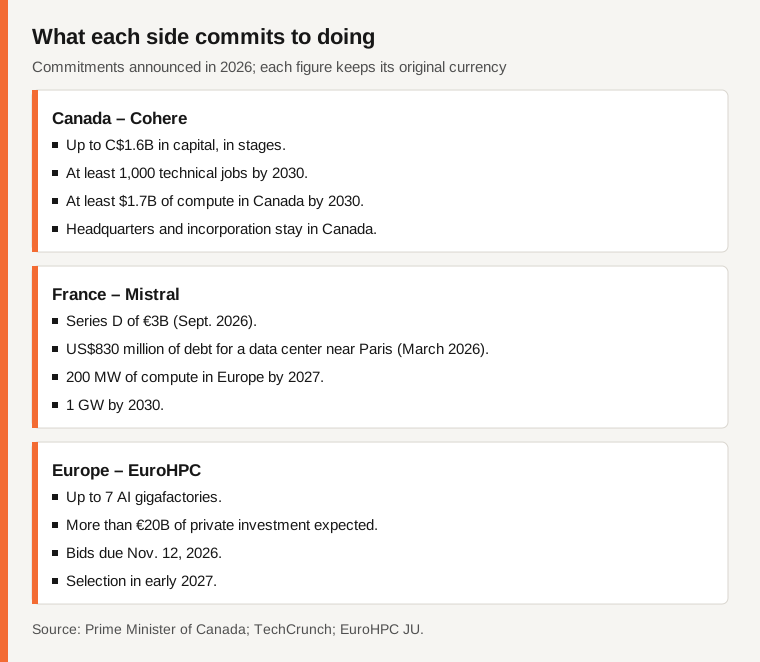
Cohere's commitments, per the government release: at least 1,000 new well-paid technical jobs in Canada by 2030; at least 1.7 billion dollars of additional compute infrastructure in Canada by 2030 (currency not stated in our sources); keeping its incorporation and headquarters in Canada; research partnerships and opportunities for students and recent graduates; and continued work with the Canadian AI Safety Institute. In 2024, Ottawa had already committed up to C$240 million for Cohere's compute (Government of Canada).
Carney said real sovereignty "depends on our ability to build, adopt, and govern AI on our own terms". AI Minister Evan Solomon said Canadian companies should not have to leave Canada to succeed globally, and called Canada one of the few countries with a large language model (Global News).
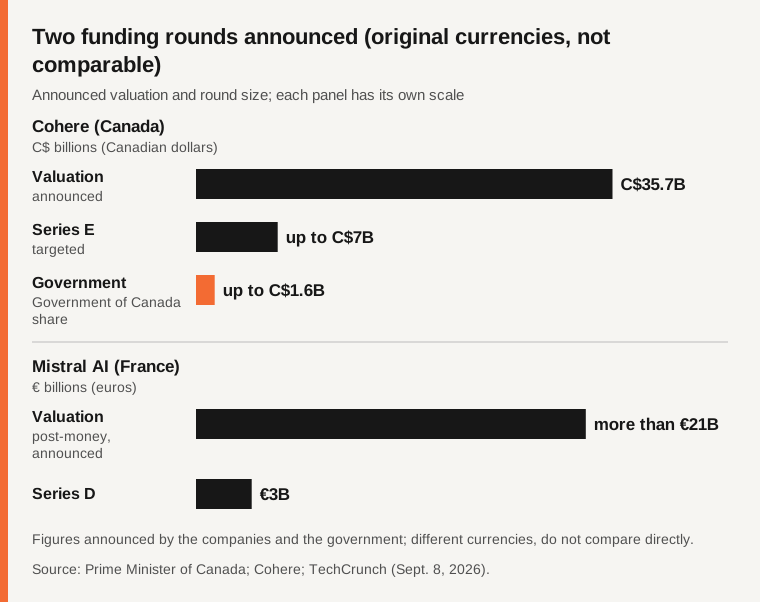
Cohere itself announced the first close of a Series E targeting up to C$7 billion, at a C$35.7 billion valuation, led by companies of Germany's Schwarz group. These are company figures, and Cohere calls it the largest private financing in Canadian tech history, a company claim. New investors: Bell Ventures, Bullhound Capital and the Government of Canada. Existing investors: Inovia Capital, NVIDIA and Prosperity7 Ventures (Cohere release). Cohere also reports annual recurring revenue up 165% year over year at the end of Q3 2026, with no amount given, and 300 customers, 20 times more than a year earlier. We could not verify these independently. In 2026 Cohere combined with Germany's Aleph Alpha (announced in April per Global News; the Prime Minister's release speaks of a recent merger).
The chart below sets out the two rounds in their own currencies.
Source: Prime Minister of Canada, Cohere, Mistral via TechCrunch; company figures, verified 2026-10-30.
Where does Mistral stand?
Mistral's Series D, announced on September 8, 2026, raised €3 billion at a post-money valuation above €21 billion (about US$24.4 billion per TechCrunch). Mistral calls it the largest equity round ever by a European tech company, a company claim. Samsung Electronics led; EQT's Scaleup Europe fund and PSG Equity co-led. Existing investors a16z, Nvidia and Salesforce Ventures took part, as did new investors Advent, BlackRock and the Grand-Duchy of Luxembourg. ASML is a partner and major investor. Samsung's entry had the backing of French authorities, and Emmanuel Macron spoke of "building a third way in AI" (TechCrunch).
Proceeds go to compute and infrastructure, commercial growth and international expansion. Mistral operates in 20 countries and says it helps governments and companies use AI while keeping control. It does not aim to build a "European ChatGPT" and also hosts third-party open-weight models, including Chinese ones. It added processing-region choice tools in August and expanded its Microsoft partnership in July.
On infrastructure, Mistral raised US$830 million of debt in late March 2026 for a data center at Bruyères-le-Châtel near Paris, using Nvidia chips, with commissioning planned for Q2 2026 (TechCrunch). Its targets are 200 MW of compute capacity in Europe by 2027 and 1 GW by 2030. In February it announced US$1.4 billion for AI infrastructure in Sweden. Total funding before the Series D was above €2.8 billion per Crunchbase. Mistral publishes no revenue figure in the sources we consulted.
Source: TechCrunch (September 8 and March 30, 2026), Mistral announcements; company figures, verified 2026-10-30.
What does "sovereign" mean when Nvidia and foreign funds are investors?
Facts first. Nvidia is a named investor in both Cohere and Mistral. Cohere's lead investors are German (Schwarz); Mistral's lead is Samsung Electronics. Schwarz Digits plans to anchor Cohere's models in its STACKIT cloud.
| Cohere | Mistral AI | |
|---|---|---|
| Lead investor | Schwarz group companies (Germany) | Samsung Electronics |
| Public investors | Government of Canada | Grand-Duchy of Luxembourg |
| Nvidia | Existing investor | Existing investor |
| Other named investors | Bell Ventures, Bullhound Capital, Inovia Capital, Prosperity7 Ventures | EQT's Scaleup Europe fund, PSG Equity, Advent, BlackRock, a16z, Salesforce Ventures; ASML is a partner |
Nationalities are given only where the sources state them. In its FY2026 annual report, Nvidia says the United States has imposed global export controls on its GPUs, that more are likely, and that they may extend to downstream users.
Our analysis: a model can be developed, hosted and governed in one country while the chips come from a US supplier subject to US rules. Sovereignty then means the ability to choose where data is processed, who holds the contracts and which laws apply, not the absence of foreign dependencies. Cohere itself cites a McKinsey projection of a US$600 billion sovereign AI market, a company-cited figure.
What is Europe preparing?
On July 30, 2026, the EuroHPC Joint Undertaking launched a call to select consortia to build and operate up to seven "AI gigafactories" in at least seven member states. More than €20 billion of private investment is expected. Applications close on November 12, 2026, selection is expected in early 2027, and sites should be operational within 18 months of selection. Public money (Union and member states) acts as anchor customer, with much of it coming from the next 2028 to 2035 financial framework (EuroHPC JU). For the scale of US spending, see our Big Tech capex article.
How many countries already have a sovereign LLM?
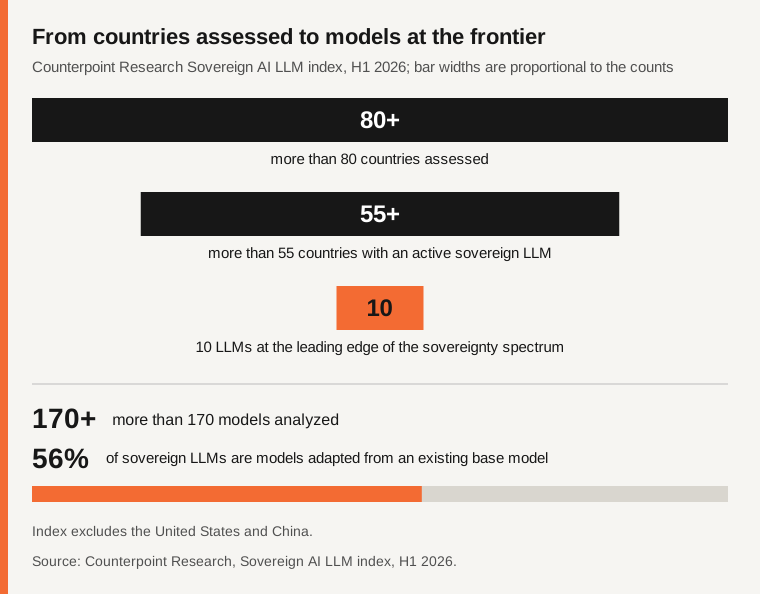
Counterpoint Research's "Sovereign AI LLM" index for the first half of 2026, which excludes the United States and China, evaluated more than 80 countries. More than 55 have an active sovereign LLM, over 170 models were analyzed, and 10 sit at the leading edge of the "sovereignty spectrum". 56% of sovereign LLMs are adapted from an existing base model. Counterpoint defines a sovereign LLM as one developed for national strategic reasons to reduce reliance on foreign LLMs (data security, language diversity, technological independence).
Source: Counterpoint Research, H1 2026 index, verified 2026-10-30.
Regional findings: the Middle East leads (UAE: Falcon H1 ranked first; Saudi Arabia: ALLaM and Jais 2). India has Sarvam 105B; Russia has GigaChat 3.1 Ultra (702 billion parameters). South Korea holds 17% of Asia-Pacific's foundation LLMs and Japan 11%. In Western Europe 59% of models are foundation models, led by Mistral AI. In Canada, Cohere is the only sovereign AI developer. Central Asia and Africa are about 80% adapted models (Egypt and Kazakhstan lead). In Latin America, sovereign activity is limited to Chile and Brazil, with adapted Llama models (Counterpoint Research).
Will every country soon have its own AI?
This section is our analysis, not a forecast, and we give no numbers for the future. The data above suggest three levels:
- Frontier model: very few countries or companies. Cohere's CEO Aidan Gomez calls Cohere the largest AI company outside the United States and China, a claim we could not verify.
- National or regional foundation model: a handful of players, such as Mistral in Western Europe.
- Adapted model or sovereign deployment of an open model: the most widespread level, given the 56% share of adapted models.
What may limit the spread: compute, chips, talent, cost and export controls. What pushes it: data protection, local languages and the political value of control. If that holds, "every country has its own AI" will mostly mean the third level. We may be wrong.
What changes for developers and companies?
Both vendors stress deployment control. Cohere lists private and public cloud, on-premises and air-gapped environments, and its 2026 products include North, an agent platform, and Command A+. Mistral offers processing-region choice. The practical question is which dependencies remain: chips, cloud, contracts. You can compare models on our models page and look up terms in the glossary. We do not recommend any purchase.
Cohere and Mistral compared
| Criterion | Cohere (Canada) | Mistral AI (France) |
|---|---|---|
| Headquarters | Toronto | France (Paris area for its data center) |
| Latest announced round | Series E, first close, targeting up to C$7 billion | Series D, €3 billion (September 8, 2026) |
| Announced valuation | C$35.7 billion | Above €21 billion post-money |
| Public support | Up to C$1.6 billion equity from Canada; C$240 million for compute (2024) | Luxembourg as new investor; Samsung's entry backed by French authorities; no French state stake mentioned in the sources consulted |
| Main investor | Schwarz group companies | Samsung Electronics |
| Infrastructure | At least 1.7 billion dollars of extra compute in Canada by 2030 (commitment); STACKIT planned | US$830 million debt for a data center near Paris, Nvidia chips; US$1.4 billion in Sweden |
| Capacity target | Not specified in the sources consulted | 200 MW in Europe by 2027; 1 GW by 2030 |
| Deployment | Private/public cloud, on-premises, air-gapped | Processing-region choice; hosts open-weight models |
Frequently asked questions
How much is Canada investing in Cohere?
Up to C$1.6 billion in equity, in instalments, alongside private investors (Prime Minister's release; the release writes "$1.6 billion", and the Canadian press indicates Canadian dollars). The stake obtained is not stated in the sources we consulted.
Is Mistral backed by the French state?
Luxembourg is a new investor, Samsung's entry had the backing of French authorities, and Macron welcomed the round. No equity stake from the French state is mentioned in the sources we consulted.
Is a sovereign AI independent of the United States?
Not necessarily. Both companies have Nvidia as an investor, and Nvidia reports US export controls on its GPUs. Our analysis: sovereignty is about control over where data and models run, not full independence.
Will every country have its own AI?
Our reading is that most will have an adapted or open-model sovereign deployment, and few a frontier model. It is an analysis, not a forecast.
Method and limits
Facts come from the sources below, checked on October 30, 2026. Company figures (valuations, growth, customers, rankings) are unaudited and attributed. Amounts are never converted between currencies. Valuations are announced numbers, not our estimates. Counterpoint's index excludes the United States and China. Where a source was silent, we say so. This is not financial advice.
Sources
- Prime Minister of Canada: Canada announces landmark investment in Cohere (verified 2026-10-30)
- Cohere: Series E announcement (PR Newswire) (verified 2026-10-30)
- Global News: Ottawa AI investment in Cohere (verified 2026-10-30)
- TechCrunch: Mistral raises €3B as sovereign AI becomes big business (verified 2026-10-30)
- TechCrunch: Mistral AI raises $830M in debt for a data center near Paris (verified 2026-10-30)
- EuroHPC JU: AI gigafactories call (verified 2026-10-30)
- Counterpoint Research: Sovereign AI LLM index, H1 2026 (verified 2026-10-30)
- Government of Canada: C$240 million for Cohere's compute (December 2024) (verified 2026-10-30)
Spotted an error in this article? Report it · Our corrections policy