Market
Big Tech AI capex hits $207 billion in one quarter as AWS, Azure and Google Cloud accelerate
Amazon, Microsoft, Alphabet and Meta spent about $207B on capex in Q3 2026. AWS grew 39%, Azure 48%, Google Cloud 103%; demand still exceeds capacity.
- Cloud & infrastructure
- Models
- #Microsoft
- #Amazon
- #AWS
- #Azure
- #Google Cloud
- #Meta
- #capex
- #cloud
- #data centers
- #AI
As of October 30, 2026, Amazon, Microsoft, Alphabet and Meta have all reported their September-quarter results: together they spent about $207 billion on capital expenditures in a single quarter. Cloud revenue grew 39% at AWS, 48% at Azure and 103% at Google Cloud, and Amazon and Microsoft both say demand still exceeds the capacity they can deliver.
The essentials
- Spending: the four groups' Q3 2026 capex adds up to $207.4 billion ($75.9 billion Amazon, $51.4 billion Alphabet, $45.2 billion Microsoft, $34.9 billion Meta).
- Growth: AWS +39% (its fastest in nearly five years), Azure +48%, Google Cloud +103%, all year over year.
- Outlook: Amazon, Alphabet and Meta guide to $550 billion to $570 billion of capex in 2026 combined, and Amazon and Alphabet expect more in 2027.
- Cash: Alphabet, Meta and Amazon all report negative free cash flow, as investment outpaces operating cash.
Q3 2026 means the quarter ended September 30, 2026. For Microsoft it is the first quarter of its fiscal year (July to September). Unless stated otherwise, figures come from the companies' own releases and calls. This follows our October 29 article on Microsoft and Alphabet, now completed with Amazon and Meta.
How fast are AWS, Azure and Google Cloud growing?
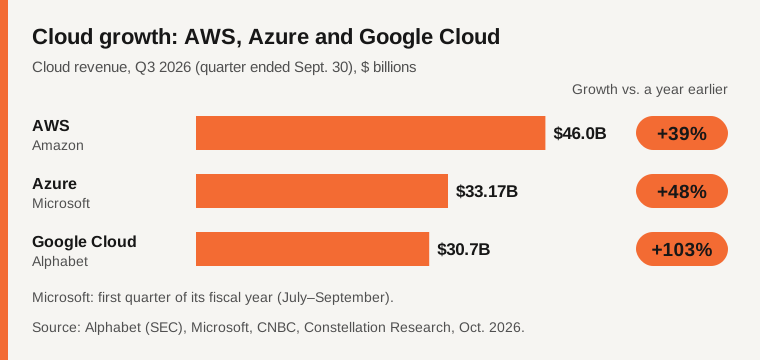
All three cloud units grew faster than the group around them, and Google Cloud's growth is the most striking. The chart below shows each unit's quarterly revenue and its growth rate.
Source: Amazon, Microsoft and Alphabet Q3 2026 results; figures as reported by each company.
AWS revenue reached $46.0 billion, up 39%, with operating income of $17.8 billion and an annualized run rate of $184 billion. Amazon's total revenue was $201.9 billion (+12%) and net income $20.7 billion. Earnings per share were $1.89 against $1.96 expected, according to CNBC. CEO Andy Jassy said: "Overall demand for AWS capacity remains exceptionally strong."
Azure revenue was $33.17 billion, up 48%, within Microsoft revenue of $92.3 billion (+19%). Microsoft Cloud reached $63.9 billion (+30%). Microsoft did not disclose a cloud operating income. Google Cloud revenue was $30.7 billion (30,709 million), against $15.2 billion a year earlier, with operating income of $11.1 billion against $3.6 billion. Alphabet's total revenue was $127.6 billion (+25%).
How much did the four giants invest in one quarter?
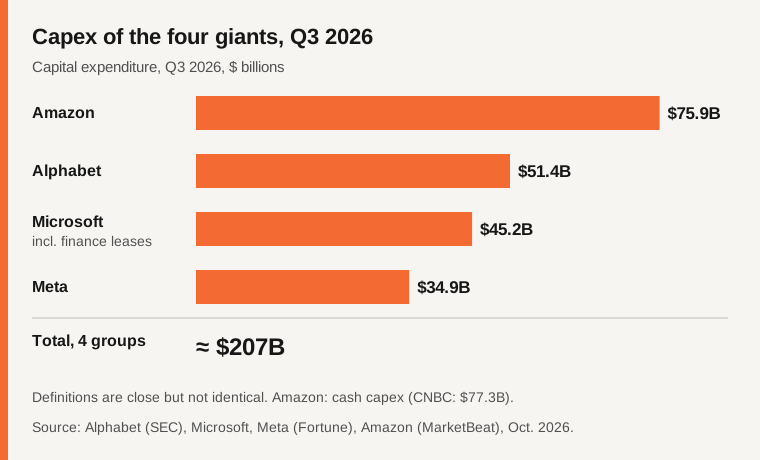
Together they invested $207.4 billion in three months. Amazon leads with $75.9 billion, and Meta, which has no cloud business, still spends $34.9 billion.
Source: company Q3 2026 releases; Amazon figure is cash capex.
One caveat on Amazon: CNBC reports $77.3 billion, while we use $75.9 billion of cash capex. We did not find the source of the gap. Meta's capex was $19.4 billion a year earlier.
What are they planning for 2026 and 2027?
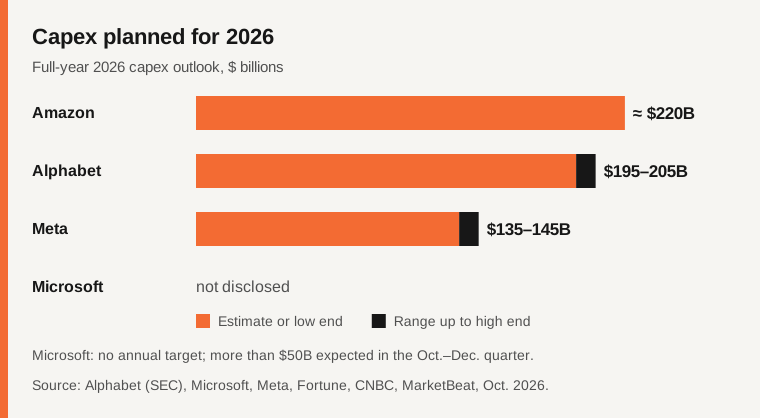
Three of the four give an annual 2026 target: about $220 billion for Amazon (unchanged), $195 billion to $205 billion for Alphabet, and $135 billion to $145 billion for Meta, narrowed from $130 billion to $145 billion. Together that is $550 billion to $570 billion.
Source: Amazon, Alphabet and Meta Q3 2026 results and calls.
Microsoft gives no annual target but expects more than $50 billion of capex next quarter. Amazon expects spending to rise "meaningfully" in 2027 and Alphabet expects capex to "increase significantly", while Meta gave no 2027 capex figure. CEO Mark Zuckerberg described the Muse service as "compute-intensive". Microsoft CFO Amy Hood said: "We still have demand that exceeds supply." She guided to Azure growth of 49% to 50% in constant currency next quarter.
Do the backlogs justify the spending?
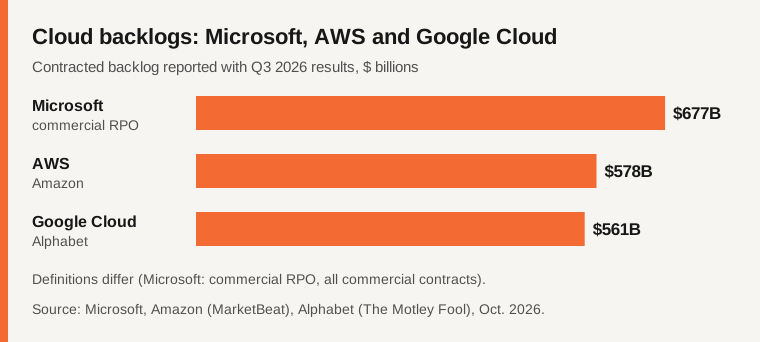
The contracted backlogs are large: $677 billion at Microsoft, $578 billion at AWS and $561 billion at Google Cloud. They are not directly comparable.
Source: Microsoft, Amazon and Alphabet Q3 2026 results and calls.
Microsoft's figure is its commercial remaining performance obligation (RPO), up 73%. It covers all commercial contracts, not only Azure. A backlog is revenue under contract but not yet recognized, and contracts can be delayed or renegotiated. It shows demand, not profit. Capex definitions also differ slightly: Microsoft includes finance leases, Alphabet counts purchases of property and equipment, Amazon uses cash capex.
Is free cash flow keeping up?
Not entirely. Free cash flow is operating cash flow minus capex, and the bases below differ, so they should not be compared line by line.
- Alphabet: minus $9.1 billion in Q3 ($42.3 billion of operating cash flow minus $51.4 billion of capex).
- Meta: minus $2.1 billion in Q3, against plus $10.6 billion a year earlier.
- Amazon: minus $42.4 billion over the trailing twelve months, against plus $14.7 billion a year earlier (Constellation Research).
Alphabet and Meta are quarterly figures, Amazon's covers twelve months. Cloud margins are rising: Google Cloud's operating income went from $3.6 billion to $11.1 billion. It does not follow that the groups lose money. Investment is simply consuming their cash.
Comparison table
| Cloud revenue Q3 | Growth y/y | Cloud operating income | Group capex Q3 | Group capex 2026 | Backlog | |
|---|---|---|---|---|---|---|
| AWS (Amazon) | $46.0B | +39% | $17.8B | $75.9B (cash; CNBC says $77.3B) | about $220B (unchanged); "meaningful" rise in 2027 | $578B |
| Azure (Microsoft) | $33.17B | +48% | not disclosed | $45.2B (incl. finance leases) | no annual target; over $50B next quarter | $677B (commercial RPO, +73%, all contracts) |
| Google Cloud (Alphabet) | $30.7B | +103% (vs $15.2B) | $11.1B (vs $3.6B) | $51.4B (purchases of property and equipment) | $195B to $205B; "increase significantly" in 2027 | $561B |
| Meta | no cloud | n/a | n/a | $34.9B ($19.4B a year earlier) | $135B to $145B (was $130B to $145B) | n/a |
What this means for developers
Capacity is the practical issue. Amazon says its customers' demand is "exceptionally strong", and Microsoft says demand exceeds supply, so available capacity may be the practical constraint to watch when planning AI workloads. Jassy said Amazon installs an AI accelerator "every 14 seconds", that commitments to its Graviton and Trainium chips grew twentyfold in a year, and that Trainium will be offered outside AWS from late 2027 (MarketBeat call summary). Google says TPU sales were "a meaningful contributor" to Google Cloud, and that its Gemini API processes about 32 billion tokens per minute, more than four times a year ago, with one billion users of the Gemini app. Jassy also said AWS could grow more than 40% in 2027 and 2028 and reach $1 trillion in annual revenue in five to ten years: management statements, not our forecasts. To compare models and prices, see our model comparison and glossary.
Frequently asked questions
How much did Big Tech spend in Q3 2026?
Amazon, Alphabet, Microsoft and Meta spent $207.4 billion on capex in the quarter: $75.9 billion, $51.4 billion, $45.2 billion and $34.9 billion. Definitions differ slightly between companies.
Which cloud is growing fastest?
Google Cloud, at +103% to $30.7 billion, against +48% for Azure and +39% for AWS. AWS is the largest, at $46.0 billion.
Is the spending covered by cash flow?
Not at the moment. Alphabet (minus $9.1 billion), Meta (minus $2.1 billion) and Amazon (minus $42.4 billion over twelve months) report negative free cash flow, on different periods.
What should we watch next?
Microsoft's guide of Azure growth of 49% to 50% and capex above $50 billion next quarter, and any 2027 capex figures from Meta and Microsoft. Amazon and Alphabet already say 2027 will be higher.
Method and limits
Capex is the cash spent on property, equipment and data centers. Microsoft's number includes finance leases, so the four figures are close but not identical. Backlog (RPO) is contracted revenue not yet recognized. Free cash flow is operating cash flow minus capex, and its period differs by company, as shown above. These are company-reported, unaudited figures, collected on the dates below, and sources can differ slightly (hence the Amazon note). We give no stock-market data. This is not financial advice.
Sources
- Alphabet: Third Quarter 2026 Results (SEC filing) (verified 2026-10-30)
- Microsoft: Microsoft announces first quarter results (verified 2026-10-29)
- CNBC: Microsoft earnings report (verified 2026-10-29)
- The Motley Fool: Microsoft Q1 2027 earnings call transcript (verified 2026-10-29)
- The Motley Fool: Alphabet Q3 2026 earnings call transcript (verified 2026-10-29)
- CNBC: Amazon Q3 earnings report (verified 2026-10-30)
- Constellation Research: AWS Q3 revenue growth surges 39%, capex stings Amazon's cash flow (verified 2026-10-30)
- MarketBeat: Amazon Q3 earnings call highlights (verified 2026-10-30)
- Fortune: Meta Q3 earnings, Zuckerberg, capex and Muse (verified 2026-10-30)
- Meta: Meta Reports Third Quarter 2026 Results (verified 2026-10-29)
Spotted an error in this article? Report it · Our corrections policy
