Analysis
Repainted paintings, vanished works: how AI helps investigators track down stolen art
Italy's Carabinieri use AI to match online images with stolen works, including a repainted canvas. What SWOADS and INTERPOL's ID-Art do, and their limits.
- New AI technologies
- #Carabinieri
- #SWOADS
- #INTERPOL
- #ID-Art
- #Santa Clara University
- #art theft
- #computer vision
As of October 30, 2026, AI helps investigators find stolen art mainly by comparing photos found online with databases of works declared stolen. In Italy, the Carabinieri's SWOADS system flagged a painting stolen in 2004, then retouched by the thieves, within hours, working from a photo. The system proposes probable matches; people check them, and the recovery itself remains police work.
The essentials
- What the AI does: it compares images and texts collected online with reference data on stolen works and produces a list of probable matches. It does not investigate.
- The repainted canvas: "Sant'Agnese", stolen in 2004 and altered by the thieves, was spotted at an antiques fair in October 2024, flagged within hours and seized the next day.
- The reported tally and its limits: since November 2023, SWOADS has reportedly contributed to the recovery of more than 300 paintings and sculptures. These figures come from press reports and we could not verify them independently.
- Humans in the loop: matches are confirmed or rejected by people, and the system cannot find what was never declared stolen.
We keep apart two different uses: tools that look for stolen works (SWOADS, INTERPOL) and a research tool for works looted by the Nazis (Santa Clara University), which reconstructs provenance and is still experimental.
How does AI find a repainted work?
SWOADS stands for Stolen Works of Art Detection System. It is a project of the Carabinieri, in the unit responsible for protecting cultural heritage (TPC). According to Il Sole 24 Ore (June 18, 2024), it crawls the web, social networks and the dark web, compares images and texts with reference data using AI, and produces a list of probable matches that humans confirm or reject. The same article says an upgrade for 3D objects and video was under way.
The principle is a search engine for stolen objects. A photo posted by an auction house, a dealer or a seller is compared with the images of works declared stolen. When the similarity is high enough, the system raises a lead. An investigator then looks at both images and decides whether to act.
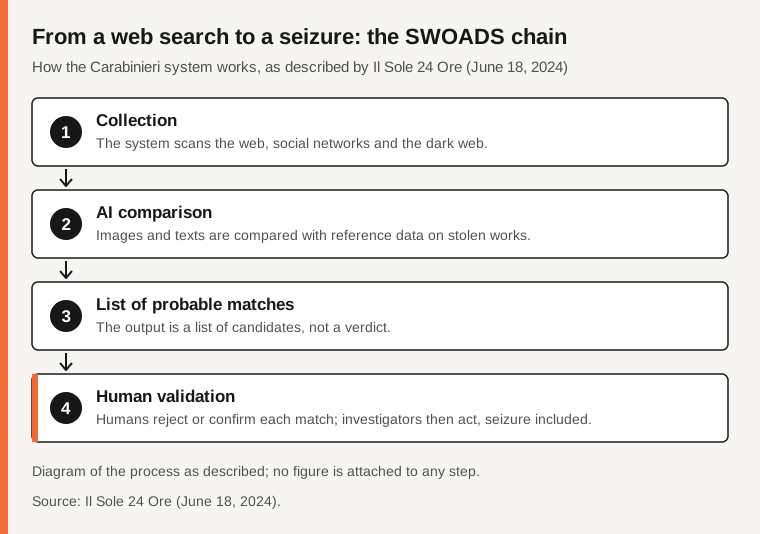
Source: Il Sole 24 Ore, June 18, 2024, verified 2026-10-30. The diagram simplifies the description given in the press; no figure is shown.
A repainted work is a hard case, because the thieves change details a person would look at first. The sources we read do not explain how SWOADS handles such changes, and we do not speculate on the algorithm used.
What do the two recent recoveries show?
Two cases are in the news. They are very different, and only the first one is credited to SWOADS in the sources we read.
"Sant'Agnese" (Saint Agnes), stolen in 2004. According to ThePrint, which relays the BBC, the canvas was stolen in August 2004 from a church in Sulmona, in the Abruzzo region. The thieves altered it: the lamb became a scroll, and the halo and the palm were removed. It was spotted in October 2024 at an antiques fair in Parma. SWOADS flagged it within hours from a photo, and the Carabinieri seized it the next day. That is about 20 years between the theft and the recovery (our calculation from the dates reported).
"Riposo della pastorella" by Filippo Palizzi, stolen in 1972. The painting was stolen in June 1972 from the Carlo Rizzarda modern art gallery in Feltre. According to Il Dolomiti, the gallery stayed closed until 2001. It was found up for sale at an auction house in Piedmont in April 2026, according to ThePrint. The seller was a private individual acting in good faith, and the painting went back to the municipality of Feltre. That is about 54 years (our calculation from June 1972 to April 2026).
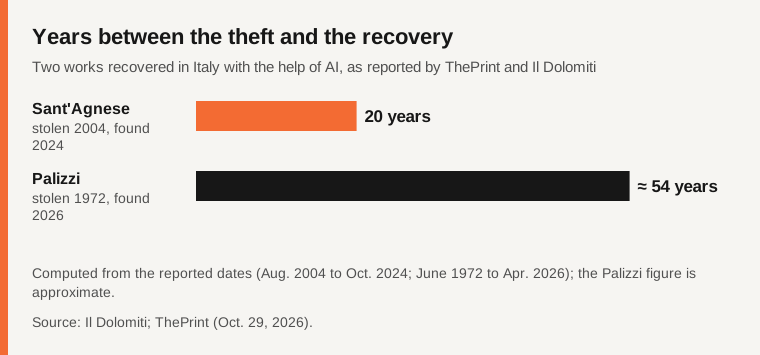
Source: calculated from dates reported by Il Dolomiti and ThePrint, verified 2026-10-30.
These two durations show that a stolen work can reappear decades later, often in a legitimate market. They do not say how often AI succeeds. Two cases are not a success rate.
What does the SWOADS tally say, and not say?
ThePrint (October 29, 2026), citing the BBC (October 28), reports that since November 2023 SWOADS has been involved in recovering more than 300 paintings and sculptures, and more than 165,000 smaller objects such as coins, manuscripts and religious items, with a total value above 203 million euros. We did not read the BBC directly, and we have not verified these figures independently. We also do not know how "involved in" is counted, for example whether the system found the lead or only helped confirm it.
The same report lists limits:
- Very famous works rarely turn up in sales catalogues. One of the developers, Lieutenant Colonel Salvatore Rapicavoli, reportedly does not expect to find the most publicised recent thefts this way.
- Carina Popovici, of the company Art Recognition, reportedly stresses that these systems answer a precise question: does this image match a work declared stolen? Recovery, she says according to ThePrint relaying the BBC, depends on investigators and on judicial cooperation.
- The system struggles with 3D objects seen from different angles, and with telling an original from a copy.
- It cannot detect what was never declared stolen.
A caution on numbers: you may see a figure of roughly 265 million euros and 100,000 objects in other coverage. That is the Carabinieri TPC's total for 2023 across all investigations, not a SWOADS result, and we do not use it here.
What do INTERPOL and ID-Art offer?
INTERPOL maintains the Stolen Works of Art database, with almost 57,000 objects described and photographed. It is fed only by INTERPOL's national central bureaus and by partners (UNESCO, ICOM, ICCROM), and anyone can request authorised access.
ID-Art is INTERPOL's mobile app. It is free, can be consulted without an account or password, and offers manual search or search by photo using image recognition. It is available in four languages: Arabic, English, French and Spanish. A buyer, a gallery or a customs officer can therefore check an object against the database, within the limits of what has been reported to INTERPOL. We found no usage figures for the app and give none.
Does AI also help with Nazi-looted art?
Here the problem is different: the works were not stolen in a recent burglary but taken from their owners under the Nazi regime. On July 5, 2026, Santa Clara University announced an "AI Provenance Assistant" developed by researchers Michael Santoro, Haibing Lu and Michele Samorani. It draws on the Jeu de Paume database (the records of the ERR, the Nazi looting task force), which the university puts at about 30,000 works.
The tool does not recover paintings. It helps reconstruct provenance trails, that is, who owned a work and when. The university says it is not yet scalable and that the source data are messy. It plans to extend the tool to other databases. It remains a research prototype, not an operational tool.
What are the limits of these tools?
- They only find what is declared. A work missing from the databases, or insufficiently documented, cannot be matched.
- They produce leads, not proof. Every match must be checked by humans, and recovery then depends on police, courts and cooperation between countries.
- Hard cases remain. 3D objects at different angles and originals versus copies are known weak points, according to the report cited above.
- Reported results are not audited. The tallies come from press reports, and we have no information on false leads. We give no error rate.
What can collectors, galleries and buyers do?
These are general precautions, not legal advice.
- Document your works. Keep clear photos from several angles, with dimensions, marks and a description. A good reference image is what a comparison system needs.
- Report a theft quickly to the authorities, so the work can be entered in national and international databases.
- Check before you buy. Search the INTERPOL database or the ID-Art app, and ask for the provenance of the work.
Comparison table
| Tool | Run by | What it looks for | Reported figure | Source |
|---|---|---|---|---|
| SWOADS | Carabinieri TPC (Italy) | Stolen works online (web, social networks, dark web) | More than 300 paintings and sculptures, more than 165,000 small objects, over 203 million euros since Nov. 2023 (reported, unverified) | ThePrint (citing the BBC), Il Sole 24 Ore |
| Stolen Works of Art database | INTERPOL | Works declared stolen by member countries and partners | Almost 57,000 objects | INTERPOL |
| ID-Art | INTERPOL | Same database, by manual or photo search | No figure found | INTERPOL |
| AI Provenance Assistant | Santa Clara University | Provenance of Nazi-looted works (Jeu de Paume records) | About 30,000 works in the source database | Santa Clara University |
Frequently asked questions
Does AI find stolen paintings by itself?
No. Tools like SWOADS propose probable matches, and humans confirm or reject them. Seizing a work remains the job of investigators.
Can AI recognise a painting that was repainted?
In the case of "Sant'Agnese", a canvas altered by thieves was flagged within hours, according to ThePrint. One case does not show how reliable the approach is in general, and we found no error rate.
Can I check an object myself?
Yes, to a degree. INTERPOL's ID-Art app is free, needs no account and can search by photo. It only covers works reported to INTERPOL.
Does the Santa Clara tool recover looted art?
No. It helps reconstruct who owned a work over time, from the Jeu de Paume records. It was announced on July 5, 2026 as a prototype that is not yet scalable.
Method and limits
This article relies on press reports and on the pages of INTERPOL and Santa Clara University, read on October 30, 2026. The SWOADS figures come from ThePrint (October 29), which cites the BBC (October 28). We did not read the BBC directly and have not verified them independently. Durations of 20 and about 54 years are our calculations from reported dates. We have no information on the algorithms used, on error rates, or on how many leads SWOADS produces. This article is not legal or professional advice, and the situation may have changed since.
Sources
- ThePrint: AI found a painting stolen in 1972, how Italy is using tech to recover missing art (verified 2026-10-30)
- Il Sole 24 Ore: the hunt for stolen art, artificial intelligence allied with the Carabinieri (verified 2026-10-30)
- Il Dolomiti: AI traces an artwork stolen in 1972 (verified 2026-10-30)
- INTERPOL: Stolen Works of Art database (verified 2026-10-30)
- INTERPOL: ID-Art mobile app (verified 2026-10-30)
- Santa Clara University: a team uses AI to uncover Nazi-looted art (verified 2026-10-30)
Spotted an error in this article? Report it · Our corrections policy
