Developer tools
Apple's MacBook Pro gets a touchscreen: PROLED XDR OLED display, M5 Pro and M5 Max, from $2,899
Apple's 14 and 16-inch MacBook Pro gets a tandem OLED PROLED XDR display and the first Touch on a Mac, with M5 Pro or M5 Max, from $2,899, shipping Nov 6.
On October 28, 2026, Apple announced new 14 and 16-inch MacBook Pro models with a tandem OLED display it calls PROLED XDR and, for the first time on a Mac, Touch. They use the M5 Pro and M5 Max chips and start at $2,899 in the United States. Orders opened on October 28 and the laptops reach customers and stores on Friday, November 6, 2026.
The essentials
- Display: 14.2 and 16.3-inch tandem OLED with the touch sensor built into the panel, replacing Mini-LED on these models. Apple says up to 2,000 nits of peak brightness.
- Touch: scrolling, pinch to zoom and drag and drop, with Touch ID but no Face ID. Apple's release does not mention a stylus.
- Price and date: from $2,899 (14-inch M5 Pro) to $4,799 (16-inch M5 Max); available November 6, 2026.
- Body: 14-inch at 3 lb (about 1.36 kg) and 16-inch at 4 lb (about 1.81 kg), lighter than before, according to Apple.
Unless stated otherwise, the figures come from Apple's October 28 press release. They are Apple's own claims: we have not tested the machine.
What changes with this touchscreen MacBook Pro?
Three things change at once: the screen technology, the input method and the body. The display is a tandem OLED panel called PROLED XDR that replaces the Mini-LED panel, and the touch sensor is built directly into it. A Dynamic Island replaces the notch. The hinge is new, for stability when you touch the screen, and the chassis is thinner and lighter.
Johny Srouji, Apple's hardware chief, calls it "the world's best laptop display". That is Apple's statement, not an independent finding. The chips are the same M5 Pro and M5 Max as in March 2026.
How does touch work on macOS?
Apple lists scrolling, pinch to zoom, drag and drop, a double tap to fill the screen and a swipe to arrange a window. Apple says it added advanced video stabilization for touch use during video calls. The software is macOS 27 "Golden Gate".
According to MacRumors, macOS converts touch into clicks, so many existing apps already work. Apple has also updated its gesture APIs for developers. The release does not mention a stylus, and the laptop keeps Touch ID rather than adding Face ID.
The Dynamic Island brings Spotlight, Live Activities and Siri AI to the top of the screen. Siri AI is in beta in macOS 27.2, in six languages, with daily usage limits on some server-based features. Spotlight there depends on Siri AI being available and turned on.
Does the PROLED XDR display live up to its claims?
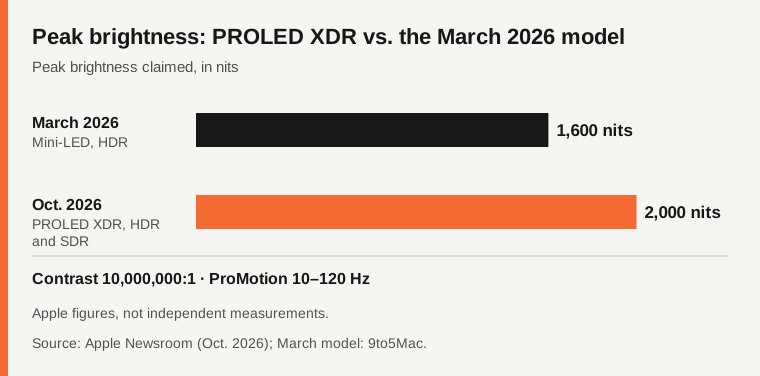
We cannot say yet: these are Apple's figures, not independent measurements, and the release does not give the resolution. The chart below sets the new peak brightness against the previous model's HDR figure.
Source: Apple press release (October 28, 2026); previous model figure from 9to5Mac.
Apple quotes up to 2,000 nits of peak brightness in both HDR and SDR, against 1,600 nits in HDR on the previous model, according to 9to5Mac. It also claims a 10,000,000:1 contrast ratio and ProMotion from 10 to 120 Hz. For color, it cites P3, Adobe RGB and more than 80% of Rec. 2020.
The screen has an anti-reflective coating, with a nano-texture option etched into the glass, DICOM modes (for non-diagnostic use) and genlock with third-party hardware.
How much does it cost and when does it ship?
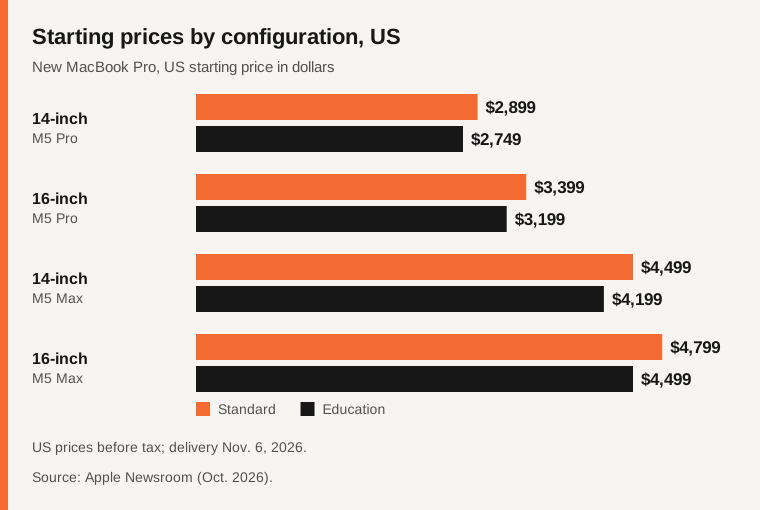
US prices run from $2,899 to $4,799, with education prices $150 to $300 lower. Pre-orders opened on October 28, 2026 in 30 countries and regions, including the United States, and deliveries and store availability start on Friday, November 6, 2026. Some outlets wrote "October 30" for pre-orders: Apple's release is the reference.
Source: Apple press release (October 28, 2026); standard US prices.
Education prices are $2,749, $3,199, $4,199 and $4,499 in the same order. Apple Upgrade leasing starts at $55.99 a month over 36 months, before tax. Power adapters are sold at $59 (70 W), $79 (96 W) and $99 (140 W).
Is it lighter and thinner?
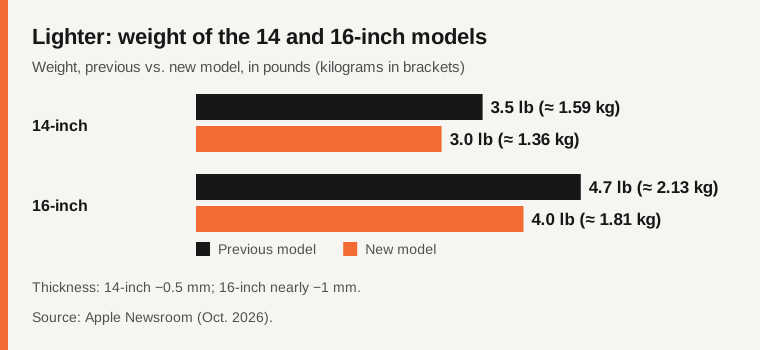
Yes, according to Apple. The 14-inch weighs 3 lb (about 1.36 kg), 0.5 lb less than before, and the 16-inch weighs 4 lb (about 1.81 kg), 0.7 lb less.
Source: Apple press release (October 28, 2026).
The 14-inch is 0.5 mm thinner and the 16-inch nearly 1 mm thinner. Apple says the case is 100% recycled aluminum.
Apple says battery life reaches 24 hours in its September 2026 test, varying with use and configuration, and that fast charging reaches 50% in 30 minutes. Ports are three Thunderbolt 5, HDMI, an SDXC card slot, MagSafe and a headphone jack, with Wi-Fi 7 and Bluetooth 6.
What does it change for local AI and developers?
The chips are those of the March 2026 announcement. Memory goes up to 128 GB of unified memory on M5 Max (M5 Pro up to 64 GB, per the March announcement) and storage up to 16 TB. Memory bandwidth reaches 307 GB/s on M5 Pro and 614 GB/s on M5 Max. For local AI, memory capacity and bandwidth matter most: see our glossary and model comparison.
Each GPU core has a Neural Accelerator. Apple says this gives more than 4x the peak GPU compute for AI versus M4 Pro and M4 Max, in its February 2026 tests. In March, Apple listed up to 20 GPU cores for M5 Pro and up to 40 for M5 Max, with an 18-core CPU (6 super and 12 performance cores). The October release does not restate core counts for these models, so we do not assert them here.
For developers, the release points to updated gesture APIs. Apple names Notion, Canva, Zoom, Microsoft Word, Excel, PowerPoint and Outlook, Adobe Lightroom, DaVinci Resolve, Blender, Maxon Cinema 4D and ZBrush, Shapr3D and djay Pro as third-party apps coming "later this year", a footnote says.
Touch model or March model?
The March 2026 models stay on sale, with unchanged prices according to 9to5Mac, which Apple's release does not confirm. They share the M5 Pro and M5 Max chips, so performance should be close. They have neither the OLED display, nor the light-up logo, nor the thinner design.
The choice depends on criteria that only you can weigh: touch, screen type and brightness, weight, and price. TrendForce, via 9to5Mac, estimates that Apple could ship 1.2 to 1.5 million of these MacBook Pros in 2027. That is an analyst estimate, not an Apple figure.
Comparison table
| Criterion | New MacBook Pro (Touch, PROLED XDR) | March 2026 MacBook Pro (Mini-LED) |
|---|---|---|
| Display | Tandem OLED, 14.2 and 16.3 inches | Mini-LED |
| Peak brightness | Up to 2,000 nits (HDR and SDR) | 1,600 nits in HDR (9to5Mac) |
| Touch | Yes, built into the panel | No |
| Top of the screen | Dynamic Island | Notch |
| Weight, 14-inch / 16-inch | 3 lb / 4 lb | 3.5 lb / 4.7 lb |
| Chips | M5 Pro, M5 Max | M5 Pro, M5 Max |
| US starting price | From $2,899 | Reported unchanged (9to5Mac), not confirmed by Apple |
Frequently asked questions
Does the new MacBook Pro have a touchscreen?
Yes. Apple says it is the first Mac with Touch, and the touch sensor is built into the PROLED XDR panel.
How much does it cost and when does it ship?
From $2,899 for the 14-inch M5 Pro to $4,799 for the 16-inch M5 Max in the US. Pre-orders opened on October 28, 2026, and deliveries start on November 6, 2026.
Is there Face ID or a stylus?
No Face ID: the laptop has Touch ID. Apple's release does not mention a stylus.
Which chips does it use?
M5 Pro and M5 Max, the same as the March 2026 MacBook Pro, with up to 64 GB (M5 Pro) or 128 GB (M5 Max) of unified memory.
Method and limits
The figures come from Apple's October 28, 2026 release and its March 3, 2026 chip announcement, plus 9to5Mac and MacRumors where marked. They are Apple's claims: no independent test exists yet, and OrigoTech has not tested the machine. Prices are US prices and may differ elsewhere. The previous model's prices come from 9to5Mac only. The TrendForce figure is an analyst estimate. This is not buying advice.
Sources
- Apple Newsroom: Apple unveils groundbreaking MacBook Pro with PROLED XDR display (verified 2026-10-30)
- Apple Newsroom: Apple debuts M5 Pro and M5 Max (March 3, 2026) (verified 2026-10-30)
- 9to5Mac: Apple announces redesigned MacBook Pro, its first touchscreen Mac (verified 2026-10-30)
- MacRumors: Apple's new MacBook Pro (verified 2026-10-30)
- 9to5Mac: Apple expected to ship up to 1.5 million OLED touchscreen MacBook Pros in 2027 (TrendForce) (verified 2026-10-30)
Spotted an error in this article? Report it · Our corrections policy
