Analysis
Bosch plans a dedicated Semiconductors division from January 2028, targeting about 5 billion euros in chip sales by 2030 and more foundry capacity for outside customers
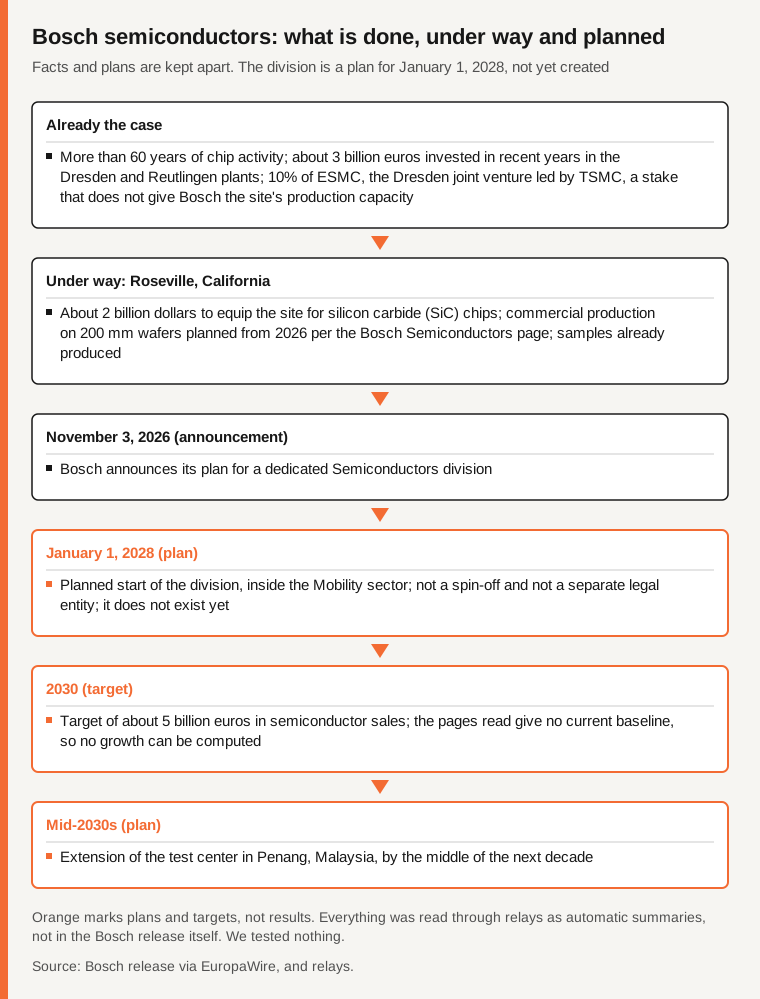
Bosch plans a Semiconductors division from January 1, 2028, inside Mobility, with a target of about 5 billion euros in chip sales by 2030. It is a plan.
On November 3, 2026, Bosch announced that it plans to create a dedicated Semiconductors division on January 1, 2028, with a target of about 5 billion euros in chip sales by 2030 and more manufacturing capacity for outside customers. It is a plan, not a creation already carried out: the division will not exist for about 14 months. We read the announcement only through relays, as automatic summaries. This is neither investment nor legal advice.
The essentials
- The plan: a Semiconductors division from January 1, 2028, inside Bosch's Mobility sector; not a spin-off, not a legally independent company.
- The target: about 5 billion euros in semiconductor sales by 2030, a target and not a result; the pages we read give no current baseline.
- The intentions: robotics, industrial automation, consumer electronics, AI infrastructure and data centers, plus more foundry capacity for outside customers. No capacity, customer or foundry revenue is announced.
- Not established: current chip sales, the division's head, and whether the target will be met.
What does Bosch plan?
According to the Bosch release as republished by EuropaWire, the division will take over the semiconductor activities of Mobility Electronics, which keeps automotive electronic control units (ECUs). The change belongs to the restructuring of Bosch Mobility announced in late October 2026; we did not read its details. For context only, group sales were 91 billion euros in 2025. With no current chip sales figure, we compute no growth.
Source: Bosch release via EuropaWire, and relays.
The sources name Markus Heyn, who heads the Mobility sector, and Erik Rein, head of the semiconductor business; Igor's Lab reports no appointment to lead the new division.
A division, not a spin-off
The division stays inside the Mobility sector. It is not a split-off and not a legally independent company, and In Electronics adds that Bosch did not propose selling or listing the business.
Robotics, AI and foundry: intentions or contracts?
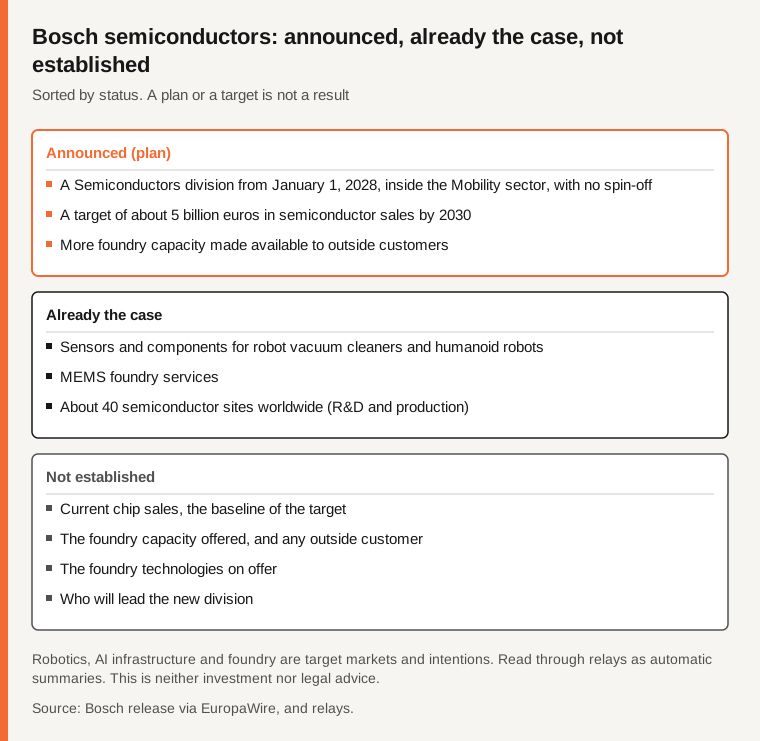
Bosch calls the automotive business its base and aims to grow toward robotics, industrial automation, consumer electronics and AI infrastructure and data centers. Part is already the case: Bosch supplies sensors and components for robot vacuum cleaners and humanoid robots. AI infrastructure is a goal, not a current activity.
On foundry, Bosch plans to expand and make more manufacturing capacity available to outside customers. According to Igor's Lab, no capacity figure, customer, foundry revenue or list of technologies is announced. MEMS foundry services already exist, per the Bosch Semiconductors page. Bosch also cites third-party forecasts: McKinsey sees generative AI possibly needing up to 3.6 million more wafers a year by 2030, and Strategy& and ZVEI analyses suggest European robotics and automation demand could double by 2040. These are forecasts, and Igor's Lab notes that a forecast does not guarantee sales growth.
Sites and investments
Bosch has about 40 semiconductor sites worldwide. It invested about 3 billion euros in recent years in the Dresden and Reutlingen plants (done) and is spending about 2 billion dollars to equip Roseville, California, for silicon carbide chips (under way; commercial production on 200 mm wafers planned from 2026, samples already made). It plans to extend the Penang, Malaysia, test center by the middle of the next decade. Its 10% stake in ESMC, the TSMC-led Dresden joint venture (In Electronics also lists Infineon and NXP), does not give Bosch the site's production capacity.
What is not established?
Source: Bosch release via EuropaWire, and relays.
Current chip sales; the foundry capacity and technologies on offer; any outside customer; the breakdown of the 5 billion euros; any robotics or AI contract; the division's head; whether the target will be met; the effect on jobs; the detail of the Mobility restructuring.
Comparison table
| Point | What the sources say | Status |
|---|---|---|
| Division | Inside Mobility from January 1, 2028; no spin-off | Announced, plan |
| Sales target | About 5 billion euros by 2030 | Plan |
| Current chip sales | No baseline in the pages read | Not established |
| AI infrastructure, data centers | Target markets | Plan |
| Foundry for outsiders | More capacity; no figure or customer | Plan |
| Roseville, SiC | About 2 billion dollars, in progress | Already the case |
Frequently asked questions
Does the division exist yet?
No. Bosch plans it for January 1, 2028, within the Mobility sector.
Will Bosch be a foundry for AI customers?
Not established. Bosch plans more foundry capacity for outside customers and targets AI infrastructure, but announces no capacity, customer or technology.
What is the financial target?
About 5 billion euros in semiconductor sales by 2030, with no current baseline given.
Method and limits
We did not read the Bosch release directly, only as republished by EuropaWire, plus four other relays, all via automatic summaries. DigiTimes was blocked and not read. At least one outlet (Analytics Insight, seen in search results, not read) speaks of a spin-off, which the release contradicts. We tested nothing. This is neither investment nor legal advice.
Sources
- EuropaWire, Bosch release, read via an automatic summary
- Bosch Semiconductors, read via an automatic summary
- Power Semiconductors Weekly, read via an automatic summary
- Igor's Lab, read via an automatic summary
- In Electronics, read via an automatic summary
Spotted an error in this article? Report it · Our corrections policy
