Analysis
Ohio voters ban or limit data centers in at least 14 towns, and Democratic wins in Texas, Georgia, Ohio and Pennsylvania raise questions for the biggest data center states
At least 14 Ohio towns approved data center bans or limits, per unofficial results. Democratic wins in four states bring promises, not laws.
On November 3, 2026, voters in at least 14 Ohio towns approved bans or new limits on data centers, per StockAnalysis, which relays the Cincinnati Enquirer. The same day, Democrats won races in Texas, Georgia, Ohio and Pennsylvania, some after promising tighter data center rules. Results are unofficial and promises are not laws. We read the sources only as automatic summaries. This is neither investment, legal nor political advice.
The essentials
- Ohio: at least 14 towns approved 10 bans and 4 restrictions, per StockAnalysis; one source says 15. Results are unofficial until county boards certify them.
- The states: Democrats won the governorship in Texas, Georgia and Ohio, an Ohio Senate seat, and a Pennsylvania state chamber. Pauses and tax-break limits are promises, not laws.
- The "50%": Wells Fargo's shares of planned gigawatts sum to 44% (our calculation); a Eurasia Group analyst says nearly half. Neither counts projects facing more control.
- Not established: the exact count, certified results, each ban's legal effect, and whether new governors will act.
What did Ohio towns vote?
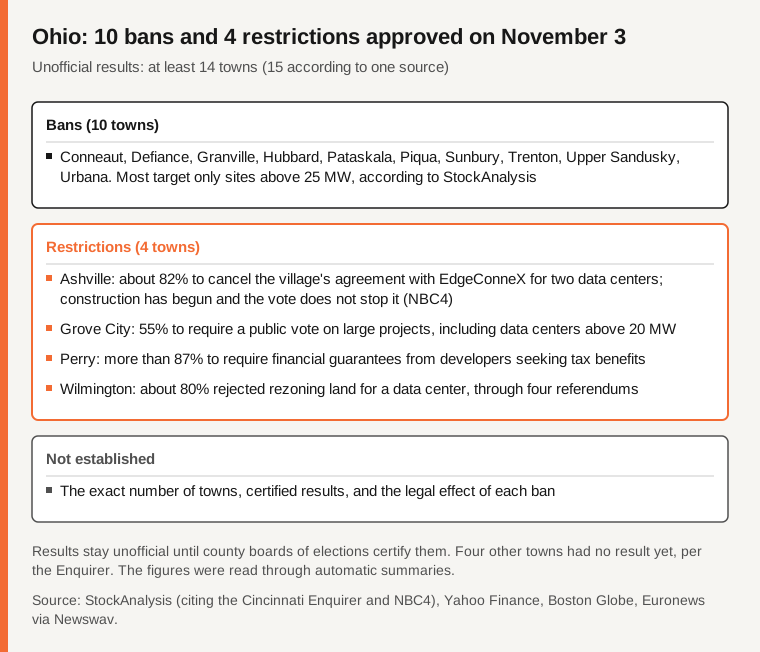
StockAnalysis, relaying the Cincinnati Enquirer, reports at least 14 towns. Euronews (via Newswav) says 15; Yahoo Finance and the Boston Globe say at least 14. The gap is not explained, so the exact number is not established. Four other towns had no result yet, per the Enquirer.
Source: StockAnalysis (citing the Cincinnati Enquirer and NBC4), Yahoo Finance, Boston Globe, Euronews via Newswav.
Ten were bans, most covering only sites above 25 MW, per StockAnalysis. Four were restrictions: Ashville, Grove City, Perry and Wilmington. In Ashville, construction has begun and the vote does not stop it (NBC4).
In Trenton, the ban (about 80%, unofficial, per WVXU) puts in question a 250 MW data center Prologis is building; a planned Amazon campus just outside town is not covered (Enquirer). In Sunbury, the ban targeted a possible large Amazon project whose future is uncertain (NBC4). We do not say any project is canceled. Nationally, StockAnalysis, citing Stateline (not read by us), says 33 local measures limiting data centers had passed or were leading; one result, in North Dakota, favored the industry. Trackers differ: one cited by Yahoo Finance lists 28 measures in 13 states.
What happened at the state level?
These are campaign positions, not laws; the incoming governors have not acted yet.
- Texas: Democrat Gina Hinojosa beat Republican Gov. Greg Abbott (CNBC, Yahoo Finance). She promised a temporary moratorium until legal safeguards exist, and an end to the industry's tax exemptions. Abbott had himself announced a permit pause for an audit, which she called an election-year pause. Democrats are on track to control the state House; the Senate is likely to stay Republican, with counting under way (Yahoo Finance).
- Georgia: Democrat Keisha Lance Bottoms won the governorship. She backed a temporary pause and making large customers cover their infrastructure costs (MagnifyPost, relaying AFP; one main source).
- Ohio: Democrat Amy Acton won the governorship, pledging a stricter regulatory framework (MagnifyPost). Democrat Sherrod Brown beat Republican Jon Husted for the Senate and called for ending tax breaks (StockAnalysis).
- Pennsylvania: Josh Shapiro was re-elected. Democrats won all four races against Republican state senators he had targeted over data centers, flipping that chamber (Boston Globe only). No Shapiro position on a moratorium is reported in the pages we read.
What does "50%" mean?
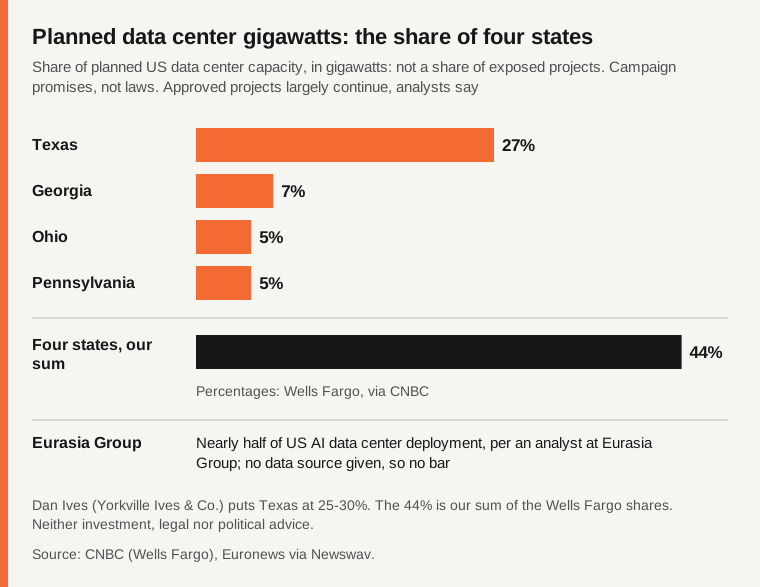
CNBC cites Wells Fargo for each state's share of planned US data center gigawatts: Texas 27%, Georgia 7%, Ohio 5%, Pennsylvania 5%. That sums to 44% (our calculation). Dan Ives of Yorkville Ives & Co. puts Texas at 25-30%. Euronews (via Newswav) reports Heather West of Eurasia Group saying these states host nearly half of US AI data center deployment, with no data source. So "50%" rounds "nearly half", while Wells Fargo's estimate is 44%. Both are shares of planned capacity, not of projects facing more control.
Source: CNBC (Wells Fargo), Euronews via Newswav.
What these votes change, and what they do not
Per West, projects already approved or well under construction largely go ahead; the effect falls mostly on future projects, through slower approvals, local procedures and pressure to pay for electricity. A governor's powers are limited, per West; a Democratic Texas House would give more room (Yahoo Finance). CNBC reports mixed market moves on November 4, some AI stocks down and others up; we draw no conclusion. For the revenue AI would need to fund these buildings, see our article on a Brookings paper.
What is not established?
The official number of Ohio towns; certified results; each ban's legal effect; the real share of capacity or projects affected; whether governors will adopt a moratorium or rules, and when; final control of the Texas legislature; Shapiro's position; and the link between data centers and the vote, since West says they were not the main reason (Euronews, via Newswav).
Comparison table
| Point | What the sources say | Status |
|---|---|---|
| Ohio towns | At least 14 approved bans or limits; 15 per one source | Reported, unofficial |
| Texas, Georgia, Ohio | Moratorium or pause promised or backed; stricter framework in Ohio | Promise |
| Pennsylvania | Four state Senate races won, chamber flipped | Reported (one source) |
| Share of capacity | 44% (our sum, Wells Fargo); nearly half (Eurasia Group) | Estimate |
| Approved projects | Largely continue, per analysts | Not established |
Frequently asked questions
How many Ohio towns voted for limits?
At least 14, per StockAnalysis; Euronews says 15. Results are unofficial and the exact count is not established.
Are projects under way stopped?
Not in general, per analysts; in Ashville, construction continues. Legal effects are not established.
Where does the 50% figure come from?
From "nearly half" (Eurasia Group, no data source) and Wells Fargo's 44% of planned gigawatts (our sum). Neither measures exposed projects.
Method and limits
Axios and Stateline returned errors and were not read; Stateline appears only through StockAnalysis. We read six pages as automatic summaries, several of them relays (AFP, Euronews). Counting continues, counts diverge, and capacity shares come from one analyst. We tested nothing. This is neither investment, legal nor political advice.
Sources
- StockAnalysis, relaying the Cincinnati Enquirer, NBC4, WVXU, Fortune and Stateline, read via an automatic summary
- CNBC, read via an automatic summary
- Yahoo Finance, read via an automatic summary
- MagnifyPost, relaying AFP, read via an automatic summary
- Newswav, relaying Euronews, read via an automatic summary
- Boston Globe, read via an automatic summary
Spotted an error in this article? Report it · Our corrections policy