Analysis
Crypto and AI super PACs spent about $250 million and their side lost 9 of 12 competitive races called so far, while Musk's record midterm spending mostly backed losing candidates, early counts say
Crypto and AI super PACs spent about $250 million; their side lost 9 of 12 called competitive races. Musk's total is $445 to $474 million. Provisional.
After the November 3, 2026 US elections, early counts say crypto and AI super PACs spent about $250 million in the midterms, and the side they backed lost 9 of the 12 competitive races called so far. Elon Musk's spending is put between $445 million and $474 million depending on the source, and most Republican candidates he backed in called races lost. Results are provisional and uncertified; races were still uncalled on November 4, and Al Jazeera reports Democrats took the House and the Senate. This is neither investment, legal nor political advice.
The essentials
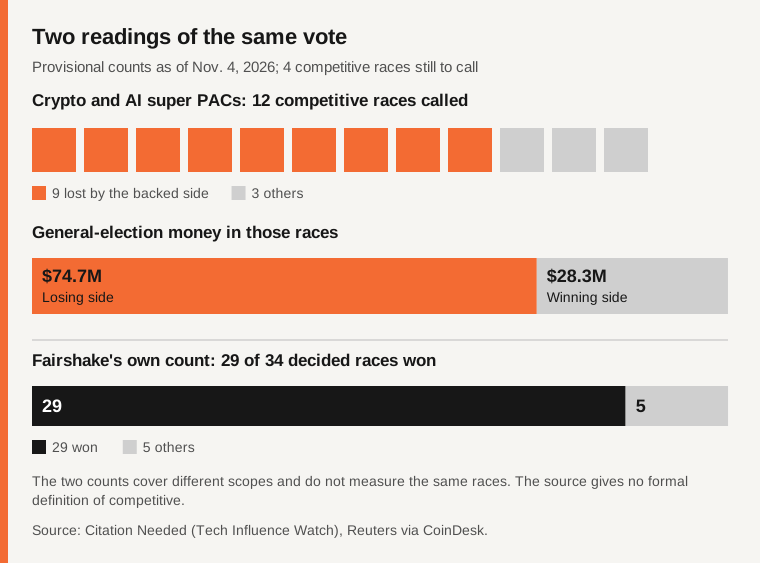
- Crypto and AI: Molly White (Citation Needed, using Tech Influence Watch, November 4) counts about $250 million, primaries included. The backed side lost 9 of 12 competitive races called; 4 were still to call.
- Fairshake: the crypto super PAC says it won 29 of 34 races decided (Reuters, via crypto outlets). The scopes differ.
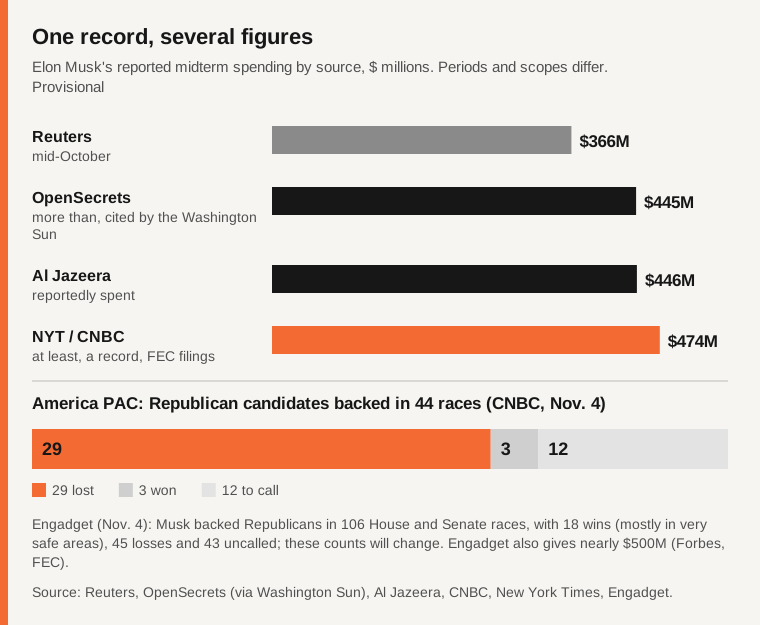
- Musk: totals run from $366 million (Reuters, mid-October) to $474 million (CNBC), a record. America PAC: 29 losses, 3 wins, 12 to call (CNBC).
- Not established: whether the money caused any result, the final figures, what competitive means.
What do the crypto and AI counts say?
White counts $74.7 million on the losing side and $28.3 million on the winning side in the competitive races called (general-election money only). Gizmodo says nearly $250 million overall, federal primaries included. Four races were uncalled: Michigan's 4th, California's 34th, Montana's 1st and Arizona's 1st. No formal definition of competitive is given. In 40 safe races called, backed candidates won all 40; she argues these should not offset the lost competitive bets.
In Ohio's Senate race, Sherrod Brown (D) beat Jon Husted (R) despite more than $64 million of crypto money against him, a record for one election; CoinDesk puts Fairshake alone at $56 million. In South Carolina, Annie Andrews (D) beat Darline Graham, backed by about $4.1 million of AI money. Backed candidates also lost in Wisconsin's 1st (Bryan Steil), Michigan's Senate race (Mike Rogers), Texas (Paxton), Maine (Collins) and others; Pete Ricketts kept his Nebraska seat against Dan Osborn. Colorado's 8th is ambiguous: the winner is from the AI safety faction, and other AI PACs may not share the result.
Source: Citation Needed (Tech Influence Watch), Reuters via CoinDesk.
What does Fairshake say?
It presents the vote differently: 29 races won of 34 decided on November 4 (Reuters, relayed by crypto outlets). Spokesman Geoff Vetter said it played a significant role in competitive wins. It spent about $154 million on ads this year and has $56 million left for the next cycle (spokesperson to CoinDesk). CoinDesk lists its defeats: Brown, the Stratton primary ($10 million against Juliana Stratton, who then won the election), Steil, and Bill Huizenga (lost to Sean McCann). Ripple's Stuart Alderoty says the facts are far more nuanced than the headlines; Mark Hays (Americans for Financial Reform) calls it a resounding defeat of the industry's political strategy.
Leading the Future (AI, tied to OpenAI and Andreessen Horowitz) had about $100 million of funding, a little over $20 million left; dozens of bipartisan backed candidates won (WIRED, via KuCoin). No precise spending or loss figure is given.
What do the Musk counts show?
Totals diverge: $446 million, reportedly, for Republican candidates, the top donor (Al Jazeera); over $445 million (OpenSecrets, cited by the Washington Sun); at least $474 million, a record (CNBC, from FEC filings; also the New York Times); nearly $500 million (Engadget); about $366 million in mid-October (Reuters). Of this, $158 million went to the Senate Leadership Fund in September, used for Ken Paxton, and about $20 million to the Congressional Leadership Fund. America PAC spent nearly $87 million across 44 federal races (CNBC).
CNBC (November 4, 10:29 a.m. ET) counts 29 losses, 3 wins and 12 races to call for America PAC's Republican candidates; over $80 million (93%) of its spending went to races Republicans lost. Engadget (November 4, tally's author not named) says Musk backed Republicans in 106 House and Senate races: 18 wins (mostly in very safe areas), 45 losses, 43 uncalled; these will change. So almost all lost holds only for America PAC's called races (29 of 32); on 106 races, 45 of 63 called (about 71%) were lost.
In Texas, James Talarico (D) beat Paxton, and Gina Hinojosa (D) beat Greg Abbott despite a $5 million gift from Musk. In Ohio's governor race, Vivek Ramaswamy lost (Semafor). Al Jazeera says voters rejected Paxton's plan to make Texas an AI hub by building data centers fast; see our November 5 article on data centers. Musk wrote on X, "Guess my election-interfering space lasers didn't work this time". Semafor reports Tesla and SpaceX shares fell about 5% before Wednesday's open (reported, not advice).
Source: Reuters, OpenSecrets (via Washington Sun), Al Jazeera, CNBC, New York Times, Engadget.
Why do the figures differ?
A short version says crypto and AI spent $250 million and lost 9 of 12 close races, and that Musk spent about $446 million, a record, with nearly all his candidates losing. The sources add nuances. $250 million includes primaries, while 9 of 12 covers called competitive races and general-election money. $446 million is one count among $445 to $474 million and nearly $500 million. Almost all lost is true for America PAC's called races, not for the 106. Correlation is not cause.
Periods, scopes and methods differ, for example donations to super PACs versus spending by his own committees. Gizmodo (Tech Influence Watch) gives $112 million spent by crypto and AI super PACs in the general election; AI-focused super PACs spent $72.3 million (Transformer) or about $79 million (Tech Influence Watch). FourWeekMBA gives $61.7 million on the losing side, 92% for Ohio: another scope.
What is not established?
Whether spending caused outcomes: backed candidates were often Republicans in a cycle that favored Democrats, and the money may or may not have narrowed the gap. Also the final figures, the definition of competitive, the exact scope of the $250 million and the effect on regulation.
Comparison table
| Point | What the sources say | Status |
|---|---|---|
| Crypto and AI spending | About $250 million, primaries included (Citation Needed, Gizmodo) | Estimate |
| Competitive races | 9 lost of 12 called, 4 to call | Reported, provisional |
| Fairshake | 29 won of 34 decided (Reuters via crypto outlets) | Reported |
| Musk spending | $366 to $474 million; nearly $500 million (Engadget) | Estimate, counts differ |
| America PAC races | 29 losses, 3 wins, 12 to call (CNBC) | Reported, provisional |
| 106 races | 18 wins, 45 losses, 43 uncalled (Engadget) | Reported, provisional |
| Cause of results | Money as the cause | Not established |
Frequently asked questions
Did crypto and AI super PACs really lose 9 races out of 12?
According to Citation Needed, yes for competitive races called, with 4 to call and no formal definition. Fairshake counts 29 wins of 34 decided.
How much did Musk spend?
From $445 million to $474 million in most counts; Reuters had about $366 million in mid-October. CNBC calls $474 million a record.
Did the money cause the defeats?
Not established. Backed candidates were often Republicans in a cycle favorable to Democrats.
Method and limits
Sources as of November 5, 2026. Figures are provisional and uncertified, taken from the outlets listed and attributed to each. We tested nothing and give no advice.
Sources
- Citation Needed
- Gizmodo
- CoinDesk
- CNBC
- Engadget
- Al Jazeera
- Semafor
- Washington Sun
- KuCoin, relaying WIRED on Leading the Future
- FourWeekMBA
Spotted an error in this article? Report it · Our corrections policy
