Analysis
At least 38 US jurisdictions banned or restricted data centers in early tallies, and an exit poll finds 56% rate AI and data centers a crucial or major factor, though counts differ
Early tallies show at least 38 US areas banned or limited data centers, but counts differ. An exit poll finds 56% rate AI and data centers a major factor.
After the November 3, 2026 votes, early tallies point to at least 38 US jurisdictions or measures banning or restricting data centers, but sources count different things. An exit poll finds 56% of voters rate AI and data centers a crucial or major factor in their congressional vote. Results are provisional and unofficial. This is neither investment, legal nor political advice.
The essentials
- The count: CBS News (Redbud Consulting) reports 38 approved measures; 404 Media, 38 ballots of more than 40 in 13 states. The Washington Post is said to count at least 38 jurisdictions.
- Other counts: 41 measures in 10 states (Scientific American, citing Ballotpedia); more than 30 localities in 9 states (Semafor). No certified official figure exists.
- The poll: 56% is crucial (23%) plus major (33%), self-reported, for the vote for Congress.
- Not established: the unit of "38", each measure's legal effect, and whether data centers decided any result.
What do the counts say?
CBS says Redbud Consulting counted 38 approved measures restricting data centers by Wednesday afternoon, in California, Illinois, Maine, Ohio, New York and elsewhere, without detail. 404 Media, a clearly hostile voice on data centers, counts a result against them in 38 of more than 40 ballots, with the count continuing; it does not say whether all are measures. It adds that six cities voted bans and twelve capped megawatts, overlaps unspecified.
Scientific American lists moratoria, rezonings and advisory votes. Emporia, Kansas, voted to ban construction. Wells, Maine, approved a retroactive 180-day moratorium with more than 80%. Harwood, North Dakota, rejected an extra review for industrial projects, about 3 to 1: the only industry-friendly result in its table. Semafor reports Edgewater, Florida, voting heavily for a charter ban, and Perry, Ohio, imposing financial conditions on large operators seeking tax benefits. Time adds Bloomington, Illinois, and two mayors recalled for backing projects, in Piqua, Ohio, and Yukon, Oklahoma (Time only). For Ohio, see our November 4 article.
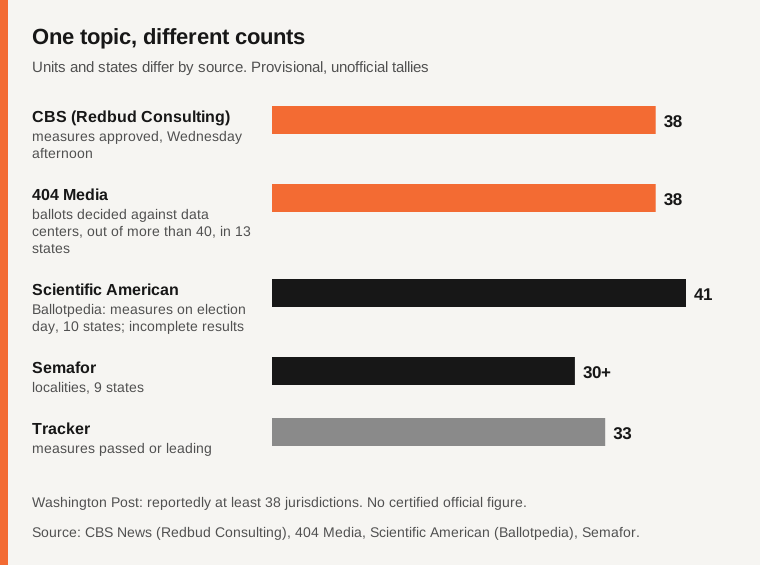
Source: CBS News (Redbud Consulting), 404 Media, Scientific American (Ballotpedia), Semafor.
What does the exit poll measure?
SSRS ran the poll for NBC, ABC, AP, CBS, CNN, Fox and MS NOW: more than 75,000 voters nationally, plus polls in 45 states. Unite.AI relays NBC's numbers as of 12:30 a.m. ET, reweighted as interviews arrive; no margin of error is given. For the vote for Congress, 23% called AI and data centers crucial, 33% major, 31% minor and 13% not a factor. The exact wording is not given.
Also reported: 76% oppose a nearby data center; 86% are concerned about energy bills; 57% say AI does more harm than good. Among voters who called it crucial or major, 64% voted Democratic and 34% Republican; among the others, 57% Republican and 41% Democratic. These are associations, not causes. Time stresses that 56% is a self-reported feeling, not isolated as the cause of any result.
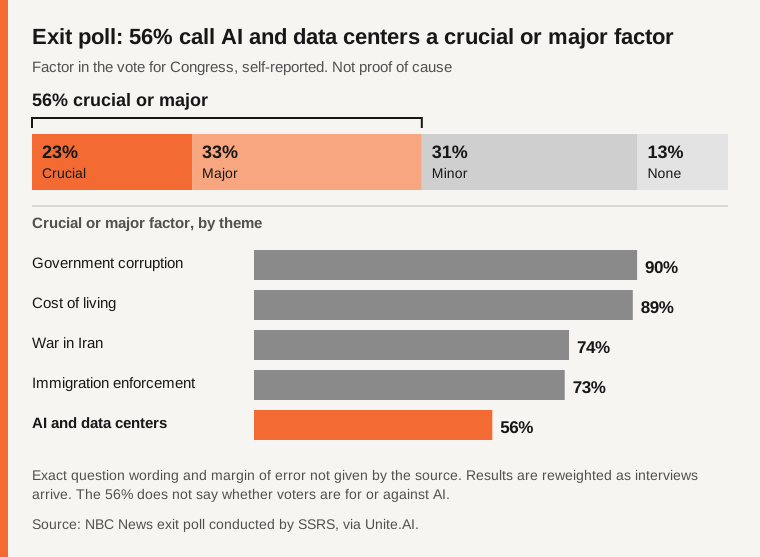
Source: NBC News exit poll conducted by SSRS, via Unite.AI.
Why do the numbers differ?
Units (jurisdictions, measures, ballots, localities), state counts (9, 10, 13), timing and method differ: a Ballotpedia table, Redbud Consulting, a tracker. Scientific American's results were incomplete; a tracker says 33. So "38" is a plausible order of magnitude, not a settled figure.
What changes, and what does not
CBS reports analysts at Franklin Templeton, Yorkville and GLJ Research expecting slower construction. GLJ estimates Hinojosa's win could block 13 GW in Texas: one analyst's estimate, not a fact. Oxford Economics says moratoria delay more than they stop. Data center-linked stocks fell Wednesday, per Vital Knowledge, with no figure. Not investment advice.
What is not established?
The official count and its unit; each measure's legal effect; the poll's wording and margin of error; any causal role of data centers in the vote; the real effect on construction.
Comparison table
| Point | What the sources say | Status |
|---|---|---|
| Count | 38 (CBS, 404 Media); 41 (Scientific American); more than 30 (Semafor) | Reported, provisional |
| Poll | 56% crucial or major for Congress | Reported, self-declared |
| Rank | Behind corruption (90%), cost of living (89%), Iran war (74%), immigration (73%) | Reported |
| Blocked capacity | 13 GW in Texas (GLJ Research) | Estimate |
| Cause of any result | Data centers as decisive | Not established |
Frequently asked questions
How many jurisdictions voted for limits?
At least 38 in early tallies, but sources count different units. No certified figure exists.
What does 56% mean?
Voters who called AI and data centers crucial (23%) or major (33%) for Congress. It is self-declared and does not say they oppose AI.
Did data centers decide the election for one side?
Not established. The poll shows associations only.
Method and limits
The poll comes through Unite.AI, not NBC. We tested nothing.
Sources
Spotted an error in this article? Report it · Our corrections policy