Analysis
Shenzhen's low-altitude economy: drone deliveries are routine, flying taxis are not yet
Drone delivery, flying taxis, robotaxis: what is routine in Shenzhen in 2026 and what is not, and how local rules try to keep up, according to Meituan, CGTN, CNBC and Aviation Week.
As of October 31, 2026, the sources we read show drone delivery as an operating service, run by Meituan. Flying taxis are not there: EHang's passenger operations face slower approvals. Robotaxis sit in between, with a paid permit limited to zones. This is a desk review, not field reporting: we were not in Shenzhen.
The essentials
- Routine: drone delivery. Meituan says its infrastructure is no longer in the testing stage, with 70 routes and more than 780,000 cumulative orders at the end of 2025.
- Not yet: flying taxis (eVTOL), where approvals are slowing in 2026 according to Aviation Week, and robotaxis, whose paid driverless permit covered only parts of one district in 2025.
- Framework: a local regulation in force since February 1, 2024, an airspace coordination mechanism and a one-stop flight service platform.
- Unresolved: noise, airspace and privacy remain, in CGTN's words, largely unresolved.
What is really routine in Shenzhen?
On May 21, 2026, Meituan said its drone delivery infrastructure is "no longer in the testing stage" and in commercial operation, and that it is recruiting low-altitude logistics providers nationwide, with 10 signed so far (Yicai, May 22, 2026). The first real drone order dates from early 2021, in Shenzhen.
By the end of 2025, Meituan reports 70 routes across Shenzhen, Beijing, Shanghai, Guangzhou, Hong Kong and Dubai, and more than 780,000 cumulative orders. Orders per site rose from about 10 a day to as many as 400. Yicai adds that the operating cost per order reportedly falls by around 40 to 50% a year. The main use cited is delivering medical samples, with routes opened in Shanghai and Sichuan where ground transport is harder. These are Meituan's figures, not an independent measurement.
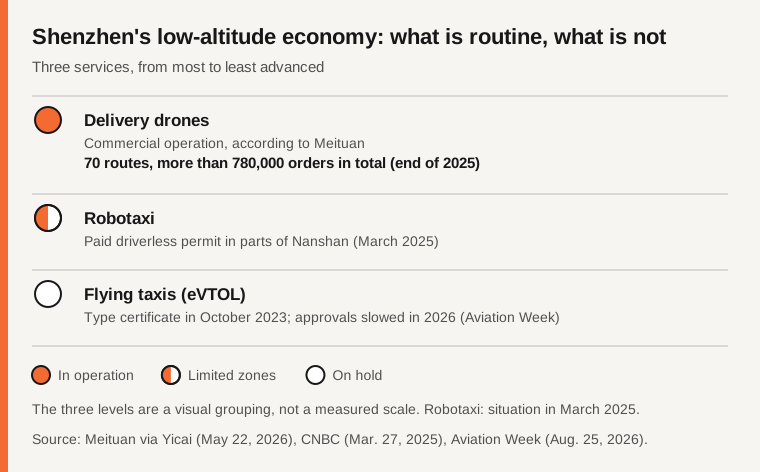
Source: Meituan via Yicai (May 22, 2026), CNBC (March 27, 2025), Aviation Week (August 25, 2026).
How are the rules keeping up?
Shenzhen published its low-altitude economy regulation on January 4, 2024, in force from February 1, 2024: 61 provisions covering infrastructure, flight services, industrial applications, innovation and safety. CGTN calls it the first local legislation specifically targeting the low-altitude economy. It provides for an airspace coordination mechanism with the air traffic and civil aviation bodies, a one-stop flight service platform, and low-altitude shuttles to airports, stations, ports and business districts. Yicai's summary mentions no certification, insurance, privacy or liability rules, and we do not fill that gap (Yicai).
A separate policy, dated late December, offers up to 20 million yuan a year to companies opening new low-altitude logistics routes. On infrastructure, CGTN reports 1,284 take-off and landing sites in March 2026, 84 above the 2026 target of 1,200, and 80,000 5G base stations, over 23,000 of them 5G-Advanced, with continuous coverage below 120 meters. The 1,200 target dates from November 2024 (Urban Air Mobility News, citing the SCMP). A revision of the civil aviation law took effect on July 1, 2026; it addresses the low-altitude economy and tightens compliance for uncrewed civil aircraft (Eye Shenzhen, details not read).
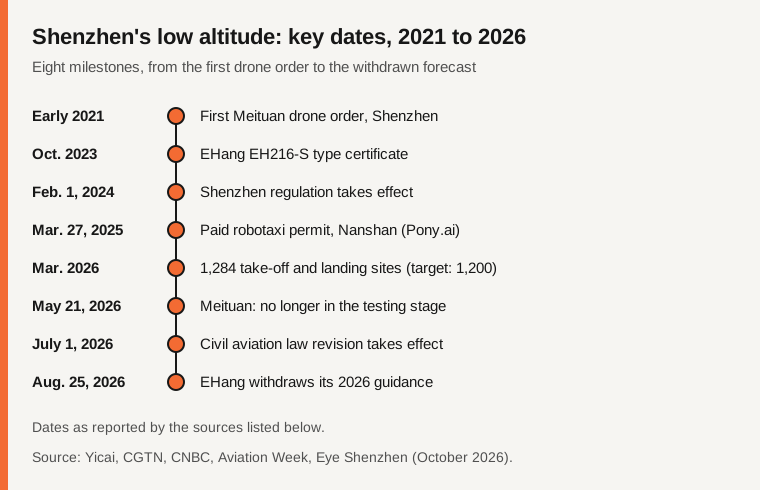
Source: Yicai, CGTN, CNBC, Aviation Week, Eye Shenzhen (October 2026).
What about flying taxis?
EHang's EH216-S received a type certificate in October 2023. Almost three years later, Aviation Week's headline of August 25, 2026 reads "EHang Withdraws 2026 Guidance As China Slows Flight Approvals". The standfirst says EHang faces "fresh uncertainty" over deploying commercial passenger operations in China, in a "more cautious" regulatory environment. The rest of the article is paywalled; we read only that summary and add nothing to it.
According to CGTN, no company has shown a clear path to commercial profitability for passenger-carrying drones. Several Chinese firms showed crewed eVTOL prototypes at a Shenzhen congress in May 2026.
For robotaxis, Pony.ai won on March 27, 2025 the first permit to charge for fully driverless rides in key parts of Shenzhen's Nanshan district, not the whole district (CNBC). Rides run from the airport and Shenzhen Bay port to Nanshan, daily from 7:30 a.m. to 10 p.m. We say nothing about its 2026 status.
Which questions remain open?
CGTN says noise, airspace and privacy remain largely unresolved. Analyst Zhang Yi of iiMedia Research, quoted by Yicai, says urban airspace approval, flight safety, noise and falling-object risks need clearer rules. CGTN also judges Shenzhen's dependence on DJI "a vulnerability", while crediting the city with about 1,900 low-altitude companies, 70% of the global consumer drone market and 50% of the industrial one.
Comparison table
| Segment | Situation in October 2026 | Source |
|---|---|---|
| Drone delivery | Commercial operation per Meituan; 70 routes, over 780,000 cumulative orders (end 2025) | Yicai |
| Flying taxi (eVTOL) | EH216-S certified October 2023; approvals slowing, EHang withdraws 2026 guidance | Aviation Week |
| Robotaxi | Paid driverless permit in parts of Nanshan (March 2025) | CNBC |
| Infrastructure | 1,284 take-off and landing sites (March 2026), target 1,200 | CGTN |
| Legal framework | Regulation in force since February 1, 2024; 61 provisions | Yicai, CGTN |
Frequently asked questions
Are flying taxis operating in Shenzhen?
The sources we read establish no regular passenger service in Shenzhen. EHang faces uncertainty and slower approvals, according to Aviation Week.
Do drones really deliver meals?
Meituan says it operates 70 routes with more than 780,000 cumulative orders at the end of 2025. The main use it cites is medical samples.
Who oversees the airspace?
The 2024 regulation provides a municipal coordination mechanism with the air traffic and civil aviation authorities, and a one-stop flight service platform. We go no further than that.
Method and limits
This article relies on CGTN, Yicai, Shenzhen Government Online, CNBC, Urban Air Mobility News and Eye Shenzhen, read on October 31, 2026. Most CGTN figures are unattributed in the original; we cite them as CGTN's, not as independent measurements. The Aviation Week article is paywalled: only the standfirst was read. The "autonomous factories" in the original request are not covered: we found no solid Shenzhen source. This is not investment advice.
Sources
- CGTN: Shenzhen's low-altitude economy soars, May 22, 2026 (verified 2026-10-31)
- Yicai: Meituan puts drone delivery infrastructure into commercial use, May 22, 2026 (verified 2026-10-31)
- Yicai: Shenzhen approves China's first low-altitude economy regulation, January 5, 2024 (verified 2026-10-31)
- Shenzhen Government Online: low-altitude economy measures (verified 2026-10-31)
- Aviation Week: EHang withdraws 2026 guidance as China slows flight approvals, August 25, 2026 (standfirst only) (verified 2026-10-31)
- CNBC via NBC Los Angeles: Pony.ai wins first permit for fully driverless taxi operation, March 27, 2025 (verified 2026-10-31)
- Urban Air Mobility News: Shenzhen announces plans for over 1,200 drone and eVTOL platforms, November 6, 2024 (verified 2026-10-31)
- Eye Shenzhen / ChinaEU, January 25, 2026 (verified 2026-10-31)
Spotted an error in this article? Report it · Our corrections policy
