Analysis
Xpeng's GroundingPI, a roughly 4B-parameter perception model, scores 73.68 against 71.54 for GPT-6 Astra on 34 benchmarks, as reported by Xpeng, with the gap and the limits explained
Xpeng's authors report 73.68 for GroundingPI against 71.54 for GPT-6 Astra on 34 perception benchmarks. GPT-6 Astra stays ahead on others. Perception only.
On November 4, 2026, Xpeng unveiled GroundingPI, an "embodied" perception foundation model of about 4 billion parameters, developed with university teams including Peking University and the University of Hong Kong (CnEVPost). Its authors report an average of 73.68 across 34 benchmarks, against 71.54 for OpenAI's GPT-6 Astra. The measurements are theirs, not independently reproduced, and cover perception only. We read four pages through automatic summaries and ran nothing. This is neither investment nor technical advice.
The essentials
- The figure: per the authors, 73.68 against 71.54 on average over 34 public grounding benchmarks, a 2.14-point gap. GPT-6 Astra stays ahead on others.
- The scope: perception only, not reasoning or general intelligence; a specialized model against a generalist one.
- Status: code and weights published, license not stated. Robotics and driving results come from simulation or recorded data.
- Not established: exact parameter count, independent reproduction, Xpeng product integration.
What is GroundingPI?
"Grounding" means locating in an image what a sentence describes, by outputting points or boxes. GroundingPI writes them as quantized coordinates in a shared vocabulary (arXiv, project page). "PI" stands for Physical Intelligence (CnEVPost, xpeng.guru).
Per the arXiv paper, it pairs a MoonViT-V2 vision encoder (from Kimi K3), a projector and a Qwen3-4B language decoder. "4B" is a label: the exact count is not in the part of the paper we read, and a research summary cites a higher figure with the vision encoder, which we could not verify. Training used no robot data with action labels, only perception data across 11 categories, such as general detection and text recognition (CnEVPost, xpeng.guru).
What do 73.68 and 71.54 mean?
It is an average over 34 public grounding benchmarks covering 11 perception capabilities, with GPT-6 Astra among 44 reference models (arXiv, project page, CnEVPost). The 2.14-point gap is our calculation. CnEVPost and xpeng.guru describe a weighting by category; the part of the paper we read does not describe the aggregation.
The authors ran the evaluation; no independent evaluator is named (CnEVPost). GPT-6 Astra, an OpenAI model from September 2026 per CnEVPost (OpenAI says GPT-Rosalind-6, covered in our article, runs on its weights), was run with thinking effort set to "high". No other setting or prompt is given in the part we read, some reference numbers come from external publications, and the paper flags prompt and analysis uncertainties (arXiv).
Where GPT-6 Astra stays ahead
The paper says GPT-6 Astra keeps a substantial advantage in robot, spatial and interface (GUI) grounding, and leads on TotalText and Dense200 pointing. It calls the model "competitive" with GPT-6 Astra while surpassing models of comparable size (arXiv).
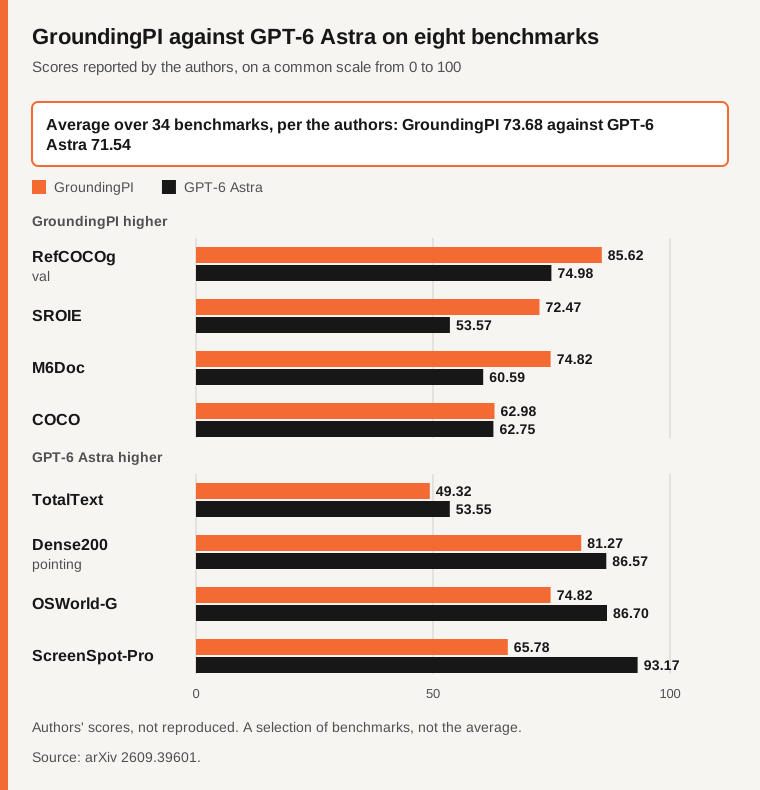
Source: arXiv 2609.39601.
So "ahead on the average of these 34 benchmarks, according to the authors" is accurate. "Better than GPT-6 Astra" is not.
Robotics and driving: simulation and open loop
According to the authors (project page, arXiv):
- RoboCasa-GR1: with 50% of the demonstrations (28.75%), the system exceeds baselines trained on 75%; in distribution, it is slightly behind RynnBrain-2B (37.75 against 39.00).
- RoboTwin 2.0: it beats the evaluated vision architectures in the four out-of-distribution scenarios, by up to 24.8% relative to the best; 66.20 in distribution against 60.62.
- nuScenes: open-loop L2 error of 0.296 m, against 0.301 m for Qwen3-VL-4B and 0.308 m for RynnBrain. Closed-loop performance is not established.
No deployment on real robots is reported (CnEVPost: simulation results).
What is not established?
The exact parameter count; the aggregation method; independent reproduction, notably of the GPT-6 Astra score; the license; closed-loop and real-robot performance; integration into Xpeng products; the full list of benchmarks; the effect of size and specialization.
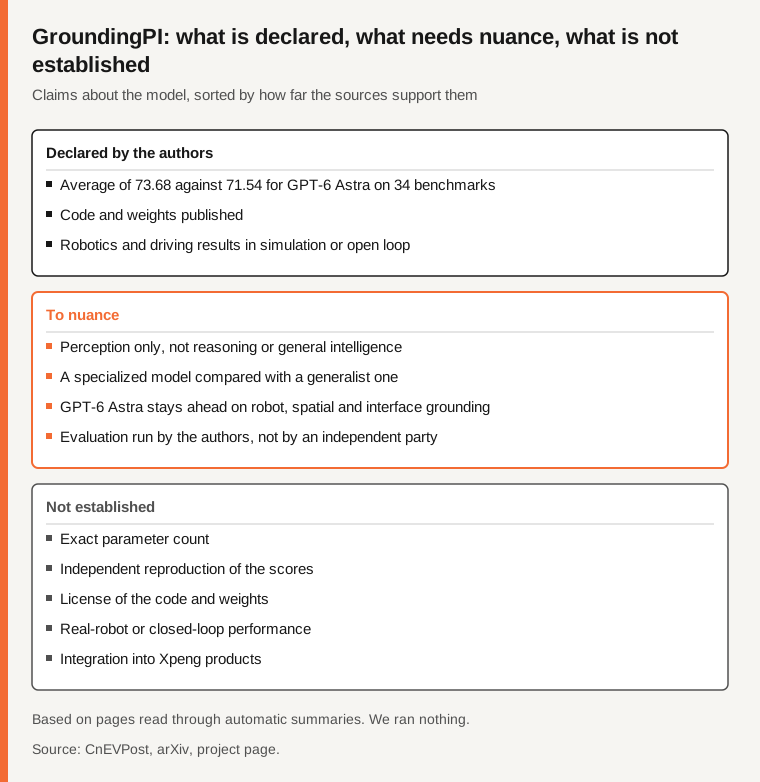
Source: CnEVPost, arXiv, project page.
Comparison table
| Point | What the sources say | Status |
|---|---|---|
| Average | 73.68 against 71.54 for GPT-6 Astra | Declared by the authors |
| Where Astra leads | Robot, spatial, GUI grounding; TotalText; Dense200 pointing | Declared by the authors |
| Release | Code and weights published; license not stated | Reported |
| Parameters and reproduction | "4B" label; no independent check named | Not established |
Frequently asked questions
Is GroundingPI better than GPT-6 Astra?
Not in general. On the average of these 34 benchmarks, according to the authors, GroundingPI is ahead, but GPT-6 Astra stays ahead on others, such as ScreenSpot-Pro. Xpeng says the score measures perception only, and presents GroundingPI as a base for the "fast system" of embodied AI, not a replacement for large general models (CnEVPost, xpeng.guru).
Is the model open source?
Code and weights are published on GitHub, Hugging Face and ModelScope (CnEVPost, xpeng.guru). No license is stated in the pages we read; the arXiv page's CC BY 4.0 says nothing about code or weights.
Will it be in Xpeng cars?
No page we read says so. CnEVPost calls it a scientific prototype; xpeng.guru, an unofficial source, says it is not a product integration announcement.
Method and limits
On November 4, 2026, we read through automatic summaries CnEVPost, the arXiv paper (only the first 100,000 of about 242,000 characters), the project page and xpeng.guru, a site of unstated affiliation that cites Xpeng's release. We did not read Xpeng's release, its post on X, AI Weekly, the GitHub repository or the Hugging Face page. Scores are the authors', not reproduced.
Sources
- CnEVPost, Xpeng unveils GroundingPI, automatic summary
- arXiv 2609.39601, automatic summary, first 100,000 characters only
- GroundingPI project page, automatic summary
- xpeng.guru, unofficial site, automatic summary
Spotted an error in this article? Report it · Our corrections policy