Analysis
OpenAI opens GPT-Rosalind-6, its biology model, to approved customers only
OpenAI's GPT-Rosalind-6 runs on the same weights as GPT-6 Astra but refuses less on dual-use biology, and only approved customers can use it. What OpenAI states, what it measures, and what is not established.
As of November 1, 2026, OpenAI has published the system card addendum for GPT-Rosalind-6, a reasoning model for biology, drug discovery and translational medicine, offered as "GPT-Rosalind-6 Research" to approved customers only. According to OpenAI, it uses the same weights as GPT-6 Astra: what changes is the refusal boundary on dual-use biology and the gate to access. We have not tested the model.
The essentials
- What it is: the same weights as GPT-6 Astra, with no training data or post-training added, per OpenAI. It refuses less on dual-use biology.
- Who gets access: approved customers (qualified scientists, institutes, companies, government partners), not the general public.
- What OpenAI measures: internal gains over GPT-Rosalind-5.5 on three life-science benchmarks.
- What stays open: independent tests, an official price, and the number of approved organizations.
What exactly does OpenAI announce?
On October 30, 2026, OpenAI published an addendum to the system card on its Deployment Safety Hub. It describes GPT-Rosalind-6 as a frontier reasoning model for biology, drug discovery and translational medicine.
The central statement is that OpenAI did not add training data or perform additional post-training for this release. In other words, the weights are those of GPT-6 Astra, OpenAI's flagship reasoning model.
The model is not in the ordinary chat tab. i-SCOOP reports an API identifier, gpt-6-rosalind, and access through Codex, the ChatGPT workspace and the API.
Who can access it, and under what conditions?
Access is "trusted access" only. Applicants must show a legitimate life-science mission, a credible use case, research and operational governance, and the ability to control who uses the model. Non-government applicants go through business verification and a compliance check. Governments have a separate track for selected entities in biosecurity, public health preparedness and biodefense.
Approved customers must apply least-privilege access and insider-risk controls, and have qualified humans review outputs before they inform experiments, publications or important decisions. OpenAI can restrict or revoke access. Model access and data retention are approved separately.
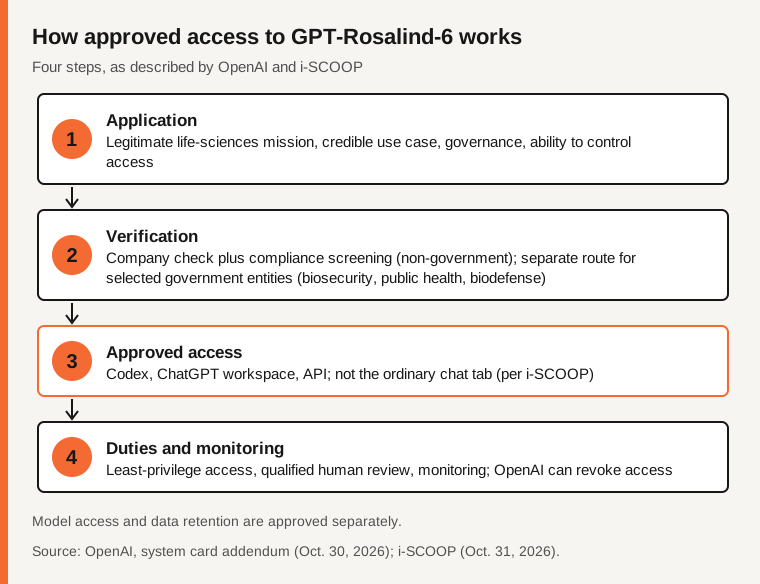
Source: OpenAI, system card addendum (October 30, 2026); i-SCOOP (October 31, 2026).
What do OpenAI's measurements say?
These are OpenAI's internal measurements, at maximum reasoning budget. The GPT-Rosalind-5.5 scores are recomputed on the same benchmark versions, so they differ from its launch figures.
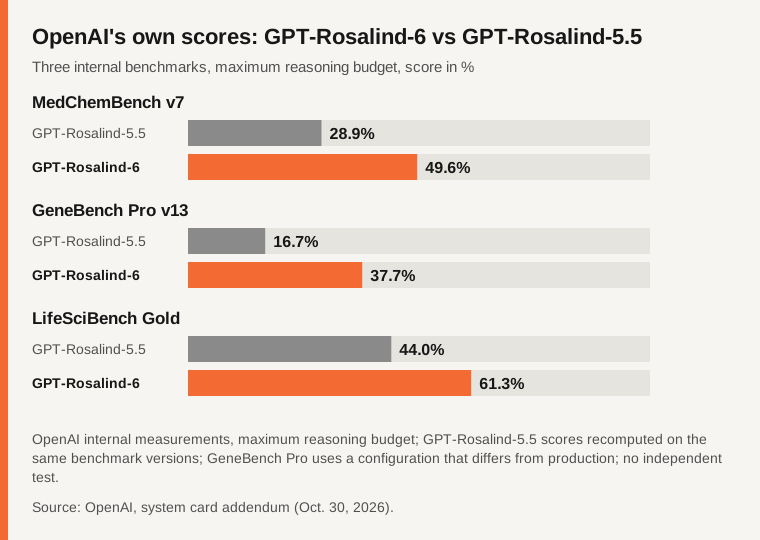
Source: OpenAI, system card addendum (October 30, 2026). Internal measurements; GeneBench Pro uses a benchmark-specific configuration, different from production.
On TroubleshootingBench, OpenAI reports 59.0% (491 of 832) against an indicative "High" threshold of 36.4%. None of its four "Critical" capability tests reaches the indicative threshold. OpenAI notes that these thresholds are preliminary estimates and that its biosecurity scoring is still being updated.
What changes compared with GPT-6 Astra?
Not the weights. OpenAI says the model is built to refuse less than its general ChatGPT models on dual-use biology, while refusing or answering cautiously when a request would meaningfully help build a biological weapon. On its biorisk knowledge test, the refusal rate is 9.4%, against 29.2% for GPT-6 Astra and 1.8% for GPT-Rosalind-5.5.
Under its Preparedness framework, OpenAI rates the model "High" for biological and chemical risk (below "Critical"), "Critical" for cybersecurity (carried over from Astra) and below "High" for AI self-improvement. In cyber jailbreak tests with real-time blocking disabled, the success rate is 14.3% (Astra: 15.7%; lower is better). OpenAI describes its safety comparisons as descriptive.
None of this shows that the model speeds up real drug discovery: these are benchmarks, not laboratory results.
What is not established?
The number of approved organizations is unknown. No independent test of the model has been published that we could find. On price, a third-party analysis (FourWeekMBA, October 31) reads a gpt-6-rosalind line at $15 input and $75 output per million tokens, about 1.5 times GPT-6 Astra ($10 and $50), but i-SCOOP says no official price was published that day. We treat the figure as unconfirmed. Biosecurity red-teaming was run on GPT-Rosalind-5.5; the repeat for Rosalind-6 is under way.
Comparison table
| Point | What sources say as of Nov 1, 2026 | Source |
|---|---|---|
| Nature | Reasoning model for biology, drug discovery, translational medicine | OpenAI |
| Access | Trusted access only; approved customers; not the ordinary chat tab | OpenAI, i-SCOOP |
| Weights | Same as GPT-6 Astra; no added training data or post-training | OpenAI |
| Refusals (biorisk test) | 9.4% (5.5: 1.8%; Astra: 29.2%) | OpenAI |
| Internal measurements | MedChemBench 49.6%, GeneBench Pro 37.7%, LifeSciBench Gold 61.3% | OpenAI |
| Price | Unconfirmed: $15 / $75 per million tokens per a third party; no official price | FourWeekMBA, i-SCOOP |
Frequently asked questions
Is GPT-Rosalind-6 available to the general public?
No. Only approved customers can use it, after an application and verification. It is not in the ordinary chat tab.
Is it a new model trained for biology?
According to OpenAI, no new training was done: it did not add training data or perform additional post-training. The weights are those of GPT-6 Astra, and the changes are in refusal behavior and access.
Are the results independently verified?
No. The figures are OpenAI's internal measurements. We found no independent test.
Method and limits
We read OpenAI's system card addendum on November 1, 2026, and three secondary articles (i-SCOOP, FourWeekMBA, AI Weekly). We did not test the model and did not read OpenAI's pricing page. Several addendum tables (ProtocolQA, virology, Rosalind-6's Critical scores) were not read. This is not buying or investment advice.
Sources
- OpenAI: GPT-Rosalind-6 system card addendum (verified 2026-11-01)
- i-SCOOP: GPT-6 Rosalind and trusted access (verified 2026-11-01)
- FourWeekMBA: OpenAI prices Rosalind-6 at 1.5x Astra on the same weights, third-party analysis (verified 2026-11-01)
- AI Weekly: OpenAI ships GPT-Rosalind-6 to trusted users (verified 2026-11-01)
Spotted an error in this article? Report it · Our corrections policy
