Analysis
China's AI compute may double in 2027, with about 65% on US-designed chips
The Institute for Progress estimates China's AI compute could rise from 4.6M to 8.8M H100-equivalents by end 2027, about 65% from US chips. Estimates only.
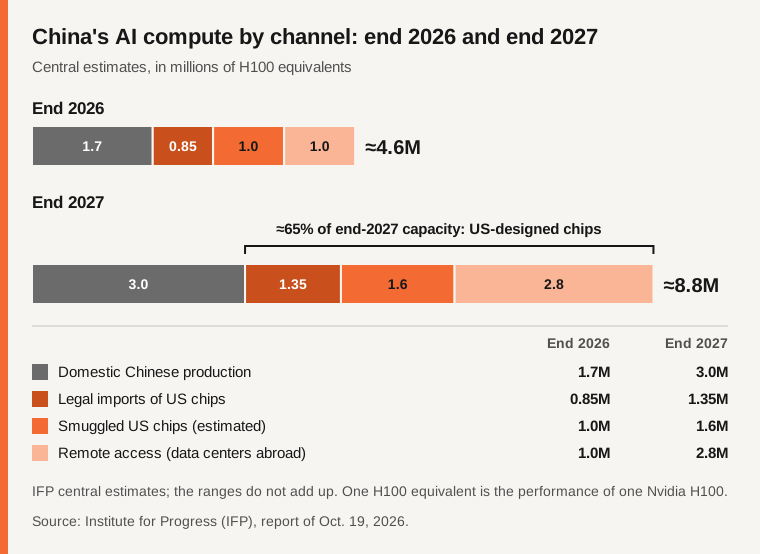
As of November 3, 2026, the Institute for Progress (IFP), a US think tank, estimates China's AI computing capacity could grow from about 4.6 million to about 8.8 million H100-equivalents between end 2026 and end 2027, a factor of about 1.9. It estimates that about 65% of the 2027 capacity would rely on US-designed chips. These are estimates, not measurements.
The essentials
- The estimate: about 4.6 million H100-equivalents at the end of 2026, about 8.8 million at the end of 2027.
- What the 65% covers: legal imports, estimated smuggling and remote access abroad. The rest is Chinese production.
- The uncertainty: the 2027 smuggling range runs from 468,000 to 6.7 million.
- What the IFP proposes: five measures it says could roughly double the US lead. The IFP argues for stricter export controls.
What does the report say exactly?
The IFP published "How to Increase America's AI Lead Over China" on October 19, 2026 (authors Tim Fist, Georgia Adamson and Konstantin Pilz). The South China Morning Post (SCMP) relayed it around October 24; we could not open that article, so we relied on ForkLog and KuCoin News.
The unit is the H100-equivalent: a chip's dense FP8 performance divided by that of an Nvidia H100 (INT8 or FP16 when FP8 is not available).
Source: IFP (October 19, 2026).
What do the 65% of US-designed chips cover?
The share is not "65% of chips sold in China". It is the part of the estimated 2027 capacity that comes from three channels: about 1.35 million from legal imports, about 1.6 million from smuggled US chips and about 2.8 million from remote access to data centers abroad. Adding the central values gives about 5.75 million out of 8.8 million, roughly 65%. The rest, about 3.0 million, is Chinese production.
About 75% of remote-access capacity would be in Southeast Asia. The report also uses "65%" for a different parameter, a Rubin product-mix assumption for leased capacity; it is not the headline figure.
Why are the ranges so wide?
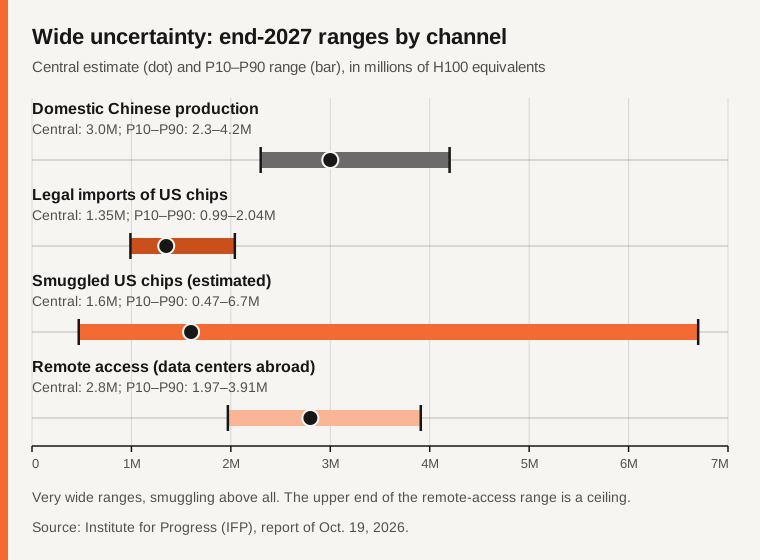
For each channel the IFP gives a central value and a P10 to P90 range, which the report says cannot be added up. For the end of 2027: 2.3 to 4.2 million for domestic production, 986,000 to 2.04 million for legal imports, 468,000 to 6.7 million for smuggling, 1.97 to 3.91 million for remote access.
Source: IFP (October 19, 2026).
Smuggling is the least certain. The authors say the upper bound for remote access equals all available commercial capacity, so the real value is probably nearer the low end. Reported inputs include about 20,000 H200 chips delivered (ByteDance and Tencent about 10,000 each, per press reports) and Epoch AI's estimate of about 663,000 smuggled H100-equivalents at the end of 2025.
What does the IFP conclude about the US lead?
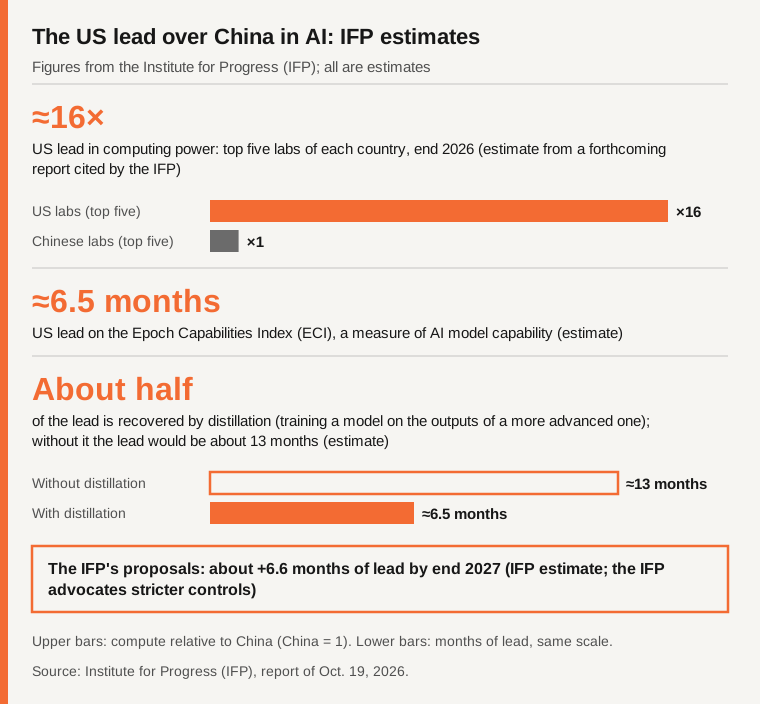
The IFP estimates the US has about 16 times more computing power than China, comparing the top five labs of each country at the end of 2026. That figure comes from a forthcoming report by Konstantin Pilz, which we could not check. On the Epoch Capabilities Index the IFP puts the US lead at about 6.5 months. Distillation (training a model on a more advanced model's outputs) would recover about half; without it the lead would be about 13 months.
Source: IFP (October 19, 2026).
The IFP says five measures under existing US authority could add about 6.6 months of lead by the end of 2027. They are its proposals, not policy, and we take no side:
- antitrust clarification to share information against distillation;
- restricting Chinese access to training clusters abroad;
- tighter checks on chip buyers, server assemblers and distributors;
- tighter controls on legal imports (H200, RTX cards);
- closing gaps on high-bandwidth memory (HBM).
ForkLog adds that Epoch AI puts Huawei's 2026 shipments under 4% of Nvidia's worldwide, limited by HBM. Huawei says its Ascend 960DT arrives in early 2027, a claim we could not verify.
What is not established?
The real values, since everything is estimated; the scale of smuggling; the share of remote access; Huawei's and SMIC's output; the 16 times figure; what the SCMP article says; and the effect of the proposed measures.
Comparison table
| Point | What sources say as of Nov 3, 2026 | Source |
|---|---|---|
| Total capacity | About 4.6M (end 2026) to 8.8M (end 2027) H100-equivalents, central estimates | IFP |
| US-designed chips | About 65% of 2027 capacity: legal imports, smuggling (estimated), remote access | IFP |
| Smuggling, 2027 | 468,000 to 6.7M (P10 to P90) | IFP |
| US lead | About 16x compute, about 6.5 months on the Epoch index; estimates | IFP, ForkLog |
| Proposals | Five measures, about +6.6 months of lead; IFP position | IFP |
Frequently asked questions
Will China's computing power really double?
The IFP's central estimate goes from about 4.6 million to about 8.8 million H100-equivalents, end 2026 to end 2027. It is an estimate, not a measurement.
What does 65% US-designed chips mean?
The estimated share of 2027 capacity from legal imports, smuggled chips and remote access abroad, not only chips sold in China.
Who is the IFP?
The Institute for Progress is a US think tank. It argues for stricter export controls.
Method and limits
We read four sources on November 3, 2026. The IFP report was read through an automated summary, about 100,000 of 181,000 characters on a first pass, the rest on a second. The SCMP article returned an access error (403); ForkLog and KuCoin News are secondary. We ran no tests and give no investment advice.
Sources
- IFP, How to Increase America's AI Lead Over China (October 19, 2026) (verified 2026-11-03)
- South China Morning Post (about October 24, 2026), not opened (403), cited via ForkLog (verified 2026-11-03)
- ForkLog, relay of the SCMP (verified 2026-11-03)
- KuCoin News, secondary source (verified 2026-11-03)
Spotted an error in this article? Report it · Our corrections policy