Analysis
The Information reports that Huawei told clients its Ascend 960DT will run largely on Samsung and SK Hynix memory
The Information reports, citing unnamed sources, that Huawei told clients its Ascend 960DT will run largely on Samsung and SK hynix HBM. Not confirmed.
On November 2, 2026, The Information reported that Huawei has told some clients that a large share of its next flagship AI chip, the Ascend 960DT, will run on high-bandwidth memory (HBM) made by Samsung and SK hynix. It rests on unnamed sources and no company has confirmed it. We did not read The Information (paywalled); we read relays through automatic summaries.
The essentials
- The report: Huawei reportedly told some clients that a large share of the chip's HBM will come from Samsung and SK hynix, with no percentage given.
- The puzzle: US rules bar the sale of advanced HBM to customers in China, so Huawei could not buy directly from the Korean makers.
- The responses: SK hynix says it has supplied nothing to Huawei since 2020. We read no response from Samsung or Huawei.
- Status: unconfirmed, and nothing says by what routes or in what volume any memory would arrive.
See also our articles on China's AI compute, Samsung's record profit and Korea's chip exports and DeepSeek and Huawei's Ascend chips.
What does The Information report?
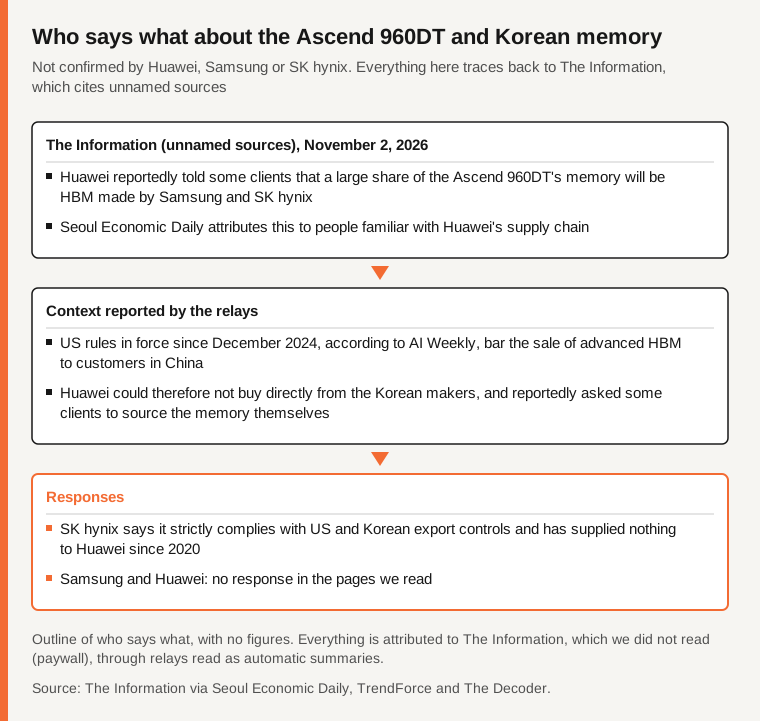
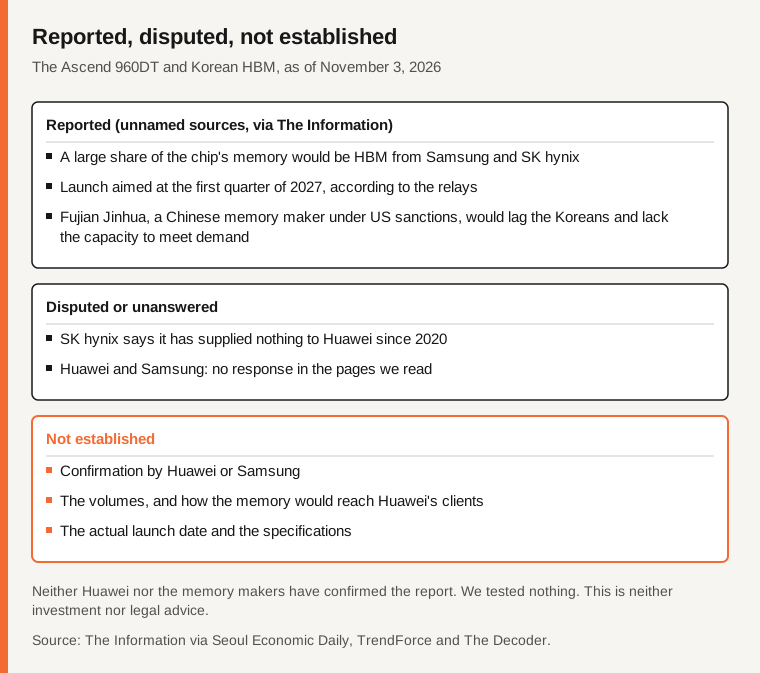
Huawei told some clients that a large share of the Ascend 960DT's memory will be HBM from Samsung and SK hynix, according to The Information. Seoul Economic Daily attributes this to people familiar with Huawei's supply chain. TrendForce and The Decoder put the launch in the first quarter of 2027. All of it is reported, not verified.
Source: The Information via Seoul Economic Daily, TrendForce and The Decoder.
Why Korean HBM?
According to AI Weekly, US rules in force since December 2024 bar the sale of advanced HBM to customers in China. Huawei could therefore not buy directly from Samsung or SK hynix, and reportedly asked some clients to source the memory themselves. According to The Information, some Korean HBM reaches China through smuggling channels, and part of it ends up with Huawei's clients; this is not independently verified. Fujian Jinhua, a Chinese memory maker under US sanctions, would lag the Koreans and lack the capacity to meet demand, per The Information via TrendForce. Samsung and SK hynix control more than 80% of the HBM market, say Seoul Economic Daily and The Decoder.
What do the companies say?
SK hynix says it strictly complies with US and Korean export controls and has supplied no product to Huawei since 2020, according to Seoul Economic Daily. We read no response from Samsung or Huawei. The same outlet says both Korean makers could face scrutiny from US authorities if their memory turned up in Chinese AI chips, which it presents as a possibility.
What is not established?
Source: The Information via Seoul Economic Daily, TrendForce and The Decoder.
Confirmation by Huawei or Samsung, volumes, supply routes, the real launch date and the specifications. Nothing here accuses a named company of anything.
Comparison table
| Point | What the sources say | Source |
|---|---|---|
| The claim | Huawei told some clients a large share of the HBM will be Samsung and SK hynix | The Information (unnamed sources), via relays |
| US rules | Sale of advanced HBM to customers in China barred since December 2024 | AI Weekly |
| Procurement | Huawei reportedly asked some clients to source the memory themselves | TrendForce, Seoul Economic Daily, The Decoder |
| Chinese suppliers | Fujian Jinhua said to lag and lack capacity | The Information, via TrendForce |
| Launch | Expected in the first quarter of 2027 | TrendForce, The Decoder |
| SK hynix | Complies with controls; nothing supplied to Huawei since 2020 | Seoul Economic Daily |
| Samsung, Huawei | No response in the pages we read | n/a |
Frequently asked questions
Do Samsung or SK hynix supply Huawei?
Not confirmed. SK hynix says it has supplied no product to Huawei since 2020, and we read no response from Samsung or Huawei.
When will the Ascend 960DT launch?
The relays say the first quarter of 2027. There is no official date.
Is it confirmed?
No. It is a report based on unnamed sources, relayed by other outlets.
Method and limits
We did not read The Information; we saw its headline via Techmeme. The other four outlets were read through automatic summaries. Everything rests on unnamed sources, and we tested nothing. This is neither investment nor legal advice.
Sources
- The Information, article of November 2, 2026 (paywalled), not read; headline seen via Techmeme
- TrendForce, read via an automatic summary
- Seoul Economic Daily, read via an automatic summary
- The Decoder, read via an automatic summary
- AI Weekly, read via an automatic summary
Spotted an error in this article? Report it · Our corrections policy