Analysis
Mischief 1, the video model derived from living neurons: what is real and what is claimed
A start-up says a software layer inspired by lab-grown neurons makes AI video faster and cheaper. What is public, what is claimed, what cannot be checked.
As of November 1, 2026, Mischief 1 is an image-to-video model from the start-up TBC, built on Alibaba's open Wan 2.2 and launched on October 30, 2026. The neurons stay in the laboratory: the product is a software layer that runs on ordinary AI hardware. The speed and cost gains are TBC's own claims, with no independent test published. We did not test the model.
The essentials
- What it is: an image-to-video model from The Biological Computing Co. (TBC), built on Wan 2.2, launched on October 30, 2026 on fal, OpenRouter and TBC's creation app.
- The role of neurons: they stay in the laboratory. The product is a software layer on standard GPUs, according to TBC.
- The claims: about 5 times faster, about 80% cheaper, from TBC, with no independent test.
- What stays open: whether the biological measurements explain the speedup cannot be checked from outside.
What exactly is TBC launching?
TBC, a San Francisco start-up, launched Mischief 1 on October 30, 2026, according to Unite.AI. A starting image guides each clip. It is built on Wan 2.2, Alibaba's open video model. Unite.AI says it modifies an existing Wan 2.2 model rather than replacing it with a new foundation model.
It is available through fal, OpenRouter and TBC's own creation app (Unite.AI). TBC claims the same quality as the base model with generation about five times faster (The Next Web, Unite.AI). A press release, reported by The Decoder, adds an inference cost about 80% lower. The Decoder points out that these are one effect in two units, not two gains: 1 − 1/5 = 80%.
What do the neurons have to do with it?
According to TBC, reported by The Next Web and Unite.AI, the company grows neural networks in the lab, studies how they respond to signals and distills a small software add-on that runs on standard AI chips. The neurons do not run the model. Per Unite.AI, quoting TBC, it is a post-training layer around the diffusion transformer blocks that adds under 0.1% of parameters to the base model.
The chain below is TBC's account.
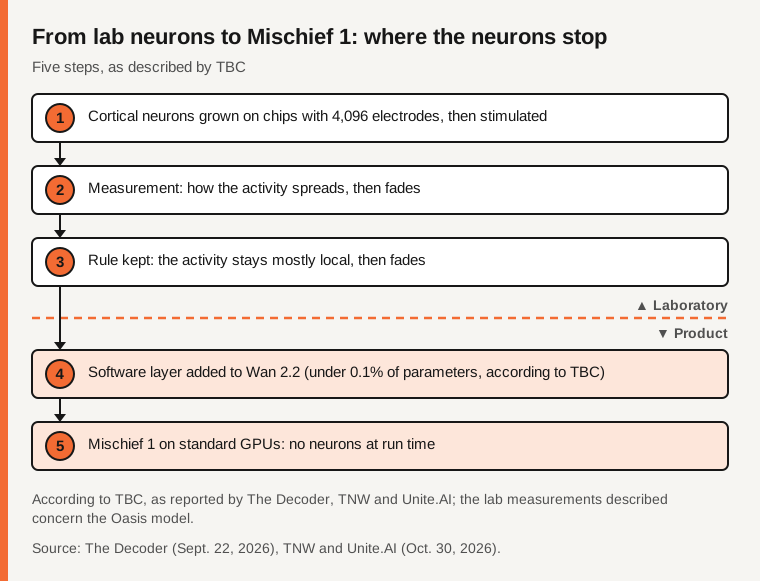
Source: The Decoder (September 22, 2026), The Next Web and Unite.AI (October 30, 2026). According to TBC; the laboratory measurements described concern the Oasis model.
The Decoder describes TBC's published research. Cortical neurons on 4,096-electrode chips are stimulated, and researchers measure how activity spreads, then fades. A "Neural Dynamics Adapter" of about 156,000 parameters encodes one rule: activity stays mostly local, then fades, like a damper. It was trained on Minecraft video sequences. The cells are not used at runtime; the adapter becomes a fixed transformation running on any GPU.
Those results concern Oasis, an interactive Minecraft model, not Wan 2.2. On ten test videos, TBC's blog reports about 19% better than the original on differential entropy and about 5% better than LoRA, and a frame rate raised from 2 to just under 10 per second with about 3% extra parameters. Unite.AI stresses that this does not prove Mischief's performance, and that gains in a second post mixed model changes with serving optimizations such as caching.
What can be verified?
The ranking below is ours, based on the three articles we read.
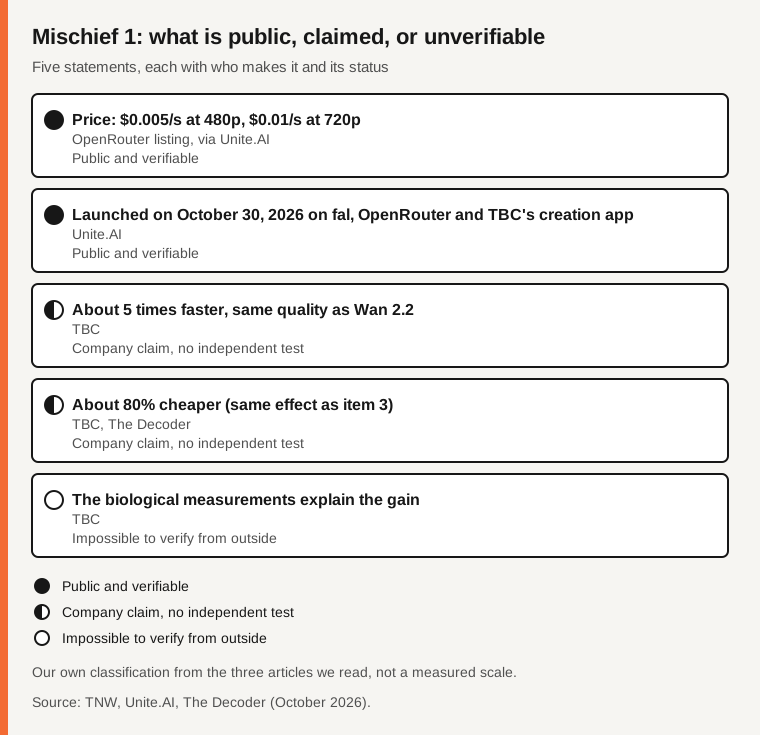
Source: The Next Web, Unite.AI, The Decoder (October 2026). Editorial ranking, not a measured scale.
Neither The Next Web nor Unite.AI reports an independent test. According to The Decoder, TBC has not disclosed the base model, hardware, resolution, clip length or quality measure behind the commercial model's figures. Unite.AI notes no direct comparison with Wan 2.2 and no energy measurement.
The Decoder adds that the idea that neurons reveal algorithms nobody would find otherwise cannot be checked with available data. No controlled comparison with digital alternatives such as distillation or caching, on the same base model, has been published.
Co-founder Jon Pomeraniec told The Next Web: "We're building a platform that can change the economics of AI at scale."
How much does it cost?
According to the OpenRouter listing as reported by Unite.AI (we could not open the listing ourselves), it costs 0.005 dollar per second of video at 480p and 0.01 dollar per second at 720p. Clips last 3 or 5 seconds, in 16:9. A 5-second clip at 480p costs 5 × 0.005 = 0.025 dollar, and 100 such clips 2.50 dollars (Unite.AI's calculation). The Decoder reports that TBC has announced a collaboration with AWS for Trainium chips, Amazon SageMaker AI and AWS Marketplace. As of September 22 it was only an early-access sign-up, for a text-to-video model with an unnamed base. Unite.AI separates that enterprise plan from the October API access for image-to-video.
Comparison table
| Point | What sources say as of Nov 1, 2026 | Source |
|---|---|---|
| Base model | Wan 2.2, modified rather than replaced | Unite.AI, The Next Web |
| Access | fal, OpenRouter, TBC's creation app | Unite.AI |
| Price | 0.005 dollar/s at 480p, 0.01 dollar/s at 720p | OpenRouter listing, via Unite.AI |
| Speed and cost | About 5 times faster, about 80% cheaper, per TBC | The Next Web, Unite.AI, The Decoder |
| Role of neurons | Lab origin of an idea; software layer at runtime | The Decoder, Unite.AI |
| Independent tests | None published | The Next Web, Unite.AI |
Frequently asked questions
Are there living neurons in Mischief 1?
No. According to TBC, as reported by The Next Web and Unite.AI, the neurons stay in the laboratory. The model is software on standard chips.
Is it really five times faster?
That is TBC's claim. No independent test has been published, and the conditions are not disclosed.
Why does the link to Wan 2.2 matter?
Mischief modifies an existing Wan 2.2 model, so the comparison that counts is with Wan 2.2. We saw no direct comparison published.
Method and limits
We read the three articles below on November 1, 2026. We did not read TBC's press release or blog, nor the OpenRouter listing, and we did not test the model. TBC's claims come from those articles. We set aside an opinion post, written by an AI agent without human review, for its latency and availability figures. The speed gains in the blog concern Oasis. Wan 2.2's license is not covered. Not buying advice.
Sources
- The Next Web: TBC Mischief, neuron-derived AI video model (verified 2026-11-01)
- Unite.AI: TBC Mischief, neuron-derived AI video model (verified 2026-11-01)
- The Decoder: a tiny software layer from lab-grown neurons promises faster, cheaper AI video (September 22, 2026) (verified 2026-11-01)
Spotted an error in this article? Report it · Our corrections policy
