Analysis
Regulating open-weight models: when the intellectual property fight reaches AI
No ban on publishing open weights appears in our sources. The fight is about distillation, sanctions and the limits of US export law.
As of November 1, 2026, none of the sources we read reports an adopted ban on publishing open-weight models. The debate is about distillation, an intellectual property theft accusation aimed at Chinese labs, and US law's little grip on published weights. Officials are reported to be weighing restrictions, with no specific text. This is a desk review, not legal advice.
The essentials
- What exists: no ban on publishing open weights in the sources we read.
- The debate: distillation and threats of targeted sanctions (Michael Kratsios, Scott Bessent) against a letter from 25 companies warning of premature restrictions.
- The levers: the "published" exclusion in US export rules, controls on services and chips, and an AI Act partial exemption.
- What is missing: a capability threshold to meet before release, in either the United States or China.
Who is asking for what?
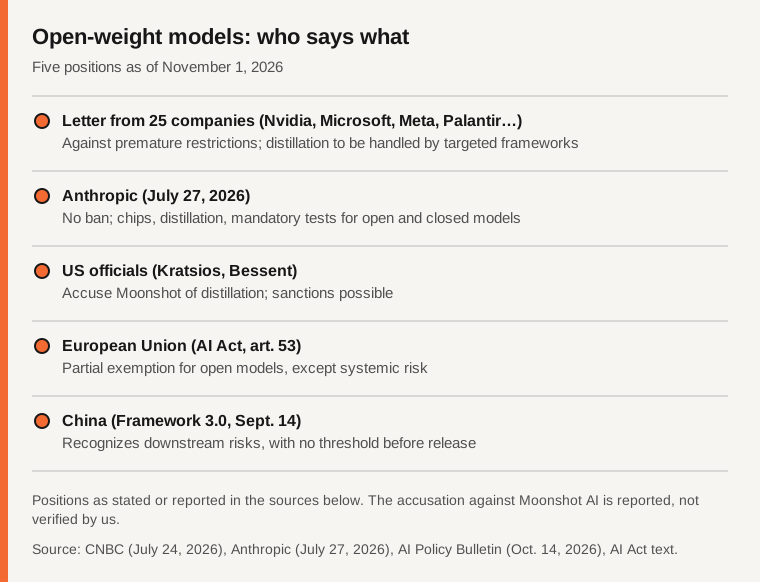
On July 24, 2026, CNBC reported a letter from 25 companies, including Nvidia, Microsoft, Meta and Palantir, warning against "premature restrictions" on open-weight models. They argue that open models strengthen competition, that closed models alone are not inherently safe, that distillation belongs under targeted frameworks rather than general limits, and that early restrictions could push innovation abroad. OpenAI and Anthropic did not sign.
CNBC adds that Chinese open models are gaining ground. Michael Kratsios, a White House adviser, accuses Moonshot AI of building Kimi K3 through covert, industrial-scale distillation of Anthropic's technology. Scott Bessent of the Treasury says the administration will examine whether Chinese firms steal US intellectual property and can sanction them. We report these accusations unconfirmed; we have seen no evidence. CNBC also mentions officials weighing limits on access to Chinese models in the US, with no named text.
On July 27, 2026, Dario Amodei wrote that "Anthropic has never advocated for a ban on open-weights models". He asks for three things: stop selling advanced chips to China and fight smuggling, crack down on industrial-scale distillation, and mandatory pre-release safety testing for all sufficiently capable models, open and closed, which he says would have to be global. He calls open models without dangerous capabilities a public good.
Source: CNBC (July 24, 2026), Anthropic (July 27, 2026), AI Policy Bulletin (October 14, 2026), AI Act text.
What can US law actually do?
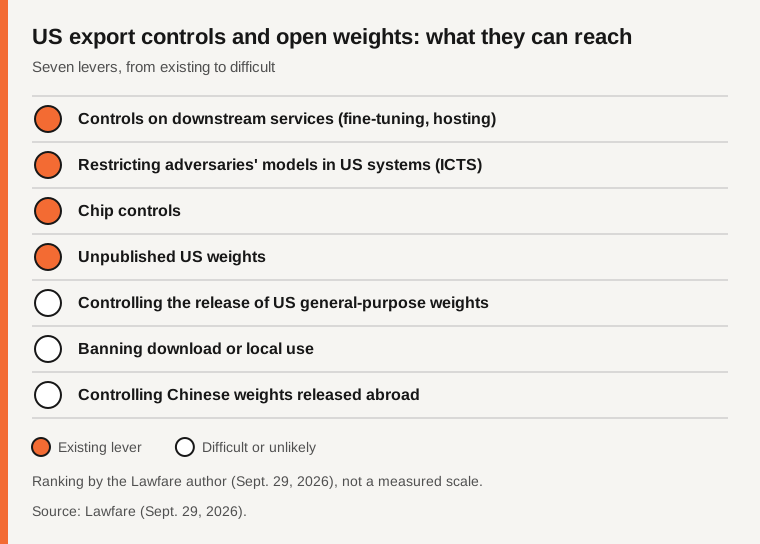
Joe Khawam of the Law Reform Institute analyzes this in Lawfare (September 29, 2026). US export rules exclude "published" content (15 CFR 734.7), and general-purpose weights published under a permissive license generally fall within it. Unpublished US weights remain under Commerce Department jurisdiction.
According to the author, the government can control downstream services (fine-tuning, hosting, integration) for military or weapons-of-mass-destruction uses, use the ICTS program to restrict adversary models in US systems, and control chips. It cannot broadly control publication of US general-purpose weights, since foreign models already offer comparable capabilities. It cannot easily ban downloading or local use (First Amendment and Berman Amendment obstacles). It cannot control Chinese weights published abroad, and a broad, lasting restriction would need dedicated legislation. A hosted model stays controllable by its developer; published open weights do not.
Source: Lawfare (September 29, 2026). The ranking is the author's, not a measured scale.
Mayer Brown (June 30, 2026) describes a June 12 "Is-Informed" letter requiring a license for foreign-person access to Anthropic's Mythos and Fable models, with BIS reportedly treating remote API access as a release; a June 26 letter exempts some trusted partners for Mythos 5. It does not say how open models are treated. Lawfare adds that Anthropic then disabled those models worldwide.
And Europe?
Under article 53(2) of the AI Act, providers of models released under a free and open license, with public parameters including weights, architecture and usage information, are exempt from the technical documentation and downstream-provider information duties. The exemption does not cover systemic-risk models. Copyright compliance and the public training-content summary still apply to all models.
Is the real issue intellectual property?
In part. The theft accusation is what triggered the US debate as CNBC reports it, but a second question is safety. The AI Policy Bulletin (Kar Mun Nicole Wong, October 14, 2026) says neither the US nor China requires a standard to meet before releasing frontier weights. China's AI Safety Governance Framework 3.0 (September 14) recognizes downstream risks without a pre-release capability threshold. In the US, a non-public August framework for voluntary pre-release evaluations would reportedly exclude open models, though officials are said to still consider including them. A bilateral AI meeting is planned for November.
Kimi K3, released in July 2026 with 2.8 trillion parameters, was the largest open model at launch, per VentureBeat as cited by the Bulletin. The UK AI Security Institute and CAISSI found it passed a simulated 32-step network attack in 1 of 10 attempts. Moonshot gave no threshold for withholding future weights; Z.ai delayed GLM 5.3 weights for cybersecurity reasons. For the state of open models, see our October overview.
Comparison table
| Actor or text | Position or scope, November 2026 | Source |
|---|---|---|
| Letter of 25 companies | Against premature restrictions; distillation via targeted frameworks | CNBC |
| Anthropic | No ban; chips, distillation, mandatory testing for open and closed | Anthropic |
| US officials | Accuse Moonshot of distillation; sanctions possible; restrictions weighed | CNBC |
| US law (published weights) | Export rules exclude published content; limited grip | Lawfare |
| AI Act art. 53(2) | Partial exemption for open models, except systemic risk | AI Act text |
| China (framework 3.0) | Recognizes downstream risks, no pre-release threshold | AI Policy Bulletin |
Frequently asked questions
Are open weights banned in the United States?
Not in the sources we read. Export rules exclude published content; restrictions are only reported as weighed.
What is distillation?
Training a model on another model's outputs. Anthropic says it is far cheaper in compute than training from scratch; we go no further.
Is an open model riskier than a closed one?
Published weights cannot be recalled or monitored, per Lawfare and an AI Security Institute report cited by Anthropic. Anthropic says testing should decide; Lawfare notes foreign models already offer comparable capabilities in the domains evaluated.
Method and limits
We read all six sources listed below on November 1, 2026. Anthropic is a party: the distillation accusation concerns one of its models, so its post is a position, not neutral evidence. This is not legal advice.
Sources
- CNBC: open-weight AI models letter, July 24, 2026 (verified 2026-11-01)
- Anthropic: position on open-weights models, July 27, 2026 (verified 2026-11-01)
- AI Policy Bulletin: when are open-weight models too dangerous to release, October 14, 2026 (verified 2026-11-01)
- Lawfare: how export controls can and cannot reduce the risks of open-weight models, September 29, 2026 (verified 2026-11-01)
- Mayer Brown: Commerce extends export controls to advanced AI models, June 30, 2026 (verified 2026-11-01)
- AI Act, article 53 (verified 2026-11-01)
Spotted an error in this article? Report it · Our corrections policy