Analysis
The Financial Times reports that Oracle cancelled a $7 billion deal to lease about 100,000 AI chips to Tencent after US officials raised concerns, with no confirmation from the companies
The FT reports, citing unnamed sources, that Oracle cancelled an estimated $7B lease of up to 100,000 AI chips to Tencent. Not confirmed.
On November 4, 2026, the Financial Times reported that Oracle has cancelled a lease of AI chips to Tencent, estimated at $7 billion, after US officials raised concerns. It rests on unnamed sources, and no company has confirmed it. We did not read the Financial Times (probably paywalled); we read three relays as automatic summaries.
The essentials
- The report: Oracle reportedly cancelled a five-year lease, signed earlier in 2026, giving Tencent access to up to about 100,000 advanced AI chips in data centers in Southeast Asia.
- The pressure: US officials, whom the relays link to the Trump administration, reportedly raised concerns with Oracle.
- The law: leasing AI chips abroad is still allowed, per the FT. The cancellation came from pressure, not a ban.
- Status: unconfirmed. The amount is an estimate, and the chip model, the country and the financial impact are not given.
See also our articles on China's AI compute and Huawei's Ascend 960DT and Korean memory.
What does the Financial Times report?
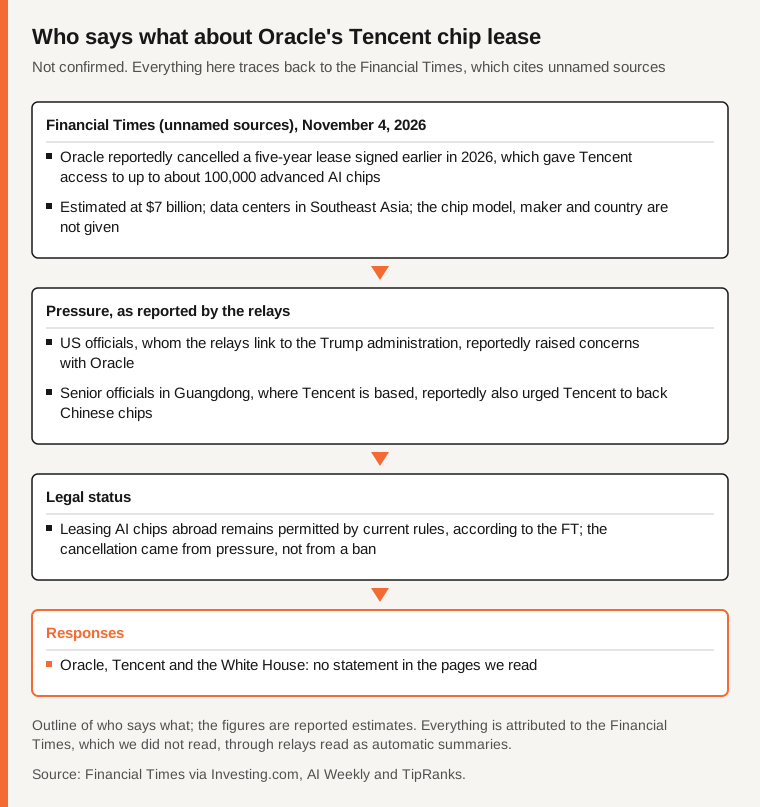
According to the Financial Times, Oracle cancelled a lease it had agreed earlier this year. Investing.com, AI Weekly and TipRanks give the same outline: five years, up to about 100,000 advanced AI chips, data centers in Southeast Asia. TipRanks calls the $7 billion an estimate. AI Weekly, citing Reuters, calls it Tencent's largest overseas deal. The relays name neither the chip model, nor its maker, nor the country, so we do not either.
Source: Financial Times via Investing.com, AI Weekly and TipRanks.
Who applied pressure?
US officials raised concerns with Oracle, says the FT. Investing.com and AI Weekly tie this to the Trump administration; TipRanks says only US officials. No person or agency is named. Senior officials in Guangdong, where Tencent is based, also urged Tencent to back Chinese chips, per the FT (AI Weekly, TipRanks); Investing.com says Beijing also examined the deal.
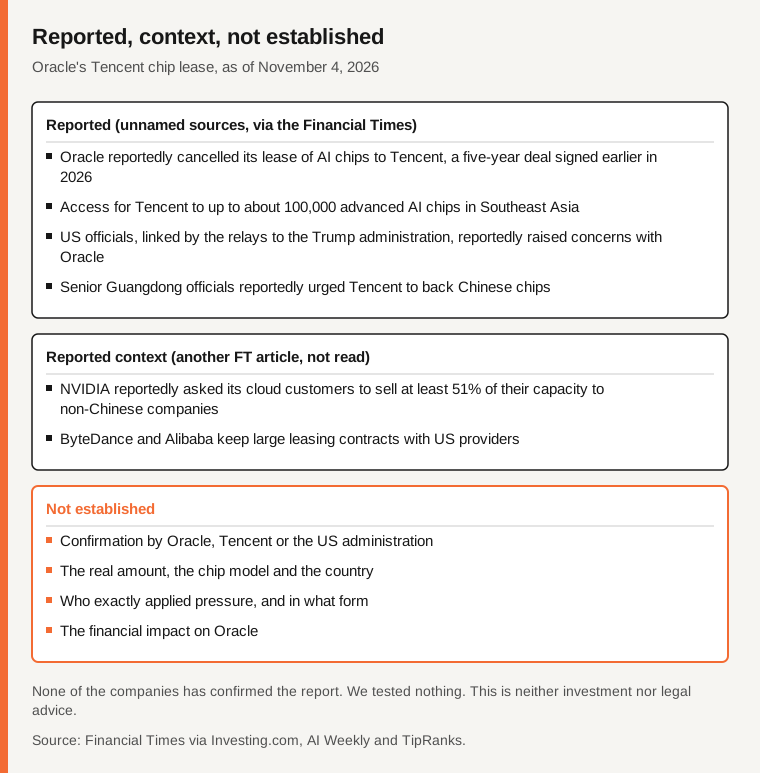
The day before, in a separate FT article we did not read, NVIDIA reportedly asked its cloud customers to sell at least 51% of their capacity to non-Chinese companies, per Investing.com and TipRanks, which add that ByteDance and Alibaba keep large leases with US providers. This context is not verified.
Is it legal?
According to the FT, via AI Weekly, leasing AI chips abroad remains permitted by current rules. The cancellation came from pressure, not a legal ban, and no new rule is cited. The same source says the chips are not available in China because of restrictions from Washington and Beijing.
What is not established?
Source: Financial Times via Investing.com, AI Weekly and TipRanks.
Confirmation by Oracle, Tencent or the US administration, the real amount, the chip model and the country, who applied pressure and how, whether another tenant will take over the capacity, the effect on Oracle's revenue, NVIDIA's 51% request (a separate report, unread) and whether other Chinese contracts will be hit. Nothing here accuses a named company of anything.
Comparison table
| Point | What the sources say | Source |
|---|---|---|
| The claim | Oracle cancelled a five-year lease of up to about 100,000 AI chips to Tencent | Financial Times (unnamed sources), via the relays |
| Amount, place | About $7 billion (an estimate); Southeast Asia, country not given | TipRanks, Investing.com, AI Weekly |
| US pressure | US officials, linked to the Trump administration, raised concerns | Financial Times, via the relays |
| Guangdong | Senior officials urged Tencent to back Chinese chips | AI Weekly, TipRanks |
| Legality | Leasing abroad still permitted | Financial Times, via AI Weekly |
Frequently asked questions
Has Oracle confirmed it?
Not in the pages we read: the relays report no statement from Oracle, Tencent or the White House.
Is leasing chips to China banned?
Not according to the FT, via AI Weekly: leasing AI chips abroad remains permitted.
Which chips are involved?
The relays name neither the model, nor the maker, nor the country of the data centers.
Method and limits
We did not read the Financial Times article; the three relays were read as automatic summaries. Bloomberg and DealRoom returned a 403 error and were not read. Everything rests on unnamed sources, with no comment from the companies. The amounts are estimates, and the 51% request comes from another unread FT report. We tested nothing. This is neither investment nor legal advice.
Sources
- Financial Times, article of November 4, 2026 (probably paywalled), not read
- Investing.com, read via an automatic summary
- AI Weekly, read via an automatic summary
- TipRanks, read via an automatic summary
Spotted an error in this article? Report it · Our corrections policy