Analysis
Chinese embodied AI companies raised 93.5 billion yuan, about $13 billion, in 322 deals in H1 2026, about five times a year earlier, per ITjuzi via Reuters
Reuters reports ITjuzi data showing Chinese embodied AI companies raised about 93.5 billion yuan in 322 deals in H1 2026. October data point lower.
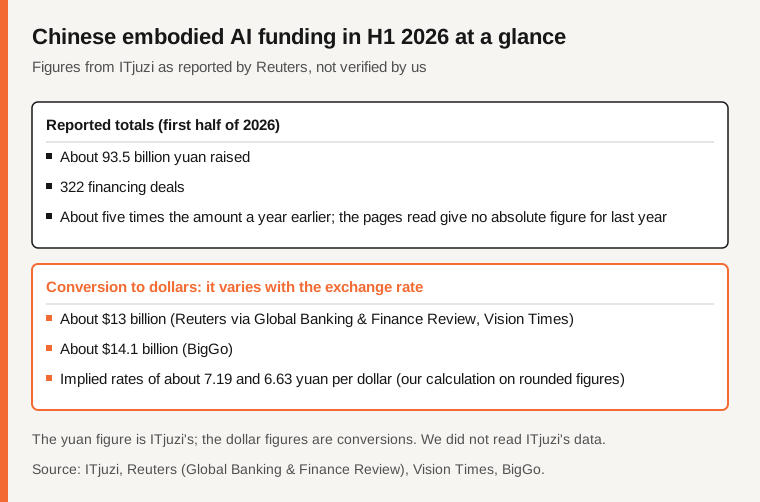
On November 2, 2026, Reuters reported figures from ITjuzi: Chinese "embodied AI" companies raised about 93.5 billion yuan in 322 financing deals in the first half of 2026, about five times the amount a year earlier. We did not read ITjuzi's data or Reuters' original, only four pages through automatic summaries. This is neither investment nor legal advice.
The essentials
- The figure: about 93.5 billion yuan, 322 deals, first half of 2026, about five times a year earlier (ITjuzi via Reuters).
- The dollars: about $13 billion (Reuters, Vision Times) or about $14.1 billion (BigGo). Conversions vary with the rate used.
- The counterpoint: second-hand October data show deals down from 60 to 33.
- Not established: ITjuzi's method, last year's amount, the exchange rate, the software and hardware split.
What ITjuzi says
Reuters, read through Global Banking & Finance Review, gives these figures; Vision Times and BigGo repeat them. No page gives an absolute amount for the previous year, so "about five times" cannot be checked.
Reuters adds that funding increasingly goes to developers specialized in robot intelligence, besides manufacturers, without a split. Dermot McGrath of ZenGen Labs, per Reuters, expects profit to come from robot intelligence rather than hardware: an opinion.
Reuters cites examples: the startups X Square, Galaxea and Spirit AI are each valued at about $3 billion, according to company information. UBTech, listed in Hong Kong, posted a chief AI scientist job paying up to 124 million yuan with equity and benefits. Vision Times adds that Xpeng's robotics arm announced over $900 million raised at a valuation above $6.3 billion in August.
Source: ITjuzi via Reuters, Vision Times, BigGo.
From yuans to dollars
ITjuzi's figure is in yuans. Reuters and Vision Times give about $13 billion; BigGo, about $14.1 billion. No page states its rate. Our calculation on these rounded figures implies about 7.19 and 6.63 yuans per dollar. The yuan figure stays the reference.
What does "embodied AI" cover?
Reuters describes a software-focused field that helps robots understand their surroundings, learn unfamiliar tasks and adapt without being programmed for each one. How ITjuzi classifies companies is not described. For recent robot intelligence releases, see our articles on Xpeng's perception model and LiberAI's Liber-0.
Cooling signals, second-hand
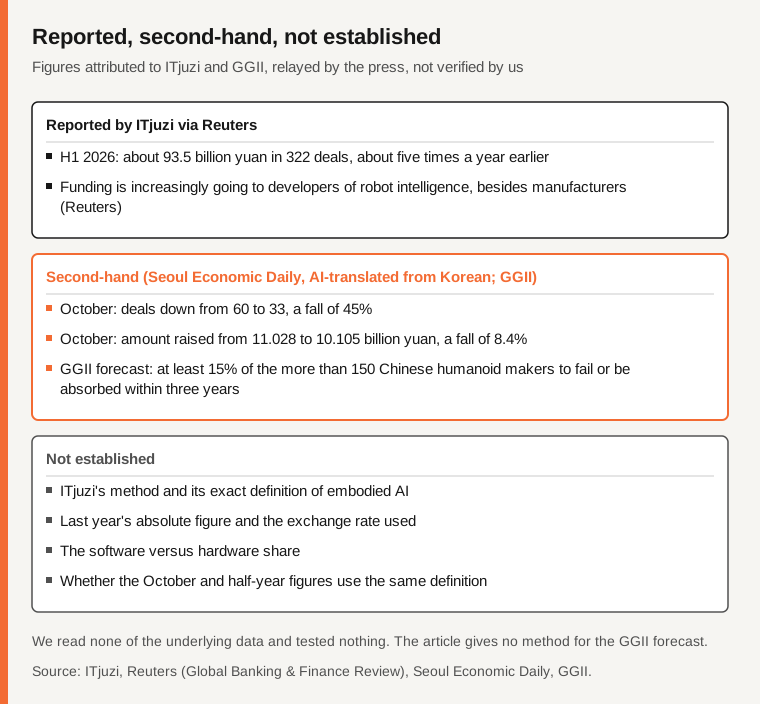
Seoul Economic Daily (Jung Da-eun, November 4, AI-translated from Korean) cites ITjuzi for October: deals in China's embodied intelligence sector fell 45%, from 60 to 33, and the amount raised fell 8.4%, from 11.028 to 10.105 billion yuan. September had already fallen about 40% on the month. It gives no first-half figures; we make no comparison, as definitions may differ.
GGII, a research firm, forecast on November 3 in Shenzhen (Zheng Liyao, via Yicai) that at least 15% of Chinese humanoid robot makers, more than 150, would fail or be absorbed within three years. No method is given.
Per the same article, an official of the regulator NFRA warned on November 3 of overheating in AI investment. Reuters also reports a tight IPO market amid worries about inflated valuations and oversupply, and shortages of advanced Nvidia chips linked to US export controls.
Source: ITjuzi via Reuters, Seoul Economic Daily, GGII.
What is not established
ITjuzi's method and definition of embodied AI; last year's figure; the exchange rate; the software and hardware shares; whether the 93.5 billion yuan are announced, paid or estimated; whether every deal discloses an amount; whether October and half-year figures share a definition; whether GGII's forecast comes true; any link between funding and technical progress.
Comparison table
| Point | What the sources say | Status |
|---|---|---|
| H1 2026 total | About 93.5 billion yuan, 322 deals, about five times a year earlier | Reported by ITjuzi via Reuters |
| In dollars | About $13 billion or $14.1 billion | Diverging |
| October | Deals 60 to 33, amount 11.028 to 10.105 billion yuan | Second-hand |
| Consolidation | At least 15% of 150+ makers, per GGII | Second-hand |
| Method, split, rate | Not given | Not established |
Frequently asked questions
How much did Chinese embodied AI companies raise in the first half?
About 93.5 billion yuan in 322 deals, per ITjuzi via Reuters.
Why $13 or $14.1 billion?
Those are conversions, and none of the pages states its exchange rate.
Is the pace holding?
Second-hand October figures show fewer deals and a smaller amount, but the definition may differ.
Method and limits
We read the four pages by automatic summary on November 4, 2026. We ignored the "Key Takeaways" section of the Global Banking & Finance Review page, whose figures are absent from its body. The Seoul Economic Daily text is an AI translation. We tested nothing.
Sources
- Reuters (Laurie Chen, Eduardo Baptista) via Global Banking & Finance Review, automatic summary
- Vision Times, Todd Crawford, automatic summary
- BigGo Finance, automatic summary
- Seoul Economic Daily, Jung Da-eun, AI-translated from Korean, automatic summary
Spotted an error in this article? Report it · Our corrections policy