Analysis
LiberAI unveils Liber-0, a world action model pretrained on more than 2.2 million hours of human experience, with a company-reported 36% zero-shot success rate on 60 tasks
LiberAI reports 36.0% zero-shot success for Liber-0, pretrained on more than 2.2 million hours of human experience. Its own evaluation, not reproduced.
On November 3, 2026, LiberAI, a "physical AI" startup, announced Liber-0, a "world action model" for robot manipulation, pretrained, it says, on more than 2.2 million hours of human experience. LiberAI reports a 36.0% zero-shot success rate on 60 tasks. Every figure comes from the company; we found no independent coverage. We read three pages through automatic summaries and ran nothing. This is neither investment nor technical advice.
The essentials
- The result: per LiberAI, 36.0% success over 600 trials on 60 tasks proposed by GPT-6, and 10.5% on hard tasks.
- The hours: more than 2.2 million hours of human experience, which LiberAI says are not millions of hours of robot demonstrations.
- The sources: all three pages repeat LiberAI's announcement; The Robot Report is content sponsored by LiberAI.
- Not established: independent reproduction, release of weights or code, the robot used.
What is Liber-0?
A world action model learns how visual observations, physical actions and what happens next relate, and predicts future video frames and actions jointly (The Robot Report, Robotics & Automation News). In short, it predicts what it will see next and what to do.
LiberAI is described as based in Beijing and led by Songming Liu, founder and CEO (The Robot Report), and as founded in December 2025 (Robotics & Automation News). Its stated goal is generalist home robots.
Training has three stages, per Robotics & Automation News: visual prediction from human videos; joint prediction of frames and actions; a final stage on manipulation. The LiberSense Glove records hand poses and trajectories with a first-person camera and two wrist cameras, and needs no robot on site (The Robot Report, Robotics & Automation News).
What are these hours of human experience?
LiberAI says pretraining used more than 2.2 million hours of human experience. Robotics & Automation News describes most of it as large-scale video of human activity, with no split by source. The Robot Report does not say how they divide between web video and glove data, or are counted. The company states the figure does not mean millions of hours of hand-made demonstrations for robots; pretraining also included robot data (release, The Robot Report).
The announced results
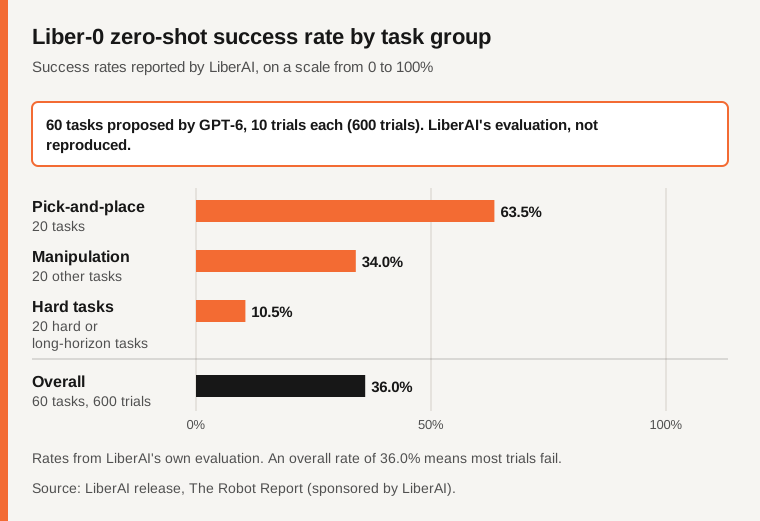
LiberAI ran the evaluation itself: 60 tasks proposed by GPT-6, each tested 10 times, for 600 trials (release).
Source: LiberAI release, The Robot Report (sponsored by LiberAI).
LiberAI reports 36.0% overall, 63.5% on 20 pick-and-place tasks, 34.0% on 20 other manipulation tasks and 10.5% on 20 hard or long-horizon tasks (release, The Robot Report). Robotics & Automation News writes that most evaluated tasks still fail; we read 36.0% likewise.
"Zero-shot" has LiberAI's meaning: no training on robot demonstrations for these target tasks, though pretraining included robot data (release, The Robot Report).
LiberAI also says that, after the same robot post-training, 10,000 hours of glove recordings beat 2 million hours of web human video. No scores are given and the two articles do not mention it: a company claim, unverified.
Limits declared by LiberAI
Gloves record neither contact nor force, which matter for insertion, fastening and soft materials. Human video alone suffers from an action supervision gap and an embodiment gap. Performance on hard and long-horizon tasks remains limited. Touch, force and collection in more homes are future directions.
What is not established?
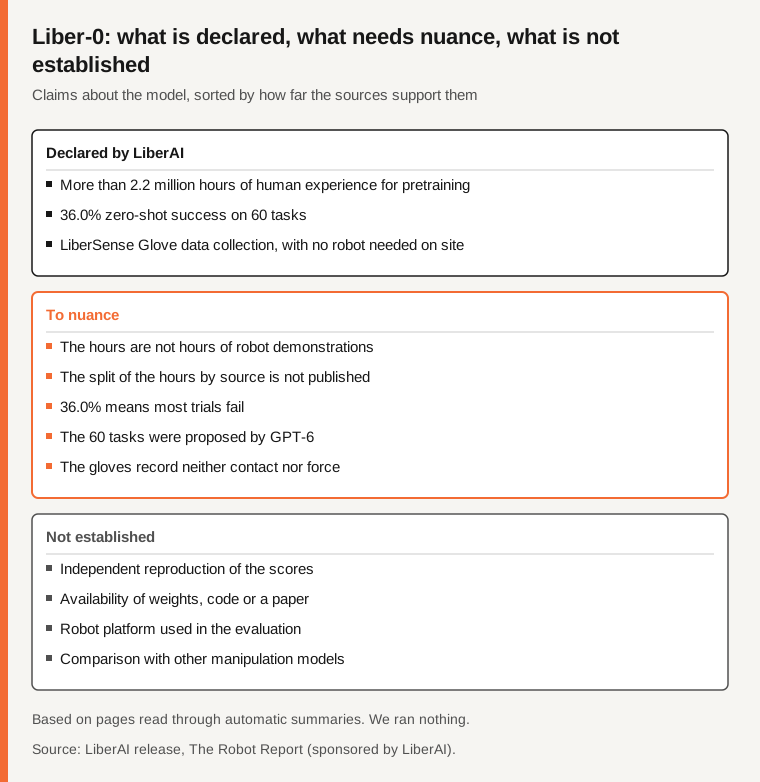
The split of the hours by source; independent reproduction of the 36.0% and of the glove comparison; the evaluation's robot platform; any release of weights, code or access; how GPT-6 chose the tasks and how hard they are; comparison with other manipulation models; the company's funding and size.
Source: LiberAI release, The Robot Report (sponsored by LiberAI).
Comparison table
| Point | What the sources say | Status |
|---|---|---|
| Result | 36.0% over 60 tasks; 10.5% on hard tasks | Declared by the company |
| Hours | More than 2.2 million hours, mostly human-activity video | Declared by the company, split not published |
| Release, reproduction | No weights, code or paper mentioned | Not established |
Frequently asked questions
Are the hours of human experience robot demonstrations?
No. LiberAI says the figure does not mean millions of hours of hand-made demonstrations for robots.
What does 36.0% mean?
LiberAI's overall zero-shot success rate over 600 trials, so most trials fail.
Is the model available?
No page we read mentions weights, code, open access, a price or a schedule, and no paper is named. The release mentions a technical blog, videos and an interactive simulation.
Method and limits
On November 4, 2026, we read through automatic summaries LiberAI's November 3 release as syndicated by Digital Media Net via ACCESS Newswire (the FinancialContent version returned an error), The Robot Report, sponsored content from LiberAI, and Robotics & Automation News (Sam Francis). We did not read the technical blog, videos, simulation or LiberAI's X account. Scores are not reproduced.
Sources
- LiberAI release via ACCESS Newswire, Digital Media Net, automatic summary
- The Robot Report, content sponsored by LiberAI, automatic summary
- Robotics & Automation News, Sam Francis, automatic summary
Spotted an error in this article? Report it · Our corrections policy