Analysis
Nvidia wants Microduck to be every developer's robotics playground: what is open and what is not
Nvidia supplies open simulation and training tools for Microduck, a $399 robot from Pollen Robotics and Hugging Face. What is open, and what is pending.
As of October 30, 2026, what Nvidia puts forward around Microduck is the training side: Isaac Lab 3.0, an open source simulation framework, and a sim-to-real tutorial published on Hugging Face. The robot itself, a 25 cm biped priced at $399 at launch, comes from Pollen Robotics and Hugging Face and carries no Nvidia processor. Deliveries and Nvidia's acquisition of Hugging Face are both still pending.
The essentials
- What Nvidia provides: simulation and training tools. A Hugging Face tutorial co-signed by Nvidia (October 21) shows how to train walking in Isaac Lab 3.0 and move it to the real robot.
- What the robot is: a small biped developed by Pollen Robotics, Hugging Face's robotics team, at $399 before taxes and shipping (launch price, according to Modern Robotics). Its processor is a Rockchip RK3566, not a Nvidia chip, according to the official README.
- What is open: the robot's software, written in Rust under the Apache-2.0 licence, plus a training repository, microduck_rl. The mechanical and electronic files are not confirmed as open.
- What is pending: deliveries (the shop now quotes 4 to 6 months for new orders) and the Hugging Face acquisition, signed but not closed.
We keep apart two sides throughout: Nvidia (simulation and training tools) and Pollen Robotics with Hugging Face (the robot and its software).
What is Microduck?
Microduck is a small biped robot, 25 cm (about 10 inches) tall, developed by Pollen Robotics, which is Hugging Face's robotics team. According to the GitHub repository, it weighs about 800 g. It has 15 servomotors and runs on a Rockchip RK3566 processor, according to the official README (GitHub, pollen-robotics/microduck). Press coverage adds 1 GB of RAM, 32 GB of storage, a front camera, a depth sensor, two inertial measurement units and a battery life of about one hour (eesel, Modern Robotics).
Hugging Face bought Pollen Robotics, not the other way round: the deal was announced on April 14, 2025, for an undisclosed amount (TechCrunch).
Microduck was shown during the GTC Berlin keynote on Wednesday, October 21, 2026, with four of them on stage. According to Modern Robotics, Jensen Huang presented them, and the demonstration was not flawless. Nvidia's GTC Berlin blog describes them as "10-inch biped robots by Hugging Face that run on open source software" (Nvidia).
What is Nvidia's role?
Nvidia's part is on the training side. The tutorial published on Hugging Face and co-signed by Nvidia on October 21, 2026 describes going from simulation to the real robot (sim-to-real) with Isaac Lab 3.0, which is open source. Its example command runs 4,096 simulated environments in parallel (Hugging Face).
Nvidia's developer blog (October 23) goes further: an adaptation run, with ramps and obstacles, uses 4,096 parallel environments on an NVIDIA RTX PRO 6000 Blackwell Workstation Edition card, with Isaac Sim used for rendering and sensors (Nvidia developer blog). The Hugging Face tutorial does not name a graphics card.
The chain therefore runs from Nvidia's tools to a walking policy learned in simulation, then to a robot built by someone else.
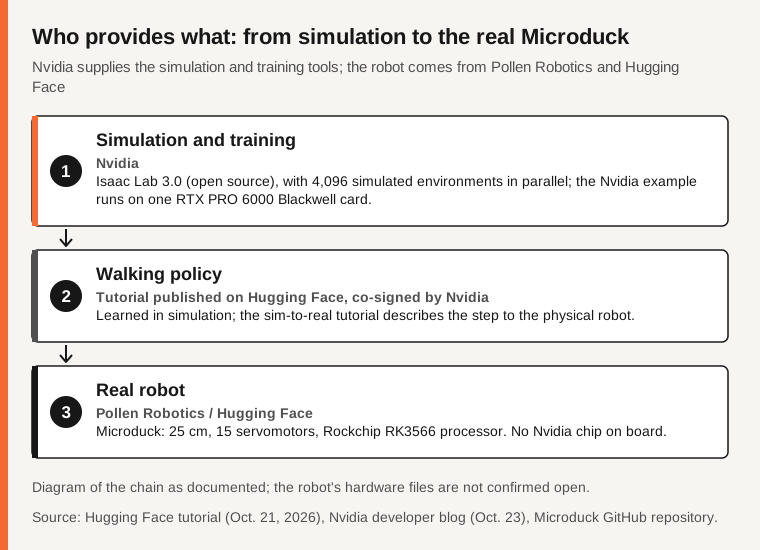
Source: Hugging Face tutorial (October 21, 2026), Nvidia developer blog (October 23, 2026), Microduck GitHub repository, verified 2026-10-30.
What can you do today, and what do you need to start?
In the sources we read, the one example with a named card is Nvidia's own: an RTX PRO 6000 Blackwell Workstation Edition. We found no statement of a minimum configuration, so we do not give one.
You do not need to own the robot to read the code: the repository is public under Apache-2.0, and so is the training repository microduck_rl. As for Jetson, we found no official support from Nvidia or Pollen. The only material we found is a third-party tutorial from Seeed Studio on training microduck_rl on a Jetson Orin NX 16 GB (Seeed Studio). The robot itself runs on the RK3566, not on a Jetson.
This is not a step-by-step guide. Follow the tutorial linked above for the actual procedure.
What is open and what is not?
- Open: the robot's software, written in Rust under Apache-2.0, and the training repository microduck_rl (GitHub). Isaac Lab 3.0 is described as open source by the tutorial.
- Not confirmed: the mechanical and electronic files. We found no confirmation that they are published. eesel states they are not open, and Modern Robotics speaks only of the software. We therefore do not call the hardware open source.
- Not Nvidia's: the robot, which is developed by Pollen Robotics and Hugging Face.
Where do deliveries and the Hugging Face acquisition stand?
Deliveries. Pre-orders opened on August 27, 2026, with delivery targeted before Christmas. According to Modern Robotics (October 23), the shop now quotes 4 to 6 months for new orders, with a risk of slipping to spring. A pre-order count is not a count of robots delivered, and we give no pre-order figure because we could not confirm one.
The Hugging Face acquisition. It is not completed. Nvidia signed a definitive agreement on September 2, 2026 and announced a price of $12,930,300,000. Closing is expected in the first half of 2027, subject to regulatory approvals (Nvidia, Form 8-K). According to Reuters via Yahoo Finance (October 28), the US Department of Justice has asked questions about the effect on competition (Yahoo Finance). Our earlier article covers the antitrust questions.
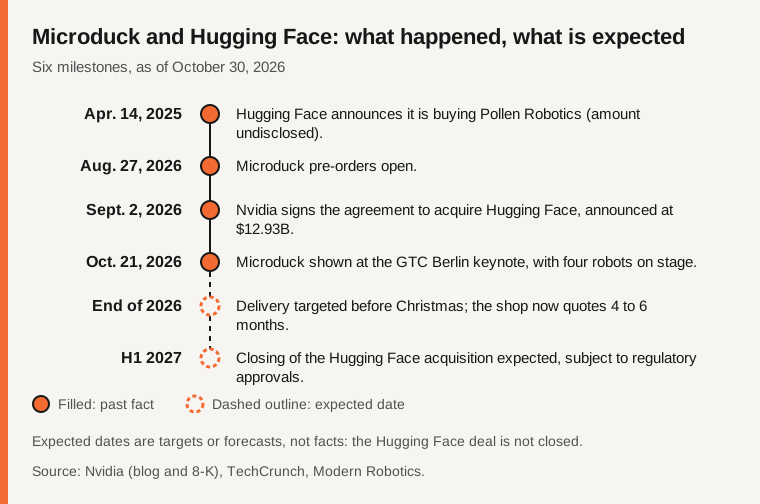
Source: Nvidia (blog and Form 8-K), TechCrunch, Modern Robotics, verified 2026-10-30. Past facts are shown filled, expected dates outlined.
"Every developer's playground": what is shown?
The phrase is ours, a way to frame the question. What the sources show is narrower. Nvidia says Hugging Face has more than 18 million developers, researchers and creators (September 3, 2026), which describes the platform, not Microduck. For Microduck, the sources show open software, a public training repository, an Nvidia-co-signed tutorial and Nvidia's own description of the robots as running on open source software.
The sources also show limits, according to eesel and Modern Robotics: it is an educational robot, it has no hands, it has 1 GB of RAM, its battery lasts about an hour, and new orders take 4 to 6 months. We found no figure on how many developers use it.
Comparison table
| Item | Who | Status on Oct. 30, 2026 | Source |
|---|---|---|---|
| Isaac Lab 3.0 (simulation, training) | Nvidia | Open source; used in the sim-to-real tutorial | Hugging Face |
| Adaptation run, 4,096 environments | Nvidia | Described on an RTX PRO 6000 Blackwell Workstation Edition | Nvidia developer blog |
| Robot software (Rust, Apache-2.0), microduck_rl | Pollen Robotics, Hugging Face | Open | GitHub |
| Mechanical and electronic files | Pollen Robotics, Hugging Face | Not confirmed as open | GitHub, eesel |
| Robot (25 cm, 15 servomotors, RK3566) | Pollen Robotics, Hugging Face | Pre-orders since Aug. 27; $399 before taxes and shipping at launch | GitHub, Modern Robotics |
| Deliveries | Pollen Robotics, Hugging Face | Targeted before Christmas; shop quotes 4 to 6 months | Modern Robotics |
| Hugging Face acquisition | Nvidia | Agreement signed Sept. 2; closing expected in H1 2027, subject to approvals | Nvidia, Form 8-K |
Frequently asked questions
Does Microduck use a Nvidia chip?
No. According to the official README, the robot runs on a Rockchip RK3566. Nvidia's role is on the simulation and training side.
Does Nvidia own Hugging Face?
No. Nvidia signed an agreement on September 2, 2026 to acquire it, and the deal has not closed. Closing is expected in the first half of 2027, subject to regulatory approvals.
Is Microduck fully open source?
The software is, under Apache-2.0. The mechanical and electronic files are not confirmed as open, and we do not claim they are.
When will Microduck be delivered?
Delivery was targeted before Christmas. According to Modern Robotics, the shop now quotes 4 to 6 months for new orders, with a possible slip to spring.
Method and limits
This article relies on Nvidia's blogs and Form 8-K, the Hugging Face tutorial, the Microduck GitHub repository, TechCrunch, Reuters via Yahoo Finance, Modern Robotics, eesel and Seeed Studio, read on October 30, 2026. Who presented the robot on stage comes from the press alone, and we did not verify it on a primary source. We did not read the shop's pages, so the price and the delivery times come from press reports. We exclude the microducks.org site, whose link with Pollen Robotics is not established. The price is the launch price, before taxes and shipping. This is not investment or purchasing advice, and the situation may have changed since.
Sources
- Nvidia: Nvidia to acquire Hugging Face (verified 2026-10-30)
- Nvidia Form 8-K, September 2, 2026 (SEC) (verified 2026-10-30)
- Reuters via Yahoo Finance: DOJ questions, October 28, 2026 (verified 2026-10-30)
- TechCrunch: Hugging Face buys a humanoid robotics startup (verified 2026-10-30)
- GitHub: pollen-robotics/microduck (verified 2026-10-30)
- Hugging Face: Microduck, Isaac Lab and sim-to-real (verified 2026-10-30)
- Nvidia developer blog: teaching robots like Microduck to walk in simulation (verified 2026-10-30)
- Nvidia: GTC Berlin 2026 news (verified 2026-10-30)
- Modern Robotics: Microduck at GTC Berlin (verified 2026-10-30)
- eesel: Microduck (verified 2026-10-30)
- Seeed Studio: microduck_rl on Jetson (verified 2026-10-30)
Spotted an error in this article? Report it · Our corrections policy
