Analysis
Apple reports $114.5 billion for the September quarter in Ternus's first results, and warns memory costs will keep rising
Apple posts $114.5 billion, up 12%, in Ternus's first results and says memory costs will keep rising. Its December margin outlook is 45% to 46%.
On November 2, 2026, Apple published its results for the fiscal fourth quarter, which ended September 26, 2026. It is the first release under CEO John Ternus, according to CNBC and Gizmodo. Revenue reached $114.5 billion, up 12%, but executives warned on the call that memory costs will keep rising. We read the release and the press through automatic summaries and did not listen to the call. This is not investment advice.
The essentials
- The release: revenue of $114.477 billion (+12%), diluted earnings per share of $2.10 (+14%), gross margin of 47.9%, about one point of it from tariff refunds.
- Against expectations: iPhone, at $57.58 billion, is above the roughly $56.5 billion expected; iPad, Wearables and Greater China are below. Consensus figures vary by source.
- Memory: according to press accounts of the call, Apple expects memory costs to rise in the December quarter and beyond, only partly offset.
- December outlook: revenue growth of 7% to 10% and a gross margin of 45% to 46%, below a consensus close to 46.3%.
The release contains no numerical forecast: those come from the call, as reported by the press. For Ternus's WIRED interview, see our November 1 article.
What does the release say?
Revenue was $114,477 million against $102,466 million a year earlier. Products brought in $82,904 million and Services $31,573 million, against $28,750 million (+9.8%, Origo calculation). Diluted earnings per share were $2.10 against $1.85, of which $0.05 comes from tariff refunds.
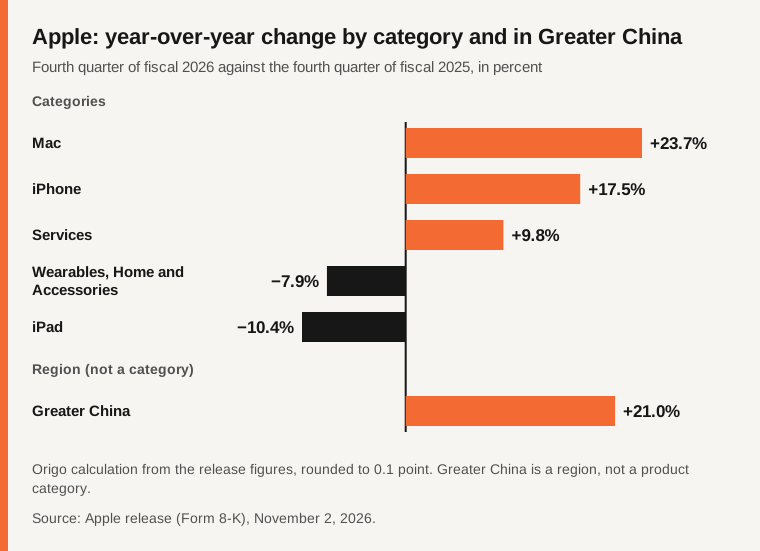
Source: Apple release, Origo calculation.
Against expectations, the press cites consensus figures that vary slightly: revenue near $113.4 to $113.5 billion and earnings per share of $1.99 to $2.00 (CNBC, citing LSEG, and Yahoo Finance, citing Bloomberg). iPhone beat the roughly $56.5 billion expected and Mac the $9.6 to $9.7 billion. iPad (about $6.7 billion expected) and Wearables (about $9.06 billion) were below. Services were in line, with $31.58 billion expected according to Yahoo Finance. CNBC notes that Services growth stayed under 10%, the slowest since 2022.
Where does Greater China stand?
Greater China brought in $17,539 million against $14,493 million, up 21% (Origo calculation from the release). Yahoo Finance reports $18.75 billion expected, which would make it a miss, but it does not state the source of that estimate. So both statements hold: growth of 21%, and a result below that one estimate.
What does Apple say about memory?
As reported by the press, Ternus said: "What we're seeing with memory pricing right now is unprecedented." Memory costs were higher in the September quarter than in June. They should rise again in the December quarter, partly offset by past price increases, carried-in inventory and lower costs on other components. Further increases are expected beyond December, as the inventory benefit shrinks.
COO Sabih Khan said memory purchase commitments grew by $33 billion from the third to the fourth quarter (Yahoo Finance, Seoul Economic Daily). He also said Mac and iPad supply will be constrained in the December quarter because of memory (Yahoo Finance). According to TechCrunch, relayed by Seoul Economic Daily and not read by us, he did not rule out further price increases.
Two points are context from journalists, not statements from Apple. CNBC says Apple raised prices reluctantly; Gizmodo adds that this was Mac and iPad in summer and iPhone in September. Seoul Economic Daily reports inventories of $14.54 billion, up 31.1% over the quarter, and reads this as preparation for a shortage: that is its interpretation.
What does Apple forecast for December?
According to CNBC, Seoul Economic Daily and Yahoo Finance, Parekh guided to:
- revenue growth of 7% to 10% (LSEG consensus of 6.1%, per CNBC and Seoul Economic Daily);
- a gross margin of 45% to 46% (consensus close to 46.3%, so below it);
- Services growth of 8% to 9%;
- operating expenses of $20.4 to $20.8 billion (Yahoo Finance).
Gizmodo adds that Parekh also ties the margin to the cloud cost of rolling out Siri AI.
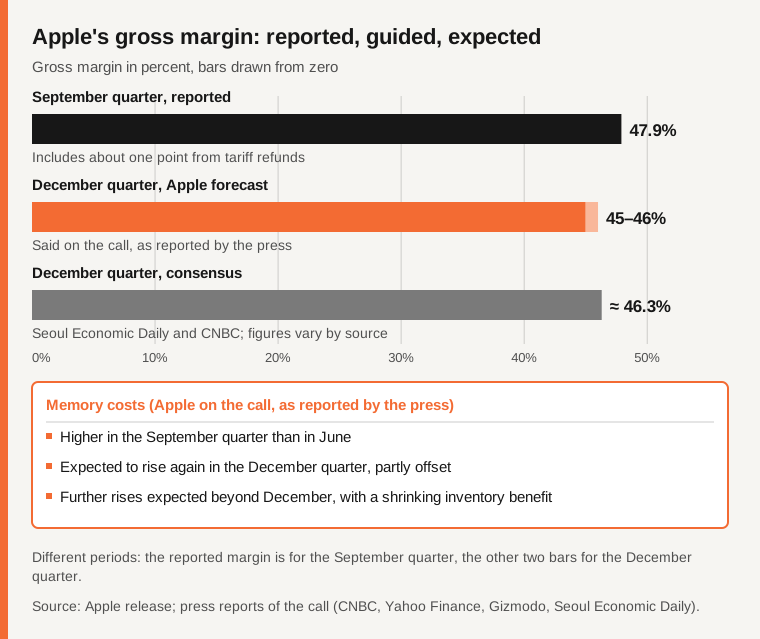
Source: Apple release, press reports of the call.
How did the stock react?
The stock lost about 3% after the close on November 2 (CNBC), after falling about 2% in the regular session. On November 3, 24/7 Wall St. and Yahoo Finance showed it about 4% lower before the open, near $325 against a close of $338.32 the day before. The 24/7 Wall St. headline ties the drop to memory costs squeezing the margin outlook: that is the outlet's reading. We do not know how the November 3 session ended.
What is not established?
How long memory costs will keep rising, and how far they will weigh on the margin beyond December. The consensus figures, which differ between sources, and the source of the $18.75 billion estimate for Greater China.
Comparison table
| Point | Figure | Source |
|---|---|---|
| Revenue | $114.477 billion, +12% | Apple release |
| Categories | iPhone +17.5%, Mac +23.7%, Services +9.8%, iPad −10.4%, Wearables −7.9% (Origo calculation) | Apple release |
| Gross margin | 47.9%, about 1 point from tariff refunds | Apple release |
| Diluted EPS | $2.10, +14%, of which $0.05 from tariff refunds | Apple release |
| Greater China | $17.539 billion, +21% (Origo calculation); $18.75 billion expected | Apple release; Yahoo Finance |
| December revenue | 7% to 10% (consensus 6.1%) | Parekh, via CNBC and Seoul Economic Daily |
| December gross margin | 45% to 46% (consensus about 46.3%) | Parekh, via the press |
| Memory commitments | Up $33 billion from the third to the fourth quarter | Khan, via Yahoo Finance and Seoul Economic Daily |
| Inventories | $14.54 billion, +31.1% over the quarter | Seoul Economic Daily |
| Stock | About −3% after the close on Nov. 2; about −4% before the open on Nov. 3 | CNBC; 24/7 Wall St., Yahoo Finance |
Frequently asked questions
Did Apple beat expectations?
On total revenue, earnings per share and iPhone, yes according to the consensus figures cited, which vary by source. iPad, Wearables and Greater China were below.
Does the release contain a forecast?
No. The December figures come from the call, as reported by the press.
Did the stock close lower on November 3?
We do not know. We saw about −3% after the close on November 2 and about −4% before the open on November 3, not the session itself.
Method and limits
We read Apple's release (Form 8-K, exhibit 99.1), CNBC, Yahoo Finance, Gizmodo, Seoul Economic Daily and 24/7 Wall St. through automatic summaries, not in full. We did not listen to the call: statements are attributed via the press. Benzinga and BigGo turned up in search but were not read, and are not cited. Consensus figures vary by source, the source of the Greater China consensus is not stated, and the release has no forecast. We tested nothing. This is not investment advice.
Sources
- Apple, Form 8-K, exhibit 99.1 (SEC) (November 2, 2026), read via an automatic summary
- CNBC, Apple Q4 2026 earnings live updates (November 2), read via an automatic summary
- Yahoo Finance, Apple earnings live (November 2), read via an automatic summary
- Gizmodo, read via an automatic summary
- Seoul Economic Daily (November 3), read via an automatic summary
- 24/7 Wall St. (November 3), read via an automatic summary
Spotted an error in this article? Report it · Our corrections policy
