Analysis
'Inside DeepSeek V4.1-Flash: its KV cache, the 1017 update and the Harness stack'
DeepSeek says V4.1-Flash's global KV cache is a quarter of V4-Flash's. How it works, what the 1017 update changed, what it costs, and what is unverified.
As of November 2, 2026, DeepSeek has shipped V4.1-Flash (September 10), published its technical paper (September 17) and updated the model to V4.1-Flash-1017 (October 17), alongside an open-source agent framework, DeepSeek Harness, and a paid search and fetch API. The technical core, according to DeepSeek, is a global KV cache of 890 bytes per token, about a quarter of V4-Flash's. Every benchmark below is DeepSeek's own; we found no independent test and did not run the model.
The essentials
- What came out: an open-weights (MIT) multimodal Mixture-of-Experts model with a 1M-token context, a paper on KV cache compression, a 1017 update under the same API id, and Harness.
- The technical idea: the constraint for agents is the KV cache and input-heavy workloads, not only model size. DeepSeek cuts the cache by sharing it across layers and storing it in FP4.
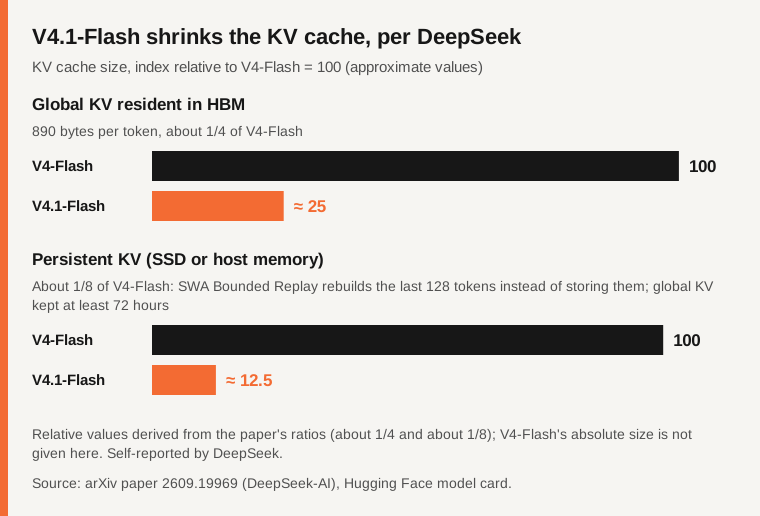
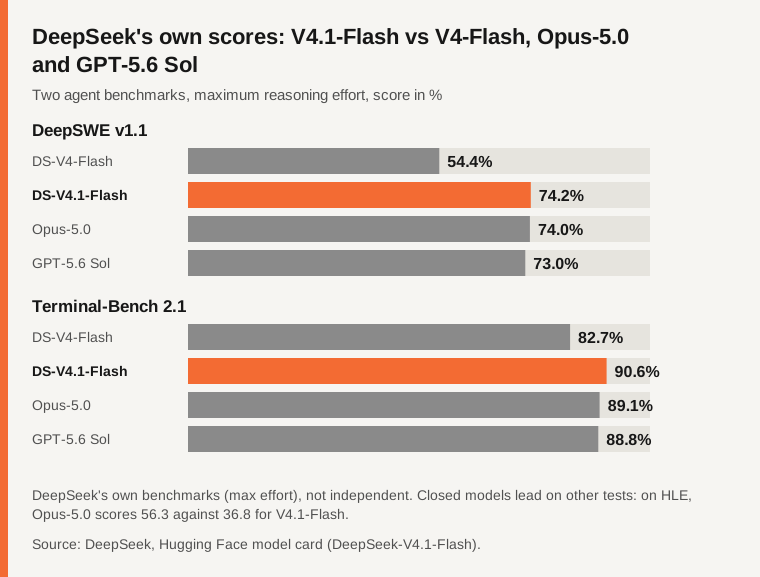
- Key figures, per DeepSeek: global KV about 1/4 of V4-Flash, persistent KV about 1/8; 74.2 on DeepSWE v1.1 and 90.6 on Terminal-Bench 2.1 (77.0 on DeepSWE after 1017).
- Usage:
deepseek-flashfrom $0.15 per million cache-miss input tokens off-peak ($0.30 at peak); weights on Hugging Face and ModelScope. - Not verified: independent benchmarks, real throughput, latency and serving cost, and the gap between 552B and 763B parameters.
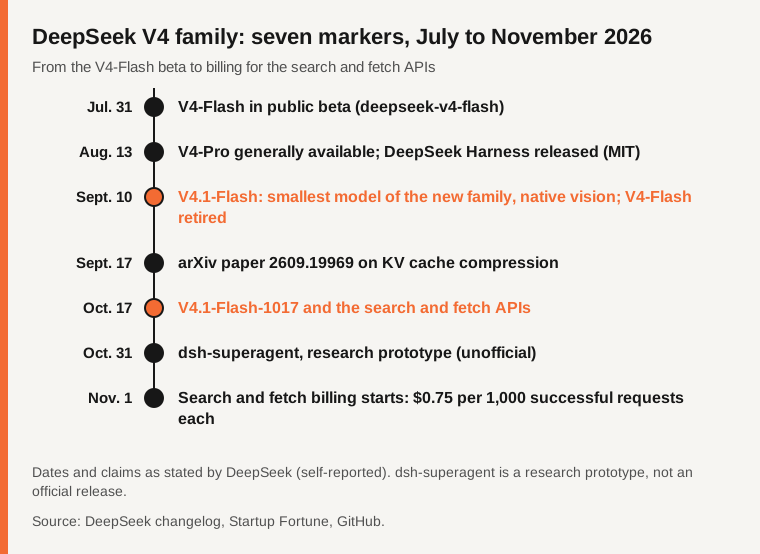
What did DeepSeek release, and in what order?
The sequence below comes from DeepSeek's API changelog, with the Harness launch date taken from Startup Fortune.
Source: DeepSeek API changelog, Startup Fortune, GitHub.
On September 10, DeepSeek called V4.1-Flash the smallest model of its new architecture family, with native image understanding. V4-Flash and V4-Flash-Vision-Exp were retired and their names redirect to it. SiliconANGLE reported an API outage of almost five hours on October 15. A research prototype, dsh-superagent, appeared on October 31; it is unofficial and covered in another article.
How does the architecture shrink the KV cache?
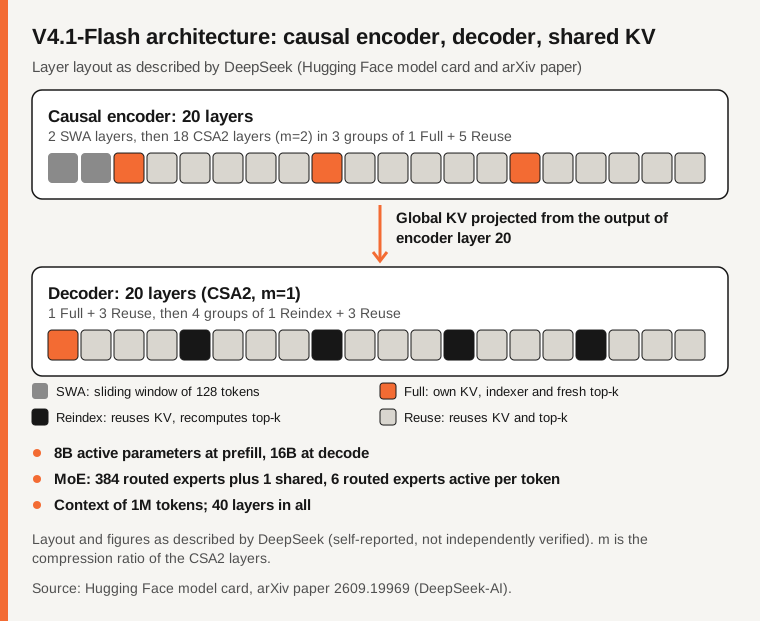
During generation, a transformer stores keys and values (the KV cache) for every earlier token, so long contexts and agent loops that re-read large inputs are limited by cache memory. DeepSeek attacks it in three places.
Source: Hugging Face model card, arXiv paper (DeepSeek).
Causal Encoder-Decoder (CED). The 40 layers (hidden size 5120) are split into a 20-layer causal encoder and a 20-layer decoder. The decoder's global KV is projected from the output of encoder layer 20, with separate weights per layer, instead of being computed from decoder states. Most prompt tokens therefore skip the full decoder at prefill; the paper puts the saving at roughly half the prefill compute. That is why 8B parameters are active at prefill and 16B at decode. The decoder's sliding-window KV is still computed per layer.
Compressed Sparse Attention 2 (CSA2). Each layer has one static mode:
- Full: computes its own main KV, indexer queries and keys, and a fresh top-k.
- Reindex: reuses the main KV and indexer keys of an earlier layer, has its own indexer query, and recomputes the top-k.
- Reuse: reuses the main KV and the top-k indices; no indexer at all.
In the encoder, layers 1 and 2 are pure sliding-window attention (SWA); 18 CSA2 layers with compression m=2 form three groups of six (1 Full + 5 Reuse). The decoder has 20 CSA2 layers with m=1: one group of 1 Full + 3 Reuse, then four groups of 1 Reindex + 3 Reuse. Top-k is 512 and the sliding window is 128 tokens. A hierarchical indexer lets the first Full layer pick 2,048 blocks of 8 positions (a pool of 16,384 positions), which only the Reindex layers score.
FP4 and SWA Bounded Replay.
- FP4: the main KV is stored in FP4 (E2M1, one E4M3 scale per 16 channels, quantized after RoPE); the SWA KV stays FP8. That roughly halves the footprint against V4's FP8. The paper is inconsistent on timing: the introduction says FP4 during training, section 2.4.4 places it in post-training QAT.
- SWA Bounded Replay: the SWA KV is no longer persisted but rebuilt by replaying the last 128 tokens. The global KV is guaranteed for at least 72 hours; the SWA KV lives in host DRAM for a few minutes.
Source: arXiv paper, Hugging Face model card. Values are relative, from the paper's ratios.
The rest of the stack, per DeepSeek:
- MoE: 1 shared plus 384 routed experts, 6 routed active per token, intermediate size 2,304, SwiGLU.
- Engram: sparse conditional memory, 196B parameters in two modules (layers 1 and 14).
- DSpark: speculative decoding with a 3-block drafter predicting 5 positions in parallel. The part of the paper we read gives no acceptance rate or speedup.
The paper's only quantitative efficiency claim is that decode FLOPs grow by about a quarter when context goes from 4K to 1M. The parts we read give no breakdown of the 890 bytes, throughput, latency or ablations.
What does DeepSeek measure, and against whom?
Training used 45T tokens (text to multimodal 7:1), with context extended to 1M at 34T tokens. Post-training runs SFT, RL, then on-policy distillation; the model card credits the gains to the data pipeline (synthesized agent tasks and environments), not a new algorithm.
Source: Hugging Face model card. Benchmarks by DeepSeek, not independent.
DeepSeek's table also compares with Opus-5.0 (Anthropic) and GPT-5.6 Sol; we report the numbers as published. Per DeepSeek, V4.1-Flash scores 90.9 on GPQA Diamond (Opus-5.0 93.4, GPT-5.6 Sol 94.1), 30.0 on Terminal-Bench 3.0 (43.3 and 34.4), and 36.8 on HLE (56.3 and 44.5; text-only subsets are marked separately). It reports 88.1 on CyberGym (GPT-5.6 Sol 84.5) and 54.8 on AutomationBench (50.3 and 45.8). So, according to DeepSeek's own table, the closed models stay ahead on several tests (HLE, Terminal-Bench 3.0, some visual ones such as ZeroBench, 49.0 versus 53.0 for GPT-5.6 Sol). SiliconANGLE counts Opus-5.0 ahead on 7 of the 11 benchmarks published for the update.
Base models, per the model card:
| Benchmark | V4-Flash-Base | V4-Pro-Base | V4.1-Flash-Base |
|---|---|---|---|
| MMLU-Pro | 68.3 | 73.5 | 74.1 |
| HumanEval | 69.5 | 76.8 | 79.4 |
| SimpleQA-Verified | 30.1 | 55.2 | 42.3 |
| MATH | 57.4 | 64.5 | 61.1 |
| LongBench-V2 | 44.7 | 51.5 | 45.2 |
V4-Pro-Base has 1.6T parameters and stays ahead of V4.1-Flash-Base on SimpleQA-Verified, MATH and LongBench-V2.
What does the 1017 update change?
V4.1-Flash-1017 keeps the id deepseek-flash and the same prices. DeepSeek reports gains from September to 1017: HLE without tools from 36.8 to 42.6 (44.0 on text only), DeepSWE v1.1 from 74.2 to 77.0, and Terminal-Bench 4.0 from 31.2 to 42.3.
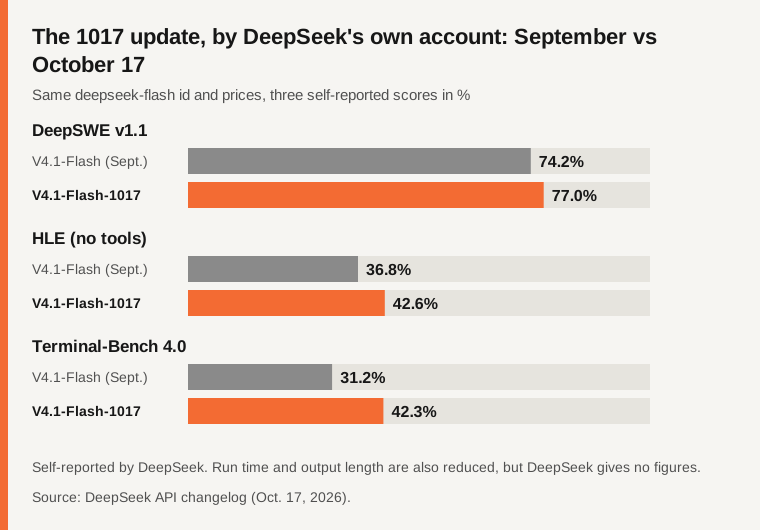
Source: DeepSeek API changelog (October 17, 2026). Self-reported.
Run time and output length were also reduced, without numbers. Harness 0.2.1-rc.1 or later is recommended, and SiliconANGLE says the model was tuned for Harness and for Tencent's CodeBuddy and WorkBuddy. DeepSeek calls the release a Pareto improvement in performance and cost; Startup Fortune notes that this is DeepSeek's own judgment and that the timing favors its in-house stack, though the MIT license lets others use the model in competing tools. Neomanex notes that no pinned version is announced: re-run your evaluations, since shorter outputs can break parsers and token budgets.
What does reasoning cost, and how do you tune it?
Reasoning effort is adjustable from 1 to 100; in the API, max is 100, high is 75 and low is 50, and the instruct results use 100.
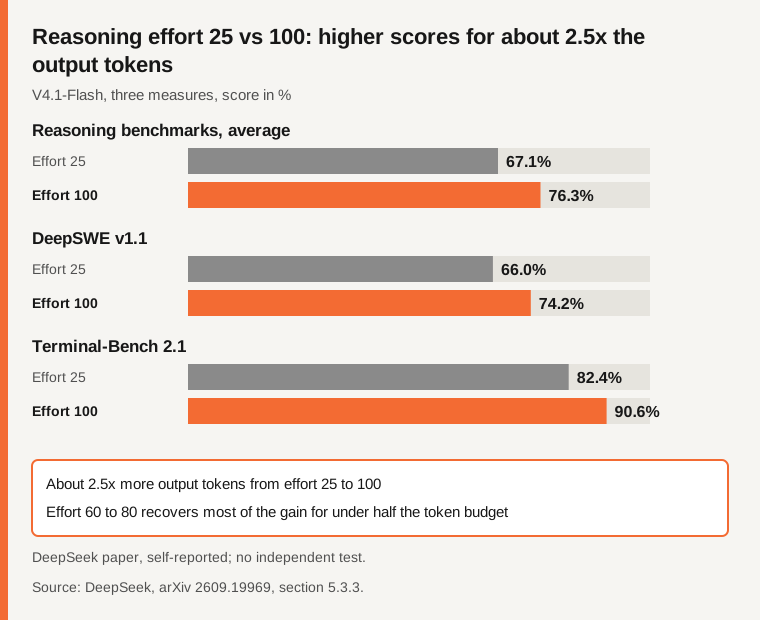
Source: arXiv paper, section 5.3.3. Self-reported.
Going from effort 25 to 100 costs about 2.5 times more output tokens; efforts of 60 to 80 capture most of the gain for under half the tokens. The scaffold matters too (DeepSWE v1.1 / Terminal-Bench 2.1, per the model card): mini-SWE 74.2 / 90.3, DSH Minimal 72.6 / 90.6, DSH Standard 70.5 / 85.8; other harnesses (Claude Code, Codex, OpenCode, Pi) score 65.5 to 69.8 on DeepSWE, and Terminal-Bench 2.1 runs from 84.1 (Codex) to 90.6. With several agents, the paper reports ProgramBench Almost@1 of 30.04% at 8 hours against 20.39% for one agent.
What does it cost and how do you use it?
deepseek-flash is V4.1-Flash-1017; deepseek-v4-pro is V4-Pro-0813. Old names redirect to Flash at Flash prices. Both offer 1M context, 384K maximum output, thinking and non-thinking modes, JSON, tool calls, the Responses API and an Anthropic-compatible API; vision is Flash only.
| Price per million tokens | Flash off-peak | Flash peak | Pro off-peak | Pro peak |
|---|---|---|---|---|
| Input, cache hit | $0.003 | $0.006 | $0.022 | $0.044 |
| Input, cache miss | $0.15 | $0.30 | $0.66 | $1.32 |
| Output | $0.60 | $1.20 | $1.98 | $3.96 |
Peak hours are 01:00 to 04:00 and 06:00 to 10:00 UTC, Monday to Friday excluding Chinese public holidays; the rest is off-peak.
- Search and fetch API: $0.75 per 1,000 successful requests each, free until November 1 and billed per request from 00:00 Beijing time on November 1, 2026. Search returns up to 50 ranked results; Fetch converts a page to Markdown (SiliconANGLE). It can be called server-side through Harness, Claude Code or Codex.
- DeepSeek Harness: official open-source agent framework (
dsh, MIT), everything is a plugin (model adapters, tools, logs, agent loops), with a web interface; repository github.com/deepseek-ai/deepseek-harness. Reported star counts diverge between sources (Startup Fortune, HelloGitHub), so we give none. - Running it yourself:
vllm serve "deepseek-ai/DeepSeek-V4.1-Flash"(OpenAI-compatible, image input) orpython3 -m sglang.launch_server --model-path "deepseek-ai/DeepSeek-V4.1-Flash", or Transformers withdevice_map="auto". There is no Jinja chat template: use the reference Python in theencodingfolder, or the Rust librarydeepseek-recipein production. The card gives no minimum hardware.
What is not established?
No independent test exists that we could find, and the comparisons with Opus-5.0 and GPT-5.6 Sol are DeepSeek's. The card and paper say 552B backbone parameters, while the Safetensors metadata shows 763B; perhaps Engram's 196B or the vision encoder, but this is not confirmed. Real throughput, latency and serving cost are unpublished, ablations are not quantified, DSpark's real gain is unknown, and minimum hardware is not stated. We did not measure the 1017 effect on long outputs.
Summary table
| Point | What sources say as of Nov 2, 2026 | Source |
|---|---|---|
| Model | Multimodal MoE, MIT, 1M context, 8B active at prefill / 16B at decode | Hugging Face, arXiv |
| Size | 552B backbone in the text; 763B in metadata, unexplained | Hugging Face |
| Global KV | 890 bytes per token, about 1/4 of V4-Flash | arXiv |
| Persistent KV | About 1/8 of V4-Flash, via SWA Bounded Replay | arXiv |
| Benchmarks | DeepSWE 74.2 (77.0 in 1017), Terminal-Bench 2.1 90.6; self-reported | Hugging Face, changelog |
| Price | Flash $0.15 / $0.60 off-peak, $0.30 / $1.20 peak (cache miss / output) | DeepSeek pricing |
| Independent tests | None found | n/a |
Frequently asked questions
Is the model really 4x lighter?
No. According to DeepSeek, it is the global KV cache in HBM that is about a quarter of V4-Flash's (890 bytes per token), not the model. The text says 552B parameters and the metadata 763B, unexplained.
Can I run it myself?
The weights are MIT and the card documents vLLM, SGLang and Transformers. It states no minimum hardware, so we cannot say what you need.
Does the 1017 update change the price or the id?
No. The id stays deepseek-flash and prices are identical. No pinned version is announced, so re-run your evaluations.
Does DeepSeek beat the closed models?
According to DeepSeek, it is ahead on some agent tests and behind on others (HLE, Terminal-Bench 3.0, some visual tests). There is no independent test.
Method and limits
We read the Hugging Face model card (through an automatic summary, so figures should be cross-checked), about two thirds of the arXiv paper, DeepSeek's changelog and pricing page, and secondary sources of uneven quality (Neomanex, HelloGitHub). We did not test the model, and found no ablation or throughput measurement in the paper. This is not buying or investment advice.
Sources
- Hugging Face: DeepSeek-V4.1-Flash model card (verified 2026-11-02)
- arXiv 2609.19969: DeepSeek-V4.1-Flash, Pushing the Limits of KV Cache Compression (verified 2026-11-02)
- DeepSeek API: updates (changelog) (verified 2026-11-02)
- DeepSeek API: models and pricing (verified 2026-11-02)
- SiliconANGLE: DeepSeek releases updated V4.1-Flash model (verified 2026-11-02)
- Startup Fortune: DeepSeek ties its new V4.1-Flash-1017 model tighter to its own Harness (verified 2026-11-02)
- Neomanex: DeepSeek V4.1-Flash-1017, same Flash id, same price (verified 2026-11-02)
- HelloGitHub: deepseek-harness (verified 2026-11-02)
Spotted an error in this article? Report it · Our corrections policy