Analysis
OpenAI says its upcoming cyber model validated and wrote candidate fixes for 948 Linux kernel privilege escalation flaws for $1.2 million, but the figures are its own
OpenAI says an unnamed cyber model found 948 Linux kernel privilege escalation flaws, each with a candidate fix, for $1.2 million. Figures are its own.
On November 4, 2026, OpenAI said that in one run in mid-October, an autonomous agent pipeline built on an upcoming, unnamed cyber model validated 948 unique local privilege escalation (LPE) flaws in the Linux kernel and produced a candidate fix for each, for $1,213,430 in API credits. The figures are OpenAI's, and no outside verification has been published. This is neither investment, legal nor security advice.
The essentials
- Claim: 948 unique LPE flaws, each with a candidate fix, for about $1.2 million, or about $1,279 per flaw (OpenAI).
- Not yet fixed: ten days after the analysis, OpenAI counts 61 fixed in the mainline branch and 43 fixes in preparation.
- Scope: the cost covers the whole pipeline; exploitation alone is $775,929.
- Not established: independent checks, the real number of distinct flaws, how many patches will be accepted.
What does OpenAI say?
OpenAI says its goal is to help defenders find and fix flaws before attackers can use them. Scout agents split about 7% of the kernel (about 2.8 million lines) into 5,034 audit areas; analysts produced 2,308 candidates in 12 hours; dynamic validation reproduced 1,724 in 30 hours (74.7%), while 3.1% rested on a faulty analysis by the model. Triage kept 313 information leaks and 1,238 LPE candidates. Exploitation gave 291 information-leak proofs of concept and 1,169 working LPE exploits, grouped by variant analysis into 948 unique LPEs. The target was the latest development kernel (over 40 million lines, per AI Weekly), run in virtual machines. In an early trial, 20 of 200 "successful" exploits hit another zero-day than assigned, so a path check was added.
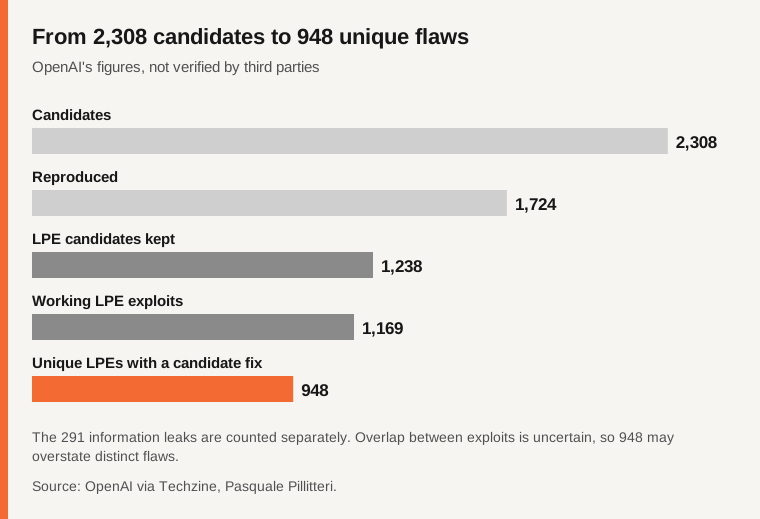
Source: OpenAI via Techzine, Pasquale Pillitteri.
Where does the money go?
By stage, OpenAI gives $3,426 for reconnaissance, $316,549 for analysis, $73,330 for validation, $44,194 for triage and $775,929 for exploitation. A successful exploit cost $360 on average; the 69 failures averaged $3,922. OpenAI calls the spend a ceiling: capacity was measured, not cost optimized. Its hypothetical comparison: past bounties of $20,000 to $70,000 per kernel LPE would imply $18.9 to $66.3 million for 948, 16 to 55 times the spend; this is not a market price or an announced bounty.
How many patches are actually merged?
OpenAI says a human researcher reviews each exploit, fix and severity before reporting to maintainers. Hundreds of reports with fixes went out for critical flaws, most severe first; the rest will follow in waves with partners (Patch the Planet, Trail of Bits, the Daybreak program). Ten days after the analysis: 61 LPEs fixed in the mainline branch, 43 with fixes in preparation, 299 reported and publicly discussed. OpenAI withholds details of at least ten new exploitation techniques (Techzine) and warns that, until patches are deployed, a limited-privilege account on an unpatched system equals root access for a well-resourced attacker.
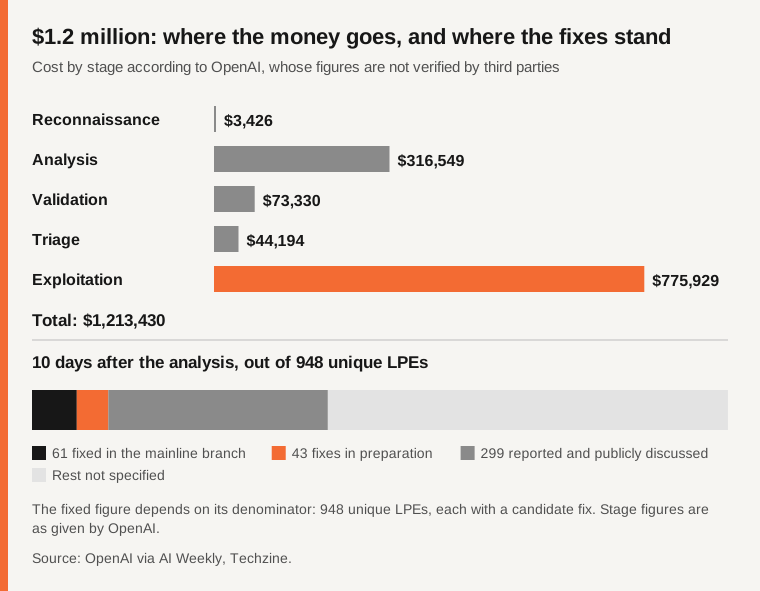
Source: OpenAI via AI Weekly, Techzine.
What does the press note?
All figures come from OpenAI; no CVEs or commit list are published. Overlap between exploits is uncertain, so 948 may overstate distinct flaws (Techzine). The fixes are candidates and the number accepted is not given; early fixes may include unneeded code or incomplete variant coverage. AI Weekly's editorial view is that maintainer capacity, more than the model, could be the bottleneck.
So "OpenAI fixes Linux in bulk" overstates: the fixes are candidates, 948 follows the grouping of 1,169 exploits, and the model is unnamed.
What is not established?
Distinct exploitable flaws outside OpenAI's conditions; accepted patches; each flaw's severity; the model's name, date and price; third-party reproducibility; cost equivalence with human work.
Comparison table
| Point | What the sources say | Status |
|---|---|---|
| Result | 948 unique LPEs with candidate fixes, $1,213,430 (OpenAI) | Announced by OpenAI |
| Cost per flaw | About $1,279 (OpenAI) | Announced by OpenAI |
| Mainline fixes | 61 after ten days, 43 in preparation (OpenAI) | Announced by OpenAI |
| Bounty comparison | $18.9 to $66.3 million, hypothetical (OpenAI) | Announced by OpenAI |
| Distinct flaws | 948 may overstate them (Techzine) | Reported |
| CVEs, accepted patches, model name | None published | Not established |
Frequently asked questions
Did OpenAI fix 948 kernel flaws?
No. It says it produced candidate fixes for 948 unique flaws; after ten days it counts 61 fixed in the mainline branch and 43 in preparation.
What do the $1.2 million cover?
The whole pipeline; exploitation alone is $775,929.
Are the figures verified?
No outside verification has been published; they come from OpenAI.
Method and limits
Sources as of November 5, 2026. Figures are OpenAI's, relayed by the outlets listed and attributed to each. We tested nothing and give no advice.
Sources
Spotted an error in this article? Report it · Our corrections policy