Analysis
OpenAI says Images 2.6 is about 50% faster and adds animated GIFs in ChatGPT, Codex and the API, with per-token prices unchanged
OpenAI says Images 2.6 is about 50% faster and adds animated GIFs in ChatGPT, Codex and the API. Token prices are unchanged; the speed claim is its own.
On November 4, 2026, OpenAI announced Images 2.6, its image generation model, about two months after Images 2.5. OpenAI says images are generated about 50% faster and that ChatGPT can now produce animated GIFs; the model is available worldwide in ChatGPT and Codex on all plans (Free included, per heise, TestingCatalog and eesel) and through the API. The speed claim is OpenAI's and has not been independently verified. This is neither purchasing, investment nor legal advice.
The essentials
- Speed: about 50% faster per OpenAI; the comparison base is not named (heise).
- GIFs: a first for a ChatGPT model, rolling out gradually in ChatGPT (heise); an output format in the API.
- Price: per-token prices unchanged, but eesel, citing OpenAI's calculator, reports more output tokens at low and medium quality.
- Not established: the basis of the 50%, GIF rollout by plan, your real cost, GIF features in Codex.
What does OpenAI say?
OpenAI says images are generated about 50% faster; heise notes that the comparison base is not named, implicitly Images 2.5. OpenAI also says about 4 billion images are generated each week across ChatGPT, Codex and the API.
What changes in ChatGPT, Codex and the API?
In ChatGPT, this is the first time a ChatGPT model generates GIFs (OpenAI): users describe the subject and its motion or upload photos or sketches, adjust the speed, then edit by text, though not existing GIFs (heise). The rollout is gradual (heise), and eesel notes that no per-plan limits were published at launch. Saved reference images (yourself, pets, characters) can be reused without a new upload. For Codex, the sources mention only the model's availability.
In the API (identifiers per eesel), gpt-image-2.6-flare targets speed and gpt-image-2.6-sunburst targets detail and edit consistency; both existed with Images 2.5 (heise). For GIFs, the generation endpoint takes output_format set to gif, frame_count from 2 to 64 (default 9) and frame_duration_ms from 20 to 2,000 (default 200); the edit endpoint, streaming and partial images are not supported (eesel). SVG output is API-only and takes two model calls, at an extra cost with no fixed published price. The API also adds image annotation (markup) to mark areas to edit, and a complexity parameter (low, medium or high; default high; no charge of its own); eesel reports that OpenAI recommends low for most edits.
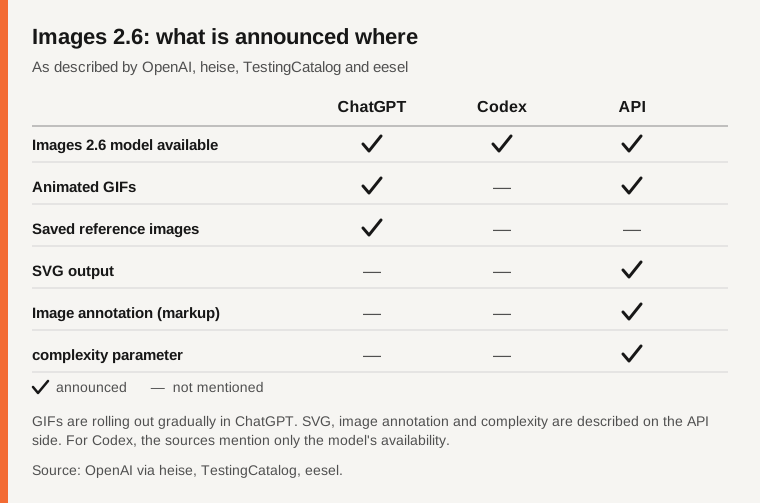
Source: OpenAI via heise, TestingCatalog, eesel.
What about the cost?
Per-million-token API prices are unchanged since Images 2.5: $5 for text input, $8 for image input and $30 for image output. According to OpenAI's calculator as reported by eesel, output tokens for a 1024×1024 image go from 196 to 823 at low quality (about $0.0059 to $0.0247), from 439 to 1,449 at medium (about $0.0132 to $0.0435), and stay unchanged at high (about $0.0527). At an equal per-token price, the cost of a low or medium image therefore rises on these figures; check it against your own requests.
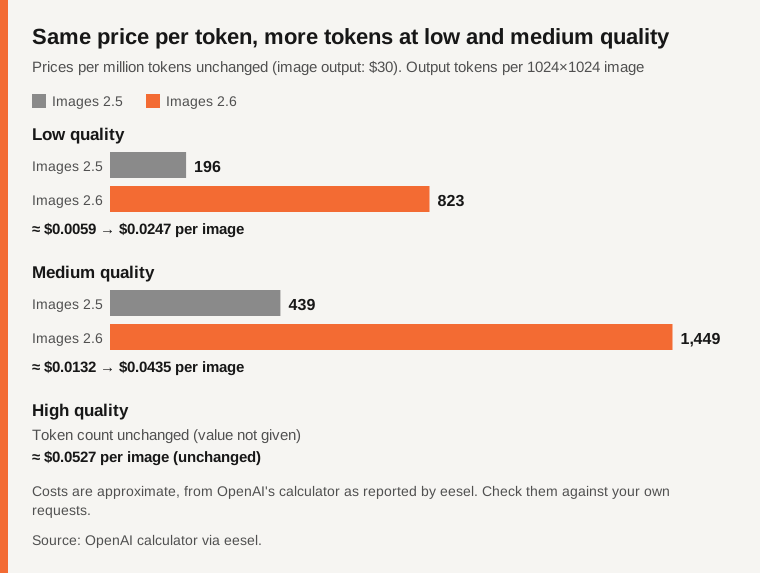
Source: OpenAI calculator via eesel.
Limits and provenance
OpenAI acknowledges limits on text, complex layouts and character consistency (heise). Images carry C2PA metadata and a SynthID watermark. In the system card, per eesel, moderation caught 77.7% of a targeted set of rule-violating GIFs; this was an adversarial set, not a production rate.
What is not established?
The basis of the 50% (model, quality, size); GIF rollout by plan; your real cost; GIF features in Codex beyond the model's availability; independent verification of the speed claim.
Comparison table
| Point | What the sources say | Status |
|---|---|---|
| Speed | About 50% faster; base not named (OpenAI, heise) | Announced by OpenAI |
| Animated GIFs | ChatGPT, gradual rollout; API with 2 to 64 frames (heise, eesel) | Reported |
| Tokens per image | Low 196 to 823, medium 439 to 1,449, high unchanged (eesel) | Reported |
| Basis of the 50%, GIF rollout by plan, GIFs in Codex | No source | Not established |
Frequently asked questions
Is Images 2.6 really 50% faster?
OpenAI says so; heise notes that the comparison base is not named, and no independent verification has been published.
Are GIFs available everywhere?
Not necessarily: the ChatGPT rollout is gradual and no per-plan limits were published at launch (eesel). In the API, GIF output works on the generation endpoint, not the edit endpoint.
Does the price go down or up?
Per-token prices are unchanged, but according to OpenAI's calculator as reported by eesel, low and medium images use more output tokens, so their cost rises; high is unchanged.
Method and limits
Sources as of November 5, 2026. Facts are OpenAI's, relayed by heise, TestingCatalog and eesel and attributed to each; eesel's opinions are not reproduced. We tested nothing and give no advice.
Sources
Spotted an error in this article? Report it · Our corrections policy