Analysis
Xen advisory XSA-523 credits Anthropic's Claude with two grant copy flaws letting a guest VM read and write other domains' memory in every version since 4.6
Xen advisory XSA-523 credits Anthropic's Claude with two grant copy flaws in all versions since 4.6. No known mitigation; severity is disputed.
Xen advisory XSA-523 (version 2) went public on November 3, 2026, titled "arbitrary read/write via grant copy". It covers two flaws, CVE-2026-102703 and CVE-2026-102704. According to the advisory, a malicious guest VM can read and write the memory of other domains, including Dom0, on every version from 4.6, and no mitigation is known. It credits Anthropic, working with Claude. This is neither investment, legal nor security advice.
The essentials
- Scope: every version from 4.6; 4.5 and earlier are not affected. Patches exist only for xen-unstable and 4.17 to 4.19.
- Severity: the advisory gives none; several outlets say critical, while a CVSS 4.4 (medium) circulates.
- Claude: the advisory credits Anthropic with Claude; the method is unpublished.
- Not established: real severity, past exploitation, affected architectures.
What do the advisory and the CVEs say?
CVE-2026-102703: frame numbers and grant references can be confused when a batch of Grant Copy operations reuses cached validation data. CVE-2026-102704: copying by frame number should be allowed only for the caller's own memory, but the check enforcing it is misplaced. In outline, batches often target adjacent ranges of the same page, so Xen caches validated details for speed, and in some cases the revalidation rules were wrong. The CVEs were reserved on September 29, the advisory went public on November 3 and the CVE records on November 4 (OffSeq Radar). No exploitation detail is given here.
Who is affected and what to patch?
The advisory lists no architectures or required configuration. Ostorlab says any guest with a grant table can issue the operations, and that KVM, Hyper-V and VMware are not concerned because the code is specific to Xen. Patches for xen-unstable and 4.19.x are xsa523-1 and xsa523-2; for 4.18.x and 4.17.x, xsa523-4.18-1 and xsa523-4.18-2. They may not apply cleanly to the latest tarball, so the advisory recommends moving to the tip of the stable branch first. None exists for 4.6 to 4.16, described as end of life by AI Weekly and Ostorlab.
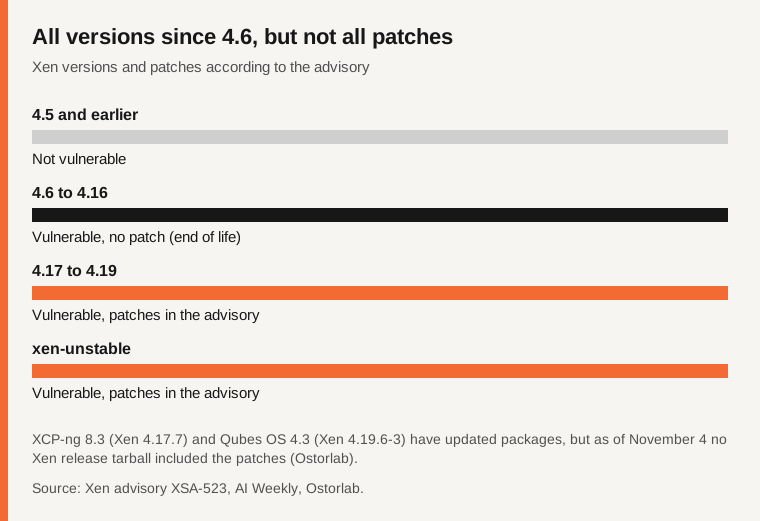
Source: Xen advisory XSA-523, AI Weekly, Ostorlab.
AI Weekly reports packages for XCP-ng 8.3 (host reboot required) and Qubes OS 4.3 (dom0 reboot required), and a SUSE update. Ostorlab says hosts running untrusted guests are exposed; a cloud customer's guest cannot see the host's patch state, so it advises asking the provider for its XSA-523 status. The sources' advice amounts to applying the vendor's patches.
How severe?
The advisory gives neither a CVSS score nor a severity rating. Several outlets, AI Weekly among them, call the flaws critical. OffSeq Radar shows a CVSS 3.1 score of 4.4 (medium) assigned by CISA-ADP, with a limited-evidence mention. That score seems at odds with the impact the advisory describes, so severity is not settled.
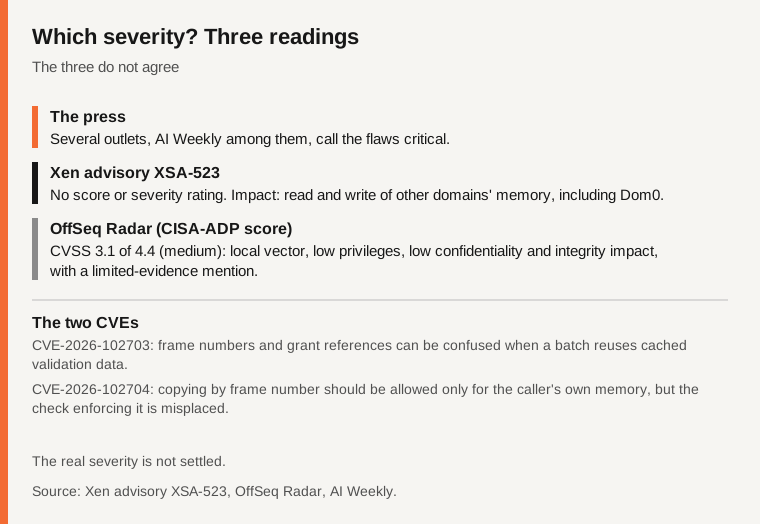
Source: Xen advisory XSA-523, OffSeq Radar, AI Weekly.
OffSeq Radar (November 5) and Ostorlab (November 4) report no public exploit code, no known exploitation and no listing in CISA's KEV catalog. Ostorlab adds that cross-domain access leaves no visible trace on the victim VM, and that patching does not show whether exploitation already happened.
What was Claude's role?
The advisory credits Anthropic with Claude, validated by Stephan Lipp (Ada Logics) and independently reported by the CodeAnt AI Security Research team. AI Weekly says the patches carry an Assisted-by: Claude tag and, in its editorial view, sees the first confirmed credit of a commercial AI on an upstream disclosure. Anthropic has not published its method (AI Weekly), so whether Claude worked unguided or with a human is unknown. See also our previous article on OpenAI's cyber pipeline and Linux kernel flaws.
So the shorthand that Claude found two critical flaws needs nuance: critical is the press's word, the advisory says read and write, a human validated the findings, and patches cover only part of the affected versions.
What is not established?
Real severity; past exploitation; affected architectures; the date of the first report; patch status at cloud providers; Claude's method and autonomy.
Comparison table
| Point | What the sources say | Status |
|---|---|---|
| Impact | A guest can read and write other domains' memory | Xen advisory |
| Versions | All from 4.6; patches for xen-unstable and 4.17 to 4.19 only | Xen advisory |
| Mitigation | None known | Xen advisory |
| Severity | Critical for several outlets; CVSS 4.4 for OffSeq Radar | Reported |
| Exploitation | No public exploit code or known exploitation | Reported |
| Real severity, Claude's autonomy | No source settles them | Not established |
Frequently asked questions
Did Claude find the flaws on its own?
Unknown. A human researcher validated them; Anthropic has not published its method (AI Weekly).
Are all versions patched?
No. Versions 4.6 to 4.16 are vulnerable and have no patch.
Are the flaws exploited?
OffSeq Radar and Ostorlab report no known exploitation, but the access leaves no visible trace on the victim VM (Ostorlab).
Method and limits
Sources as of November 5, 2026. Facts come from the Xen advisory; the other outlets are attributed. We tested nothing and give no advice.
Sources
Spotted an error in this article? Report it · Our corrections policy