Analysis
EU court adviser says chatbot answers that reuse press articles may infringe publishers' rights, in the first generative AI case
Advocate General Szpunar says chatbot answers reusing press articles may, in certain circumstances, infringe publishers' rights. Opinion not binding.
On November 3, 2026, Advocate General Maciej Szpunar advised the EU Court of Justice that chatbots which retrieve and reuse online press publications in real time to answer users may, in certain circumstances, infringe press publishers' rights. The Court calls this the first generative AI case to reach it. The opinion does not bind the Court, which will rule later. We read the Court's press release, not the full text of the opinion.
The essentials
- The case: Case C-250/25 Like Company, a Hungarian operator of web portals, against Google over the answers of its Gemini chatbot, referred by a Budapest court.
- The core view: chatbot answers may, in certain circumstances, infringe the press publisher's right. Two factors matter: how the publication was accessed, and whether the answer reuses its form of expression recognisably.
- Training: the two questions on training are inadmissible in his view. In passing, he suggests that training is, as a rule, freely allowed by the text and data mining exception.
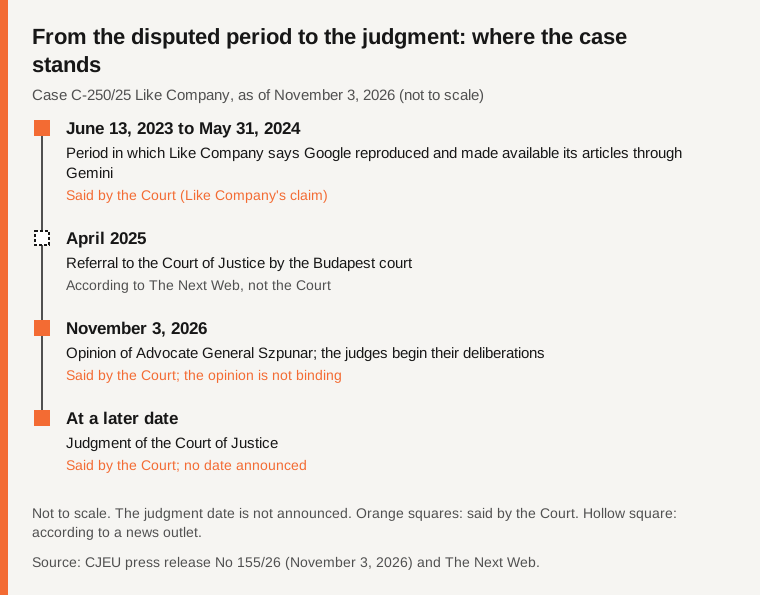
- Status: the opinion is not binding. The judges begin their deliberations and the judgment comes at a later date, which the Court does not give.
For a lawsuit by newspapers over AI search, see our article on the New York Times and Brave.
What does the Advocate General say?
Szpunar advises the Court to say that the real-time retrieval and reuse of online press publications by AI chatbots, to generate answers for users, may in certain circumstances infringe press publishers' rights. The case concerns Alphabet (Google Ireland), which provides Google Gemini, a generative AI chatbot based on large language models (LLMs). Gemini uses Retrieval-Augmented Generation to collect information from the web in real time.
Like Company brought the case before the regional court of Budapest. It claims its articles are protected by the press publisher's neighbouring right (Article 15(1) of Directive (EU) 2019/790) and says Google reproduced them and made them available to the public through Gemini several times between June 13, 2023 and May 31, 2024. The Hungarian judge asked four questions: two on training an LLM and two on chatbot answers.
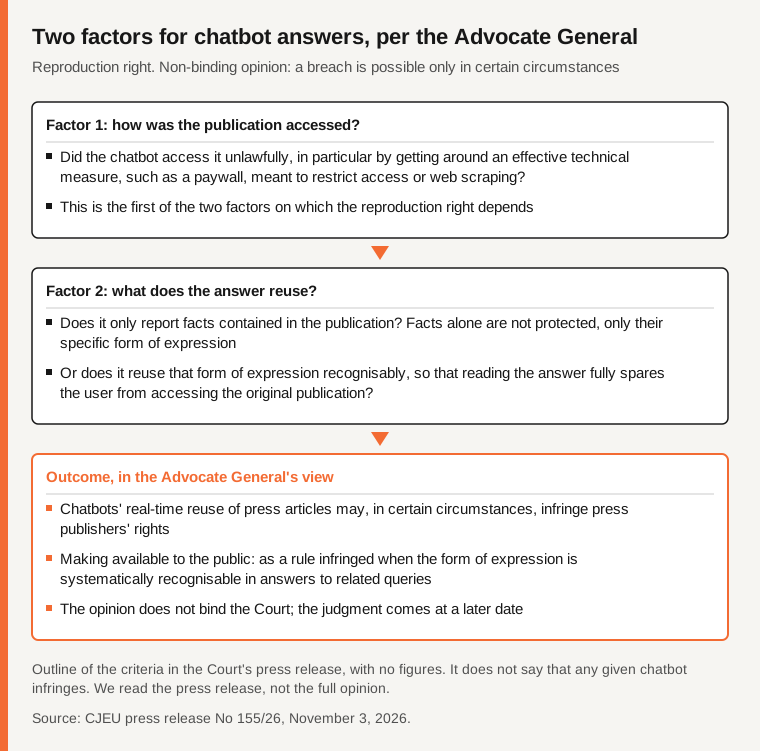
The right does not protect mere facts, only their specific form of expression. Its purpose is to protect the investment in the publication, not to give a monopoly on news.
Which criteria apply to chatbot answers?
For the reproduction right, the opinion points to two factors. First, did the chatbot access the publication unlawfully, in particular by getting around effective technical measures, such as a paywall, meant to restrict access or web scraping? Second, does the answer only report facts contained in the publication, or does it reuse its form of expression recognisably, so that the user, by reading the answer, is fully spared from accessing the original publication?
For the right of making available to the public, the right is as a rule infringed when the form of expression of the publication is systematically recognisable in the chatbot's answers to related user queries.
Source: CJEU press release No 155/26.
The provider of the online chatbot is liable for these potential acts when they are inherent to its business model, or when it has not put in place appropriate measures to combat them credibly and effectively.
What about training?
The Advocate General advises declaring the two training questions inadmissible. There is no evidence that the articles were used to train Gemini's LLMs, so the questions are hypothetical, he says. For completeness, he suggests that using protected works to train an LLM is, as a rule, freely allowed by the text and data mining exception (Article 4 of the directive). Some outlets summarise this as training is allowed. That simplifies: the Court's release treats the training questions as inadmissible and presents the remark as a complement.
What does Google say?
We read no statement from Google. The Next Web and Dataconomy, read through automatic summaries, report Google's position: Gemini does not memorise articles, any contested outputs would fall under the exceptions for temporary copies and for text and data mining, and Google disputes that Hungarian law applies, since Gemini was not trained in Hungary. The Next Web, which attributes its information to Reuters, dates the referral by the Budapest court to April 2025.
What is not established?
Source: CJEU press release No 155/26, The Next Web.
Whether the Court will follow its Advocate General: the relays say judges mostly do, a general statement they do not source. When it will rule: the Court gives no date. Whether any Gemini answer actually infringed: a preliminary reference is not the judgment of the national dispute, and the Hungarian court decides after the Court's judgment. We also did not read the full opinion, a reaction from Like Company or a Google statement.
Comparison table
| Point | What the sources say | Source |
|---|---|---|
| Opinion | Real-time retrieval and reuse by chatbots may, in certain circumstances, infringe press publishers' rights | CJEU |
| The case | The first generative AI case to reach the Court of Justice, in the Court's words | CJEU |
| Reproduction right | Depends on lawful access (paywall) and on facts versus recognisable form of expression | CJEU |
| Making available | As a rule infringed when the form of expression is systematically recognisable | CJEU |
| Liability | Provider liable if inherent to its business model or without credible, effective measures | CJEU |
| Training | Two questions inadmissible; remark that training is as a rule freely allowed by text and data mining | CJEU |
| Binding force | None; judgment at a later date, no date given | CJEU |
| Google's position | Does not memorise articles; exceptions apply; disputes Hungarian law | The Next Web, Dataconomy |
| Referral | April 2025 | The Next Web |
Frequently asked questions
Has the chatbot been found liable?
No. The Advocate General is not the Court, and his opinion does not bind it. Even after the judgment, it is for the Hungarian court to decide the dispute.
Can a chatbot summarise the news?
The release says the right does not protect mere facts, only their specific form of expression. Whether an answer crosses the line depends on the two factors above. We tested no chatbot.
When will the Court rule?
The Court gives no date. It says the judgment will be delivered at a later date.
Method and limits
We read the Court's press release in full, as text extracted from a PDF with a few words missing, but not the full text of the opinion. The Next Web and Dataconomy were read through automatic summaries. We read no reaction from Like Company and no Google statement; Google's position comes from the relays. There is no judgment yet and we tested no chatbot. This is neither legal nor investment advice.
Sources
- CJEU press release No 155/26, Opinion of Advocate General Szpunar in Case C-250/25 Like Company (November 3, 2026), read in full (text extracted from the PDF)
- The Next Web, read via an automatic summary
- Dataconomy (November 3), read via an automatic summary
Spotted an error in this article? Report it · Our corrections policy