Analysis
LeCun and Balestriero report JEPAs align text and images with 42 times fewer samples
A v1 arXiv preprint by Balestriero and LeCun reports a JEPA text encoder matching next-token image alignment with 42 times fewer samples. Authors' results.
- Models
- #JEPA
- #Yann LeCun
- #Randall Balestriero
- #representation learning
- #next-token prediction
- #Platonic representation
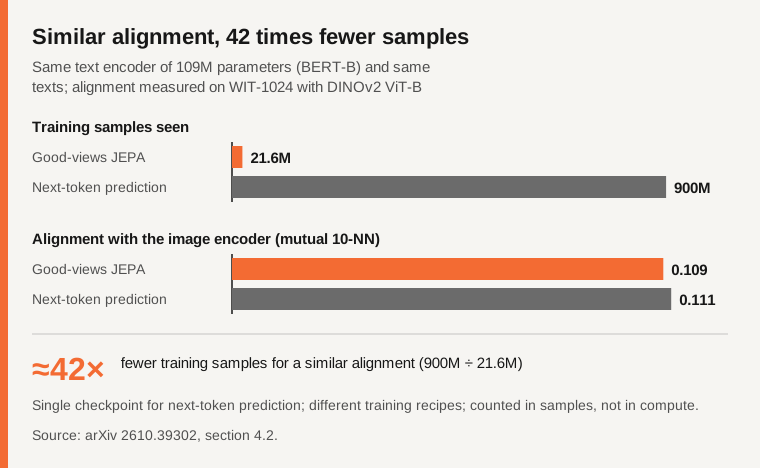
As of November 3, 2026, a preprint by Randall Balestriero and Yann LeCun (arXiv 2610.39302, version 1, October 29, 2026) reports that a text encoder trained as a JEPA reaches about the same alignment with an image model as next-token prediction (0.109 against 0.111), using 21.6 million training samples instead of 900 million, about 42 times fewer. These are the authors' results, not independently replicated to our knowledge.
The essentials
- What the authors prove: under idealized assumptions, separately trained JEPAs converge to the same representation up to a rotation.
- What the 42x measures: training samples at one checkpoint, for one alignment score. It is not a compute saving.
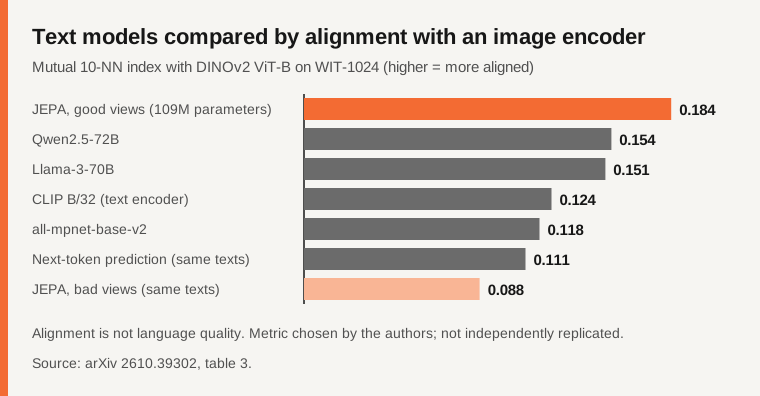
- What the 109M versus 72B table shows: a 109-million-parameter JEPA text encoder scores higher on one image-alignment index than 70-billion-class language models.
- What is not established: that this improves language quality, or that other teams get the same numbers.
What is the Platonic representation hypothesis?
The hypothesis (Huh et al.) says that models trained separately, even on different kinds of data, drift toward one shared picture of the world. It has been observed, not proved. A JEPA (joint-embedding predictive architecture) trains a context encoder and a target encoder to bring the embeddings of two related "views" of the same thing close together. "Alignment" here means that two models' embeddings place the same items near the same neighbors.
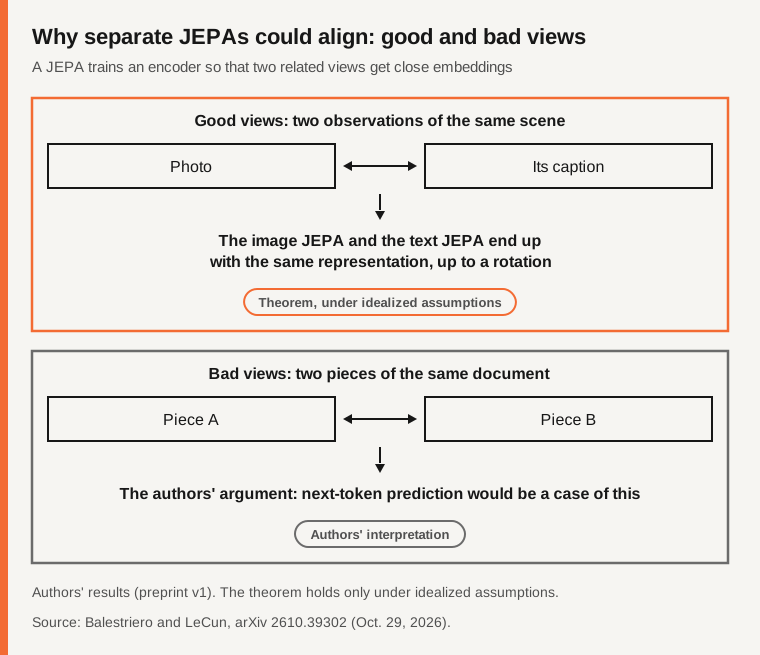
The preprint's main theorem says that if every modality shares the same distribution of positive pairs, and the minimizers are unique up to a rotation, all encoders coincide up to a rotation. About k well-placed pairs would find that rotation.
The distinction that matters is between "good views" and "bad views". Good views are two observations of one scene, such as a photo and its caption. Bad views are two pieces of one document. The authors argue, as an interpretation they present as a hypothesis to test, that next-token prediction is a JEPA with bad views, so language models would align with vision only at large scale.
Source: Balestriero and LeCun, arXiv 2610.39302.
The theorem assumes idealized optima, a finite world, an identity predictor and uniqueness up to a rotation. It does not cover JEPAs with a learned predictor.
What exactly does "42 times fewer" measure?
The comparison (section 4.2) uses the same 109-million-parameter text encoder (BERT-B) and the same web image captions (Recap-DataComp). Alignment is the mutual 10-nearest-neighbor index against DINOv2 ViT-B on WIT-1024. The JEPA with good views scores 0.109 after 21.6 million samples. Next-token prediction scores 0.111 after 900 million. The ratio, 900 over 21.6, is about 42.
Source: arXiv 2610.39302, section 4.2.
Three caveats from the text. The two runs use different recipes, with different learning rates and batch sizes. There is a single checkpoint for next-token prediction, not a matched learning curve. And the count is in samples, not compute. At equal samples (21.6 million, with a 33-million-parameter encoder), the authors report a larger gap, 0.108 against 0.071.
How does it compare with large language models?
On the same index (WIT-1024 with DINOv2 ViT-B), the authors' table 3 gives 0.184 for the 109-million-parameter JEPA, 0.154 for Qwen2.5-72B and 0.151 for Llama-3-70B. The text encoder of CLIP B/32 gets 0.124, all-mpnet-base-v2 0.118, next-token prediction on the same texts 0.111, and a bad-views JEPA 0.088.
Source: arXiv 2610.39302, table 3.
Other measures lean the same way: linear CKA of 0.507 against 0.418 for Qwen2.5-72B, and 0.161 against 0.108 on COCO. But the JEPA does not win everywhere. In Flickr image retrieval (R@1) it scores 0.478, slightly below CLIP's text encoder (0.489) and all-mpnet (0.481), which were trained on pairs. The abstract also reports 64% top-5 zero-shot accuracy on ImageNet-100 without paired data, against at most 56% for language models up to 8 billion parameters.
What limits do the authors acknowledge?
A fourth random seed with a doubled SIGReg weight gave 0.121, which brings the four-seed mean to 0.168, still above every language model in the table. The model that wrote most captions sees images through CLIP ViT-L/14. At least 43 of the 1,024 WIT captions appear in the training texts, though removing them changes the score by less than 0.002. The bad-views JEPA at 940 million samples is a single seed. Three of 36 runs collapsed without gradient clipping.
What is not established?
That alignment with vision improves language or reasoning quality. That the result holds with other recipes, datasets or metrics. Independent replication and peer review, which we have not seen. Total compute, since comparisons are in samples. Startup Fortune (November 1) relayed the figures; it is a single press source.
Comparison table
| Point | What sources say as of Nov 3, 2026 | Source |
|---|---|---|
| Theorem | Separately trained JEPAs coincide up to a rotation, under idealized assumptions | arXiv 2610.39302 |
| 42x | 21.6M samples at 0.109 versus 900M at 0.111; one checkpoint, different recipes | arXiv 2610.39302 |
| 109M vs 72B | Mutual 10-NN 0.184 versus 0.154 (Qwen2.5-72B), against DINOv2 ViT-B | arXiv 2610.39302 |
| Replication | None reported to our knowledge; preprint v1 | arXiv, Startup Fortune |
Frequently asked questions
Does JEPA beat large language models?
Not established. The measure is alignment with image encoders, not language quality.
Is the 42x a compute saving?
No. It counts training samples, at a single checkpoint, with different recipes.
Has the result been reproduced?
Not to our knowledge. This is version 1 of a preprint.
Method and limits
We read the preprint on November 3, 2026 through automated summaries of the abstract and HTML version, about 100,000 of 255,000 characters. Sections 6 and 7, the appendices and the end of 5.2 were not read. We ran no tests, found no independent check, and give no investment advice.
Sources
- Balestriero and LeCun, Proving and Improving the Platonic Representation Hypothesis with JEPAs, arXiv 2610.39302 (October 29, 2026) (verified 2026-11-03)
- arXiv 2610.39302, HTML version (verified 2026-11-03)
- Startup Fortune (November 1, 2026), secondary source (verified 2026-11-03)
Spotted an error in this article? Report it · Our corrections policy