Analysis
Revolut makes self-hosted GLM its default for AI coding and says costs fell about 90%, with Claude Code and Codex now the exception, per a talk reported by The Register
Revolut says self-hosted GLM is now its default for AI coding, with Claude Code and Codex the exception, and that costs fell about 90%. Unverified.
On November 3, 2026, The Register (Tobias Mann) reported a talk by David Abitbol, Revolut's head of operations and infrastructure, at the AI Engineer conference in New York in October 2026. According to the report, Revolut has made self-hosted models its default for AI-assisted coding, rather than commercial services such as Claude. The figures are Revolut's own and not independently verified. We read the sources only through automatic summaries. This is neither investment nor legal advice.
The essentials
- What Revolut says: self-hosted GLM from Z.ai (Zhipu) is the default for about 2,000 engineers; Claude Code and Codex are the exception (The Register).
- The claim: AI coding inference costs fell about 90% in under a year, or 10 times (The Register).
- Not a removal: Claude Code and Codex remain available; a router sends some requests to other models.
- Not established: the comparison basis, whether hardware is counted, the GLM version, any independent check.
What Revolut says it changed
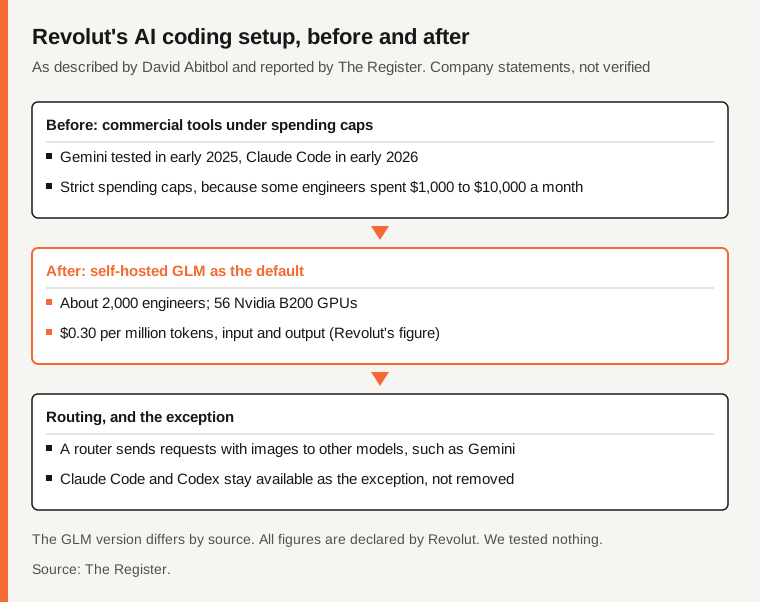
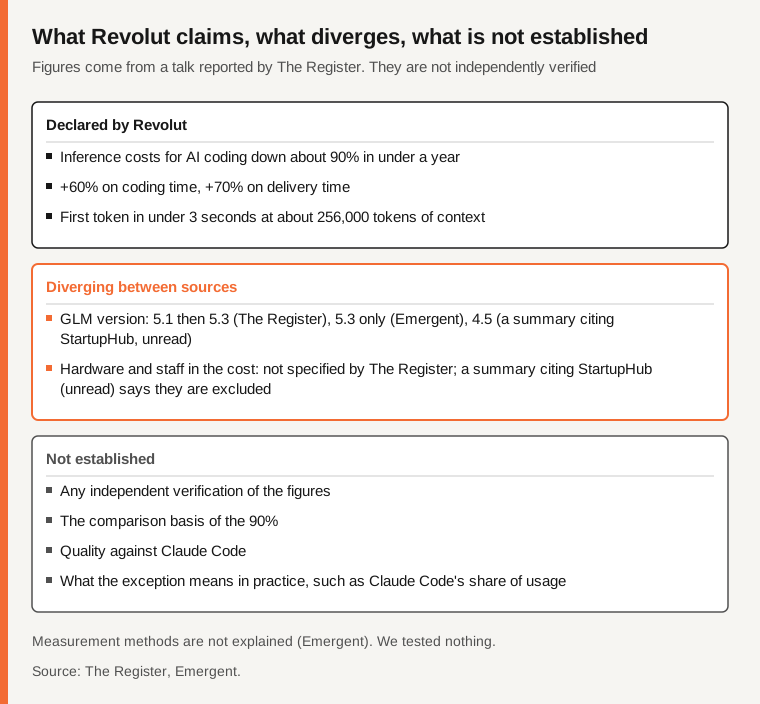
According to The Register, Revolut tested Gemini in early 2025 and Claude Code in early 2026. The tools launched with strict spending caps, because some engineers were spending between $1,000 and $10,000 a month (Abitbol, via The Register). Revolut then moved to GLM from Z.ai, first GLM-5.1, then GLM-5.3. Emergent mentions only GLM-5.3, and a summary citing unread StartupHub mentions GLM 4.5, so we do not tie the cost to a version. For where open-weight models stand, including GLM-5.3, see our October overview.
For GLM-5.3, The Register reports 56 Nvidia B200 GPUs (seven DGX B200 systems), about 754 billion parameters (about 40 billion active per token) and about 380 GB of GPU memory for the weights. Gains came from tuning, NVFP4 quantization and prefill/decode separation, not extra GPUs.
Source: The Register.
How much, and compared with what?
The Register reports that self-hosting GLM costs $0.30 per million tokens (input and output), about a tenth of Codex or Claude Code, with flat billing. It does not say whether hardware amortization is counted. A summary citing StartupHub (unread) says the $0.30 excludes cloud, staff and observability, so the total saving could be smaller. Emergent notes the comparison basis is not detailed.
Revolut self-reports a first token in under 3 seconds at about 256,000 tokens of context. It also reports +60% on coding time and +70% on delivery time; Abitbol says the gains come mostly from debugging and handling Jira and Confluence tickets, not code generation. Emergent notes the measurement methods are not explained.
Not a total replacement
The Register says GLM does not fully replace GPT or Claude. It is limited to text and poorly suited to interface work, so a router sends requests with images to models such as Gemini, while code generation stays on GLM. Abitbol calls the frontier models "the exception". They are not removed, and what that means in practice, such as Claude Code's share of usage, is not stated.
The reservations
Abitbol acknowledges privacy and security concerns about Chinese open models. In his view the main risk is access through APIs hosted in China, and on-premises or regional cloud deployment reduces it (The Register). We add no assessment of our own.
Source: The Register, Emergent.
What is not established
The verified figure and its basis; whether hardware, staff and observability are in the cost; the exact GLM version; quality against Claude Code, with no independent test; how the +60% and +70% were measured; Anthropic's reaction; whether others will follow.
Comparison table
| Point | What the sources say | Status |
|---|---|---|
| Default for AI coding | Self-hosted GLM; Claude Code and Codex the exception | Declared by Revolut |
| Inference cost | About 90% lower in under a year | Declared by Revolut |
| GLM price | $0.30 per million tokens, hardware unspecified | Reported by The Register |
| Productivity | +60% coding time, +70% delivery time | Declared by Revolut |
| GLM version | 5.1 then 5.3, 5.3 only, or 4.5, by source | Diverging |
| Independent check | None read | Not established |
Frequently asked questions
Did Revolut stop using Claude Code?
Not according to The Register: they stay available as the exception.
Are the 90% verified?
No. It is Revolut's claim from a talk, with no detailed comparison basis.
What hardware does it take?
Revolut reports 56 Nvidia B200 GPUs for GLM-5.3.
Method and limits
We read The Register by automatic summary on November 4, 2026, plus two second-hand pieces. We did not read the talk, any Revolut release, Cybernews or StartupHub, and saw no comment from Anthropic, OpenAI or Z.ai. Nothing was tested.
Sources
- The Register, Tobias Mann, automatic summary
- Emergent, second-hand, automatic summary
- Pasquale Pillitteri, second-hand, automatic summary
Spotted an error in this article? Report it · Our corrections policy